
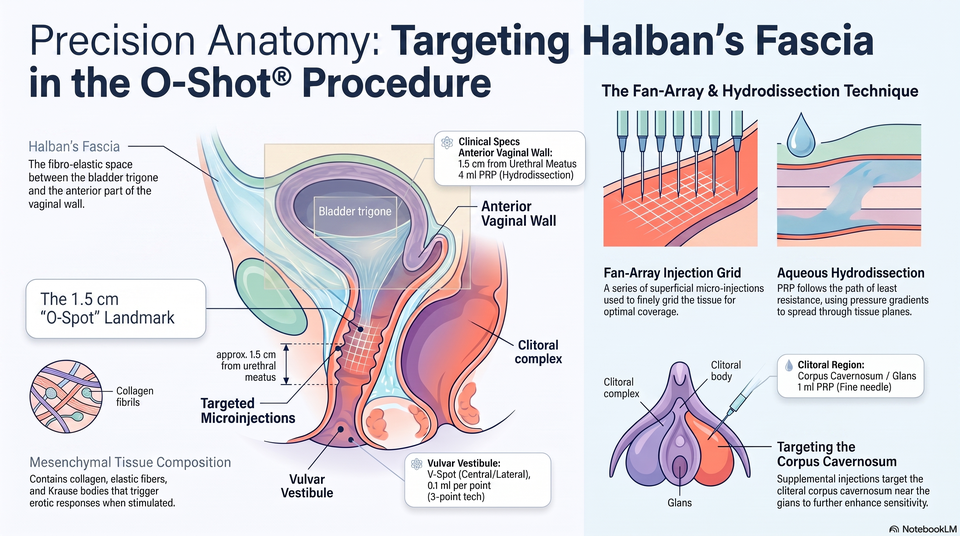


What is injected during the o shot?

What is injected during the o shot?

How does the o shot work?
Anatomy-led
No injection map
Assessment first
Women’s Health Clinic FAQ
What anatomical landmarks define the precise fan-array injection technique for targeting the Halban’s fascia during an O-Shot?
O-Shot anatomy questions need a careful boundary: education should improve consent, not teach placement.
Direct answer
Precise fan-array landmarks for Halban's fascia should not be published as patient-facing O-Shot instructions. The key point is to explain the anatomy and why placement depends on examination, training, comfort, tissue state and safety checks.
The useful answer separates patient education from clinician-only technique, so the reader understands what to ask without being given procedural instructions.
Educational only. Use this as general education before discussing your own symptoms with a clinician. Results vary. Not a cure.

O-Shot safety review
At a glance
These points keep the technical question useful without turning it into a procedure guide.
At a glance
Clinical summary
Individual anatomy
The anterior wall, lamina propria, clitoral crura and periurethral tissues vary between patients.
No angles
Injection angles, depths, landmarks and vectors are clinician-only procedural decisions.
Different planes
Sub-mucosa, fascia and muscle are different tissue planes with different risks.
Evidence limits
More precise anatomical language does not prove predictable sexual-function benefit.
Important safety note
Seek medical advice promptly for heavy or persistent bleeding, fever, offensive discharge, ulcers, severe pelvic or vulval pain, urinary retention, worsening swelling, suspected infection, active urethral lesions or symptoms that feel unusual after treatment.
Placement
Consent
No map
Evidence
Detailed answer
Detailed answer
The O-Shot is often described around clitoral, anterior-wall or periurethral tissue, but those words do not create a universal map.
Clinical context
Placement decisions depend on examination, tissue thickness, pain, scarring, urinary symptoms, menopause-related change and consent.
Anatomy
Safety
Evidence
What matters first
The O-Shot is often described around clitoral, anterior-wall or periurethral tissue, but those words do not create a universal map.
Why it is clinician-led
Placement decisions depend on examination, tissue thickness, pain, scarring, urinary symptoms, menopause-related change and consent.
Evidence boundary
A public answer can explain the anatomy without giving an injection depth, fan-array, vector or angle.
Safety boundary
This is especially important because intimate PRP evidence is variable and anatomy-led precision does not promises a clinical response.
What this means in practice
A useful answer explains the safety logic without publishing anaesthetic, injection, device or aftercare techniques.
Exact procedural decisions should be confirmed by the treating clinician after examination, consent and review of symptoms.
Patient safety
Why this matters
Technical O-Shot questions matter because genital tissue is sensitive, vascular and affected by anatomy, pain, hormones, scarring and urinary symptoms.
It avoids false precision
A ratio, angle or technique can sound precise while being unsafe outside clinical context.
It protects sensitive tissue
Vulval, vaginal, clitoral and periurethral tissue may be fragile, painful, scarred or inflamed.
It supports consent
Patients should understand why some details are withheld and what questions to ask before treatment.
It keeps evidence honest
Intimate PRP studies use variable protocols, so outcomes should not be promised from anatomy or device language.
A careful treatment conversation
The right question is not only how a procedure is performed, but whether the symptom, tissue and medical history make it appropriate.
That is why assessment, consent and follow-up are central to responsible intimate PRP care.
Considerations
What to consider
Consider the symptom target, tissue health, pain, urinary symptoms, scarring, menopause status, medicines, infection symptoms, bleeding history and treatment goals.
Consultation priorities
The clinician clarifies whether the concern is pain, arousal, orgasm, lubrication, sensitivity, urinary leakage or tissue comfort.
Tissue
Safety
Follow-up
Assessment
The clinician clarifies whether the concern is pain, arousal, orgasm, lubrication, sensitivity, urinary leakage or tissue comfort.
Safety review
Assessment reviews vulval and vaginal tissue, scarring, pelvic-floor tenderness, infection symptoms, menopause context and bleeding risk.
Treatment fit
If PRP is suitable, the clinician explains the intended area in consent language rather than public technique language.
Review
Follow-up checks pain, bruising, bleeding, urinary symptoms, swelling and whether the target symptom has changed meaningfully.
Practical expectations
Response can be partial, delayed or absent, and published intimate PRP protocols are not uniform.
Prices, exact procedural details, treatment timing and aftercare should be confirmed with the clinic before booking.
Common concerns and myths
Common misconceptions
These myths can make technical O-Shot questions sound more controllable than they really are.
Myth: one injection map fits everyone
Reality: anatomy and tissue state vary, so placement is individualised.
Myth: online angles prove safer treatment
Reality: angles and depth decisions require examination and training.
Myth: precise anatomy proves better results
Reality: anatomy helps safety and consent, but outcomes remain variable.
Evidence and context
Mechanism helps explain why PRP is considered, but it does not replace diagnosis, clinical evidence or suitability checks.
Different outcomes
Comfort, arousal, lubrication, orgasm, urinary symptoms and pain are different outcomes and should not be blurred together.
Safety checklist
Safety checklist
Use these checks before assuming intimate PRP is suitable.
Is the symptom clear?
Clarify whether the concern is orgasm, arousal, lubrication, pain, sensitivity, urinary leakage or tissue comfort.
Has tissue context been reviewed?
Scarring, menopause-related change, infection symptoms, urinary issues and active lesions can affect suitability.
Are red flags absent?
Pause and seek clinical review for new bleeding, fever, offensive discharge, ulcers, severe pain, urinary retention, spreading swelling, active urethral lesions or any concern about infection.
Is uncertainty documented?
Consent should explain limited evidence, variable response and possible discomfort, bruising or bleeding.
Reassuring signs
Proceeding is more reasonable when symptoms are clearly assessed, red flags are absent and expectations are realistic.
No red flags
Review plan
Reasons to pause
Pause for new bleeding, infection symptoms, ulcers, severe pain, urinary retention, spreading swelling, active urethral lesions or uncertainty about medicine safety.
Infection
Severe pain
When to escalate
When to seek medical help
Some symptoms around intimate PRP treatment need prompt assessment.
Use NHS 111 online
Bleeding
Heavy bleeding, persistent bleeding or bleeding after sex should be assessed by a clinician.
Infection symptoms
Fever, offensive discharge, worsening burning, ulcers or pelvic pain may need swabs, urine testing or review.
Unexpected reaction
Worsening swelling, severe soreness, prolonged numbness or tissue colour change should be reviewed.
Emergency symptoms
Call 999 in a life-threatening emergency, including collapse, chest pain, breathing difficulty or sudden neurological symptoms.
Use NHS 111 for urgent advice or call 999 in a life-threatening emergency. This page is educational and does not replace individual medical assessment.
More clinical detail
Why anatomy matters
Terms such as lamina propria, anterior vaginal wall and clitoral crura describe different structures. They help explain risk and consent, not a do-it-yourself map.Why exact placement stays clinician-led
Tissue thickness, tenderness, scarring and urinary anatomy can change the safest approach. Those decisions belong in clinical assessment.Regulatory resources
Authoritative resources
These resources support evidence-aware, assessment-led discussion of intimate PRP and relevant safety issues.
O-Shot official questions
Competitor anchor because it names clitoral, vaginal and G-spot treatment areas.
O Shot and G Shot London competitor page
UK competitor source for common injection-area framing.
Skin Excellence O-Shot competitor page
UK competitor source showing broad rejuvenation and sexual-function claims.
Next step
Book an intimate health consultation
A consultation can clarify whether symptoms fit GSM, sexual-function concerns, pelvic-floor pain, urinary symptoms or another cause, and whether PRP is suitable.
▶ View Research Sources (12 Sources)
These 12 source names are selected from 208 curated sources. Additional reviewed material included peer-reviewed clinical papers; duplicate and low-relevance records were removed before display.
Educational only. This information is for education only and is not a substitute for professional medical advice, diagnosis or treatment. Results vary. Not a cure.
