



Can patients with mild von Willebrand disease or hereditary clotting factor... | WHC Clinical FAQ

What is the therapeutic approach when using the O-Shot for patients with lo... | WHC Clinical FAQ

Can the O-Shot cause excessive sensitivity? | WHC Clinical FAQ
Bleeding risk
Blood draw
Medicine review
Women’s Health Clinic FAQ
Can patients with mild von Willebrand disease or hereditary clotting factor deficiencies safely undergo an O-Shot procedure?
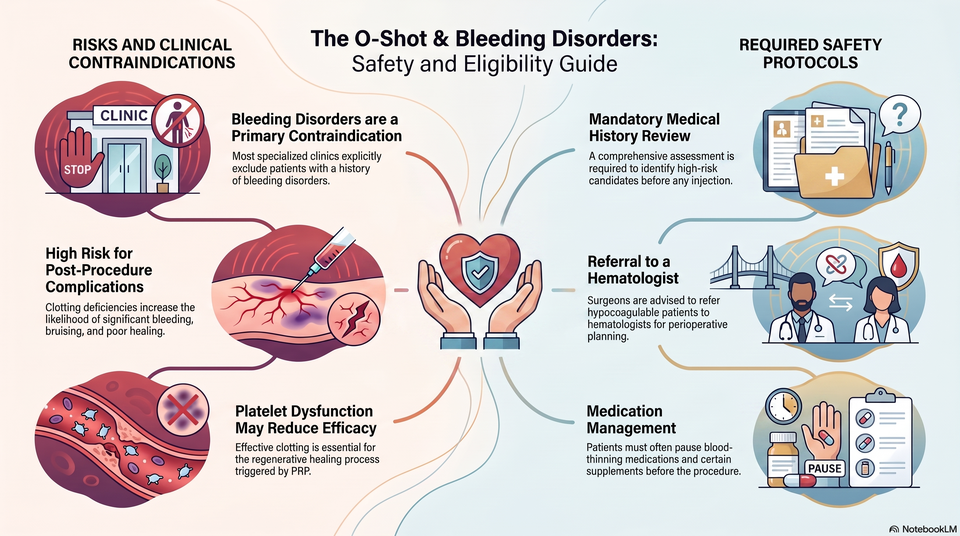
Bleeding disorders, anaemia, supplements and vasovagal episodes can all change how safe or sensible an O-Shot pathway is.
Direct answer
Mild von Willebrand disease or inherited clotting-factor deficiency does not automatically rule treatment in or out, but it requires haematology-aware bleeding-risk assessment before blood draw or injection.
The useful answer explains why complex medical history can change suitability, while avoiding protocols, medicine-stopping advice or promises of response.
Educational only. Use this as general education before discussing your own medical history with a clinician. Results vary. Not a cure.

O-Shot suitability review
At a glance
These points frame the medical-history question before considering elective intimate PRP.
At a glance
Clinical summary
Bleeding review
Inherited clotting disorders need individual risk assessment before blood draw or injection.
Anaemia matters
Severe iron deficiency anaemia may affect procedure tolerance and needs medical review.
Supplements count
High-dose omega-3 or other supplements should be discussed before treatment.
Fainting history
Recurrent vasovagal syncope during blood draws needs planning and may justify delaying treatment.
Important safety note
Seek medical advice promptly for heavy or persistent bleeding, fever, offensive discharge, ulcers, severe pelvic or vulval pain, urinary retention, fainting, worsening swelling, suspected infection, systemic illness or unexplained genital lesions.
Anaemia
Supplements
Fainting
Review
Detailed answer
Detailed answer
The O-Shot starts with venepuncture and includes intimate injections, so bleeding risk and blood-draw tolerance matter.
Clinical context
Von Willebrand disease, clotting-factor deficiency, severe anaemia, high-dose supplements and fainting history should not be treated as small details.
Tissue
Safety
Evidence
What matters first
The O-Shot starts with venepuncture and includes intimate injections, so bleeding risk and blood-draw tolerance matter.
Why review matters
Von Willebrand disease, clotting-factor deficiency, severe anaemia, high-dose supplements and fainting history should not be treated as small details.
Evidence boundary
Patients should not stop prescribed medicines or supplements without clinician advice.
Safety boundary
The safer answer routes these issues to pre-procedure review, possible specialist advice and realistic consent.
What this means in practice
A useful answer explains the clinical reason for caution without publishing protocols or implying suitability.
Medical history, medicines, tissue state and specialist input should be reviewed before elective intimate PRP.
Patient safety
Why this matters
Complex medical history can change blood draw safety, tissue resilience, infection risk, bleeding risk, pain interpretation and realistic expectations.
It avoids false reassurance
Autologous PRP does not automatically make treatment suitable for every complex history.
It protects sensitive tissue
Vulval, vaginal, neovaginal and periurethral tissue may be fragile, painful, scarred or affected by systemic illness.
It supports shared decisions
Some patients need oncology, renal, haematology, rheumatology, pelvic-floor or gender-surgery-aware input.
It keeps evidence honest
Intimate PRP protocols and patient groups vary, so outcomes should not be promised.
A careful treatment conversation
The question is not only whether PRP is biologically plausible, but whether it fits the patient's medical context.
That is why assessment, consent and follow-up are central to responsible intimate PRP care.
Considerations
What to consider
Consider the symptom target, diagnosis, medicines, bleeding history, infection risk, urinary symptoms, tissue fragility, surgery history, specialist follow-up and treatment goals.
Consultation priorities
The consultation reviews bleeding history, bruising, clotting diagnosis, fainting episodes, supplements, medicines, anaemia symptoms and previous procedures.
Medicines
Specialist
Follow-up
Assessment
The consultation reviews bleeding history, bruising, clotting diagnosis, fainting episodes, supplements, medicines, anaemia symptoms and previous procedures.
Safety review
The clinician considers whether blood tests, haematology advice, positioning, observation or postponement is needed.
Treatment fit
If treatment proceeds, consent should cover bruising, bleeding, faintness, discomfort and aftercare review.
Review
Follow-up is important for heavy bleeding, spreading bruising, faintness, fever, severe pain or urinary symptoms.
Practical expectations
Response can be partial, delayed or absent, and published intimate PRP protocols are not uniform.
Prices, exact procedural details, treatment timing and aftercare should be confirmed with the clinic before booking.
Common concerns and myths
Common misconceptions
These myths can make complex suitability questions sound simpler than they are.
Myth: mild bleeding disorders never matter
Reality: even small injections can need individual bleeding-risk planning.
Myth: supplements are irrelevant
Reality: high-dose supplements can be relevant to bruising discussions.
Myth: anaemia only affects energy
Reality: severe anaemia can affect procedure tolerance and needs assessment.
Evidence and context
Mechanism helps explain why PRP is considered, but it does not replace diagnosis, specialist review or suitability checks.
Different outcomes
Comfort, arousal, lubrication, orgasm, urinary symptoms and pain are different outcomes and should not be blurred together.
Safety checklist
Safety checklist
Use these checks before assuming intimate PRP is suitable.
Is the medical history clear?
Clarify diagnosis, current stability, medicines, specialist follow-up and previous procedure reactions.
Has tissue context been reviewed?
Scarring, menopause-related change, infection symptoms, urinary issues, pain and active lesions can affect suitability.
Are red flags absent?
Pause and seek clinical review for new bleeding, fever, offensive discharge, ulcers, severe pain, urinary retention, fainting, spreading swelling, systemic illness or any concern about infection.
Is uncertainty documented?
Consent should explain limited evidence, variable response and possible discomfort, bruising or bleeding.
Reassuring signs
Proceeding is more reasonable when the condition is stable, red flags are absent and expectations are realistic.
No red flags
Review plan
Reasons to pause
Pause for unstable illness, new bleeding, infection symptoms, ulcers, severe pain, urinary retention, fainting, spreading swelling or uncertainty about medicine safety.
Infection
Unstable illness
When to escalate
When to seek medical help
Some symptoms around intimate PRP treatment need prompt assessment.
Use NHS 111 online
Bleeding or fainting
Heavy bleeding, persistent bleeding, spreading bruising or fainting should be assessed by a clinician.
Infection symptoms
Fever, offensive discharge, worsening burning, ulcers or pelvic pain may need swabs, urine testing or review.
Unexpected reaction
Worsening swelling, severe soreness, tissue colour change or new urinary difficulty should be reviewed.
Emergency symptoms
Call 999 in a life-threatening emergency, including collapse, chest pain, breathing difficulty or sudden neurological symptoms.
Use NHS 111 for urgent advice or call 999 in a life-threatening emergency. This page is educational and does not replace individual medical assessment.
More clinical detail
Why blood context matters
PRP depends on a blood draw and injection, so anaemia, fainting, clotting history and bruising tendency are part of suitability.Why self-stopping is unsafe
Medication or supplement changes should be clinician-led, especially where bleeding, clotting or cardiovascular risks are involved.Regulatory resources
Authoritative resources
These resources support evidence-aware, assessment-led discussion of intimate PRP and complex medical history.
O-Shot official questions
Competitor baseline for same-visit blood draw and injection claims.
PRP injections for female sexual dysfunction and SUI systematic review
Clinical anchor for variable safety reporting in intimate PRP.
NHS von Willebrand disease
UK patient anchor for inherited bleeding disorder context.
Next step
Book an intimate health consultation
A consultation can clarify whether symptoms fit GSM, sexual-function concerns, pelvic-floor pain, urinary symptoms or another cause, and whether PRP is suitable.
▶ View Research Sources (12 Sources)
These 12 source names are selected from 96 curated sources. Additional reviewed material included peer-reviewed clinical papers, evidence reviews, clinical trial records; duplicate and low-relevance records were removed before display.
Educational only. This information is for education only and is not a substitute for professional medical advice, diagnosis or treatment. Results vary. Not a cure.
