
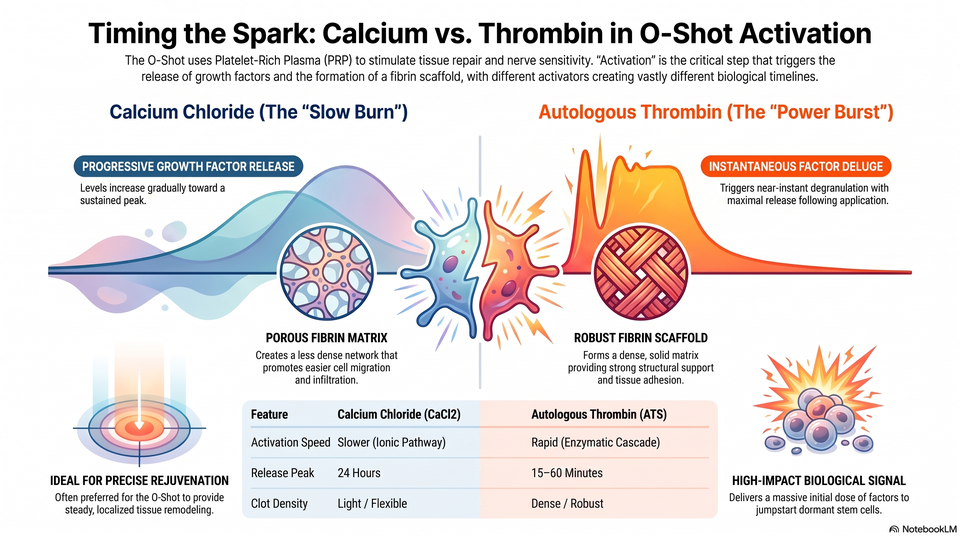


How does local activation with calcium chloride or autologous thrombin alter growth factor...

How does local activation with calcium chloride or autologous thrombin alte... | WHC Clinical FAQ

How does exogenous calcium gluconate activation differ from endogenous thrombin activation when...
PRP quality
No public protocol
Evidence-aware
Women’s Health Clinic FAQ
How does local activation with calcium chloride or autologous thrombin alter growth factor release timing in the O-Shot?
Technical O-Shot questions about PRP preparation need a careful answer because the treatment depends on blood processing, tissue context and evidence limits.
Direct answer
Calcium chloride or autologous thrombin activation may alter the timing of growth-factor release, but that mechanism should be described cautiously. It should not be used to promise faster, stronger or more predictable sexual-function outcomes.
The answer should connect PRP biology with symptoms, medicines, anatomy, tissue health and evidence limits before suggesting whether treatment is suitable.
Educational only. Use this as general education before discussing your own symptoms with a clinician. Results vary. Not a cure.

O-Shot suitability review
At a glance
These points frame the question before considering treatment suitability.
At a glance
Clinical summary
PRP variables
Platelet concentration, leukocyte content and activation method may affect the biological signal.
No recipe
Centrifuge settings and activation steps are not suitable public instructions.
Evidence
Published intimate PRP studies use varied protocols and remain limited.
Suitability
The preparation only matters after diagnosis and treatment suitability are clear.
Important safety note
Seek medical advice promptly for heavy or persistent bleeding, fever, offensive discharge, ulcers, severe pelvic or vulval pain, urinary retention, active genital herpes symptoms, worsening swelling or symptoms that feel unusual after treatment.
Intimate health
Suitability
Evidence
Review
Detailed answer
Detailed answer
PRP preparation can affect what is injected, but it should not be simplified into one universal O-Shot recipe.
Clinical context
Processing variables may influence platelet concentration, leukocyte content, growth-factor release and clotting behaviour.
Anatomy
Safety
Evidence
What matters first
PRP preparation can affect what is injected, but it should not be simplified into one universal O-Shot recipe.
Biological logic
Processing variables may influence platelet concentration, leukocyte content, growth-factor release and clotting behaviour.
Evidence boundary
Because protocols vary across studies and devices, public-facing content should explain principles rather than laboratory settings.
Safety boundary
The clinical decision still depends on symptoms, tissue health, medical history, consent and realistic expectations.
What this means in practice
A useful answer explains the mechanism without becoming a public protocol or a promise about sexual response.
Treatment details, medicine changes, anaesthetic plans, activity restrictions and treatment timing should be confirmed by the treating clinician.
Patient safety
Why this matters
O-Shot questions often sit at the intersection of sexual wellbeing, tissue sensitivity, pain, confidence and medical safety.
It avoids overpromising
PRP biology is plausible, but response in lubrication, orgasm, pain or sensitivity varies.
It protects sensitive tissue
Genital tissue can be affected by menopause, skin disease, infection, scarring, medicines and pelvic-floor pain.
It keeps anatomy clear
Clitoral, vaginal, vestibular, urethral and scar-related symptoms should not be blurred together.
It supports consent
Patients should understand uncertainty, discomfort, bleeding, bruising and aftercare before choosing treatment.
A careful treatment conversation
The right question is not only whether PRP could help, but whether it fits the patient's symptoms, tissue health and medical history.
That is why consultation, review and clear safety advice are central to responsible intimate PRP care.
Considerations
What to consider
Consider the main symptom, menopause status, medicines, platelet count, bleeding history, HSV history, vulval skin disease, infection symptoms, scarring, pelvic-floor pain and treatment goals.
Consultation priorities
The consultation clarifies whether the concern is orgasm, arousal, lubrication, pain, sensitivity or urinary leakage.
Medicines
Tissue
Follow-up
Assessment
The consultation clarifies whether the concern is orgasm, arousal, lubrication, pain, sensitivity or urinary leakage.
Safety review
The clinician reviews medicines, bleeding history, infection symptoms, vulval skin disease, menopause status and previous treatments.
Treatment fit
If PRP is considered, the preparation method should follow validated equipment and local governance rather than an online protocol.
Review
Follow-up looks at comfort, bleeding, bruising, symptoms and whether any change is meaningful for the patient.
Practical expectations
Response can be partial, delayed or absent, and published intimate PRP protocols are not uniform.
Prices, exact products, injection details, treatment timing and aftercare should be confirmed with the clinic before booking.
Common concerns and myths
Common misconceptions
These myths can make the O-Shot sound either simpler or more predictable than the evidence supports.
Myth: more platelets always means better results
Reality: concentration is only one factor and a stronger laboratory number does not make outcomes predictable.
Myth: every PRP machine produces the same product
Reality: preparation systems and protocols can vary, which is why governance matters.
Myth: activation timing proves tissue repair
Reality: growth-factor release is biologically interesting, but it does not prove symptom improvement.
Evidence and context
Mechanism helps explain why PRP is considered, but it does not replace diagnosis, clinical evidence or suitability checks.
Different outcomes
Desire, arousal, lubrication, orgasm, pain and urinary symptoms are different outcomes and should be assessed separately.
Safety checklist
Safety checklist
Use these checks before assuming intimate PRP is suitable.
Is the symptom clear?
Clarify whether the concern is orgasm, arousal, lubrication, pain, sensitivity, urinary leakage or confidence.
Have medicines been reviewed?
Aspirin, antiplatelets, NSAIDs, supplements and clotting history can affect suitability and aftercare.
Are red flags absent?
Seek medical advice promptly for heavy or persistent bleeding, fever, offensive discharge, ulcers, severe pelvic or vulval pain, urinary retention, active genital herpes symptoms, worsening swelling or symptoms that feel unusual after treatment.
Is uncertainty documented?
Consent should explain limited evidence, variable response and possible discomfort, bruising or bleeding.
Reassuring signs
Proceeding is more reasonable when symptoms are clearly assessed, red flags are absent and expectations are realistic.
No red flags
Review plan
Reasons to pause
Seek medical advice promptly for heavy or persistent bleeding, fever, offensive discharge, ulcers, severe pelvic or vulval pain, urinary retention, active genital herpes symptoms, worsening swelling or symptoms that feel unusual after treatment.
Infection
Severe pain
When to escalate
When to seek medical help
Some symptoms around intimate PRP treatment need prompt assessment.
Use NHS 111 online
Bleeding
Heavy bleeding, persistent bleeding or bleeding after sex should be assessed by a clinician.
Infection symptoms
Fever, offensive discharge, worsening burning, ulcers or pelvic pain may need swabs, urine testing or review.
Herpes or skin flare
Blisters, ulcers, new vulval plaques or severe irritation should be assessed before further treatment.
Emergency symptoms
Call 999 in a life-threatening emergency, including collapse, chest pain, breathing difficulty or sudden neurological symptoms.
Use NHS 111 for urgent advice or call 999 in a life-threatening emergency. This page is educational and does not replace individual medical assessment.
More clinical detail
Why PRP preparation matters
PRP is not a single identical product. Platelet concentration, leukocyte content, activation and handling may change the signal delivered to tissue, but clinical usefulness still depends on the person being treated.Why exact settings are not shown
Centrifuge speed, spin time and activation details belong in trained clinical protocols, not public FAQ copy. The safer patient question is whether the provider uses appropriate governance and explains uncertainty.Regulatory resources
Authoritative resources
These resources support evidence-aware, assessment-led discussion of intimate PRP and relevant safety issues.
O-Shot official questions
Competitor baseline for patient-facing O-Shot process, numbing, PRP and expectation language.
O-Shot how it works for women
Competitor explanation of blood draw, centrifugation, PRP and growth-factor claims.
PRP injections for female sexual dysfunction and SUI systematic review
Clinical literature anchor showing low-certainty evidence and protocol variability.
Next step
Book an intimate health consultation
A consultation can clarify whether symptoms fit GSM, sexual-function concerns, pelvic-floor pain, urinary symptoms or another cause, and whether PRP is suitable.
▶ View Research Sources (12 Sources)
These 12 source names are selected from 140 curated sources. Additional reviewed material included peer-reviewed clinical papers, clinical trial records; duplicate and low-relevance records were removed before display.
Educational only. This information is for education only and is not a substitute for professional medical advice, diagnosis or treatment. Results vary. Not a cure.
