

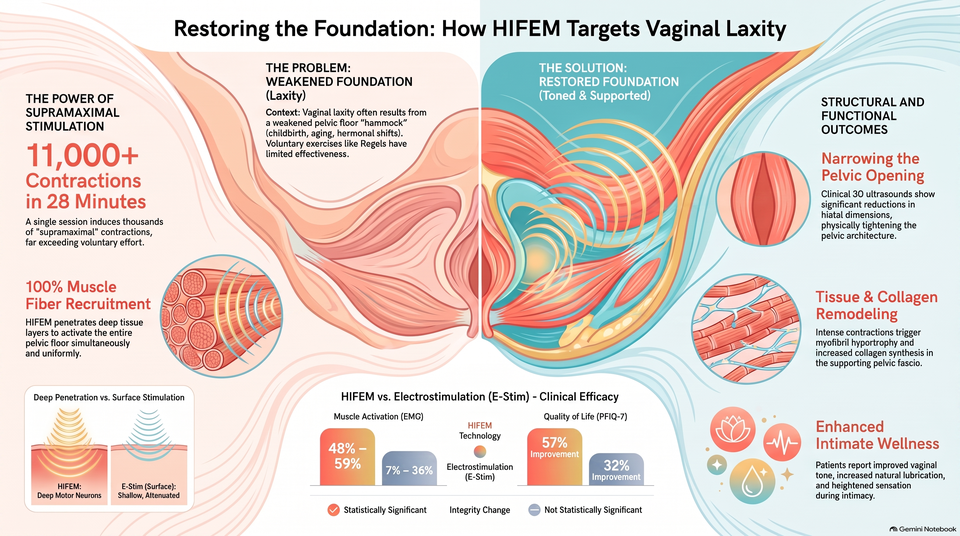


Can HIFEM help vaginal laxity symptoms by strengthening pelvic-floor support?

Can HIFEM help vaginal laxity symptoms by strengthening pelvic-floor suppor... | WHC Clinical FAQ

Can weightlifting technique affect vaginal laxity symptoms?
Postpartum
Support
Assessment
Women’s Health Clinic FAQ
Can HIFEM help vaginal laxity symptoms by strengthening pelvic-floor support?
Postpartum and laxity symptoms deserve careful assessment because muscle weakness, tissue healing and prolapse can overlap.
Direct answer
HIFEM may be relevant where vaginal laxity symptoms reflect pelvic-floor weakness or poor support, but it does not tighten vaginal tissue in the way surgery or tissue procedures claim to. Laxity feelings may overlap with prolapse, childbirth injury, low-oestrogen dryness, scar discomfort or body-confidence concerns. Assessment should clarify the cause before treatment is recommended. The language should stay honest about muscle support.
The safest answer explains what HIFEM may do without giving device-operation instructions. Suitability should be confirmed through consultation, symptom assessment, contraindication screening, realistic goals and informed consent.
Educational only. Suitability must be confirmed after consultation and assessment. Results vary. Not a cure.

Pelvic-floor rehabilitation
At a glance
These points keep the HIFEM discussion clear, cautious and useful before treatment is considered.
At a glance
Clinical summary
Recovery is layered
Birth can affect muscles, nerves, connective tissue, scars and confidence.
Laxity is not one cause
A loose sensation can overlap with prolapse, dryness or support changes.
Timing matters
Healing, breastfeeding and pain should be considered before device treatment.
Assessment protects choices
Physiotherapy, medical care or referral may be more appropriate first.
Important safety note
A fully clothed pelvic-floor chair treatment still needs medical screening, especially with pregnancy possibility, implants, coils, pelvic pain, urinary retention, infection symptoms or unexplained bleeding.
Laxity
Levator
Prolapse
Healing
Detailed answer
Detailed answer
The key is to understand postpartum support and laxity symptoms while keeping pelvic-floor treatment assessment-led.
The clinical distinction
HIFEM is best framed as a neuromuscular pelvic-floor rehabilitation option for selected patients, not as a universal answer for leakage, urgency, prolapse, vaginal laxity, sexual discomfort or pelvic pain.
Symptoms
Safety
Evidence
Muscle stretch
The pelvic floor may be stretched or inhibited after labour and birth.
Levator and support
The levator ani and puborectalis contribute to support but may not explain every symptom.
Prolapse and dryness
Bulge, pressure or low-oestrogen dryness need specific assessment.
Individual recovery
Treatment should be based on healing, symptoms, goals and clinical findings.
What this means in practice
Patients should ask how their leakage type, pelvic-floor function, pain, prolapse symptoms, implants and goals affect suitability.
Response should be reviewed against symptoms and function rather than assumed from completing a course.
Patient safety
Why this matters
Pelvic-floor symptoms can affect confidence, exercise, intimacy and daily life, but they still need a clear diagnosis before device treatment is chosen.
It separates symptoms
Stress leakage, urgency, prolapse, laxity, pain and guarding are different clinical patterns.
It protects safety
Implants, coils, pregnancy possibility, infection symptoms or unexplained pain can change suitability.
It keeps physiotherapy visible
Supervised pelvic-floor physiotherapy remains central for many continence and coordination problems.
It sets honest goals
A contraction mechanism does not promise continence, sexual comfort or tissue change for every patient.
A measured rehabilitation discussion
The page should help patients understand why HIFEM may be discussed and when another route is safer or more useful.
Consent is stronger when benefits, limits, alternatives, contraindications and follow-up measures are explained without device hype.
Considerations
What to consider
Before choosing HIFEM, the consultation should cover symptoms, bladder pattern, pelvic-floor tone, pain, prolapse concerns, implants, pregnancy status, alternatives and review.
Consultation priorities
A safe pathway starts with symptom history, screening, consent, clear expectations and a plan for follow-up.
Screening
PFMT
Review
Before treatment
Tell the clinician about implants, coils, pregnancy possibility, pelvic surgery, pain, bleeding, infections, prolapse symptoms, neurological history and bladder emptying issues.
During planning
The clinician should explain whether HIFEM fits the symptom pattern and what alternatives exist.
Measuring progress
Progress may be tracked through leakage triggers, urgency, pad use, symptom scores, comfort and confidence.
When to delay
Treatment should wait if symptoms suggest infection, unexplained bleeding, urinary retention, severe pain, pregnancy or an unreviewed implant or coil concern.
What not to assume
Do not assume that more intense contractions, a preset course, a combined treatment or a branded chair means a better result.
Costs and treatment plans should be confirmed with the clinic before booking.
Common concerns and myths
Common misconceptions
These myths are common because pelvic-chair marketing can make neuromuscular treatment sound simpler than it is.
Myth: Postpartum looseness is only muscle weakness
Reality: suitability depends on diagnosis, symptom pattern, pelvic-floor function, safety screening and realistic goals.
Myth: HIFEM repairs levator injury
Reality: device treatment should be judged against symptoms, function and alternatives, not the treatment label alone.
Myth: Treatment can replace a pelvic-health assessment
Reality: results vary, evidence has limits, and follow-up should guide whether the plan continues or changes.
Mechanism is not a promise
A stimulated contraction does not prove that leakage, laxity, pain or sexual concerns will improve.
Assessment changes the route
Some patients need supervised pelvic-floor physiotherapy, bladder review, prolapse assessment, menopause care or pain support first.
Safety checklist
Safety checklist
Use these checks before considering HIFEM or another electromagnetic pelvic-floor treatment.
Has the symptom been classified?
Stress leakage, urgency, mixed symptoms, prolapse, pain and guarding should not be treated as one problem.
Are contraindications checked?
Implants, electronic devices, coils, pregnancy possibility, infection and neurological history should be disclosed.
Are alternatives clear?
Ask about supervised PFMT, bladder advice, menopause care, prolapse review, pain care or referral.
Is follow-up planned?
You should know how progress will be measured and who to contact if symptoms worsen.
Reassuring signs
Proceeding is more reasonable when goals are clear, red flags are absent, contraindications are checked and follow-up is planned.
Screened
Review planned
Reasons to pause
Pause for pregnancy possibility, unreviewed implants or coils, urinary retention, severe pelvic pain, new neurological symptoms, fever, infection signs or unexplained bleeding.
Bleeding
Implants
When to escalate
When to seek medical help
Some pelvic-floor or urinary symptoms need medical assessment before elective device treatment.
Use NHS 111 online
Severe or worsening pain
Severe pelvic, bladder, back or vulval pain should be assessed promptly, especially if new or worsening.
Bleeding or retention
Heavy or unexplained bleeding, blood in urine, inability to pass urine or a new bulge sensation needs review.
Infection or neurological symptoms
Fever, feeling very unwell, offensive discharge, new numbness, weakness or saddle-area symptoms should not be ignored.
Emergency symptoms
Call 999 for life-threatening symptoms such as collapse, chest pain, breathing difficulty or sudden neurological symptoms.
Use NHS 111 for urgent advice or call 999 in a life-threatening emergency. This page is educational and does not replace individual medical assessment.
More clinical detail
Why postpartum support and laxity symptoms needs careful framing
HIFEM has a plausible neuromuscular mechanism, but the patient-facing answer should connect that mechanism to the specific symptom rather than giving technical device instructions.What patients can safely ask
Ask what symptom pattern is being treated, what alternatives exist, what contraindications have been checked, how progress will be measured and when treatment should stop or change.What should stay clinician-led
Technical device choices, coil-position decisions, intensity changes, implant clearance, IUD decisions, RF combinations and maintenance planning should be handled by appropriately trained clinicians using device documentation.Regulatory resources
Authoritative resources
These resources support cautious discussion of pelvic-floor symptoms, HIFEM evidence, conservative care and consent.
NICE NG123 urinary incontinence and pelvic organ prolapse in women
UK guidance supporting assessment and supervised pelvic-floor muscle training for stress or mixed urinary incontinence.
NICE NG210 pelvic floor dysfunction
UK guidance covering pelvic-floor symptoms, when to get help and conservative management.
GMC decision making and consent
UK consent standard for explaining risks, uncertainty, alternatives and individual suitability.
Next step
Book a pelvic-floor consultation
A consultation can confirm whether HIFEM is suitable, whether pelvic-floor physiotherapy or medical review should come first, and how progress would be measured.
▶ View Research Sources (12 Sources)
These 12 source names are selected from 93 curated sources. Additional reviewed material included peer-reviewed clinical papers, evidence reviews, clinical trial records; duplicate and low-relevance records were removed before display.
Educational only. This information is for education only and is not a substitute for professional medical advice, diagnosis or treatment. Results vary. Not a cure.
