


How do temperature-controlled radiofrequency devices target the pubourethral ligaments to reduce...

Is temperature-controlled RF safer for vaginal laxity?

Can vaginal RF help coital incontinence? | WHC Clinical FAQ
Diagnosis first
Condition-specific
Caution
Women’s Health Clinic FAQ
Can vaginal RF help coital incontinence?
Condition-specific RF questions need careful assessment because symptoms may reflect pelvic-floor, skin, menopause or continence problems.
Direct answer
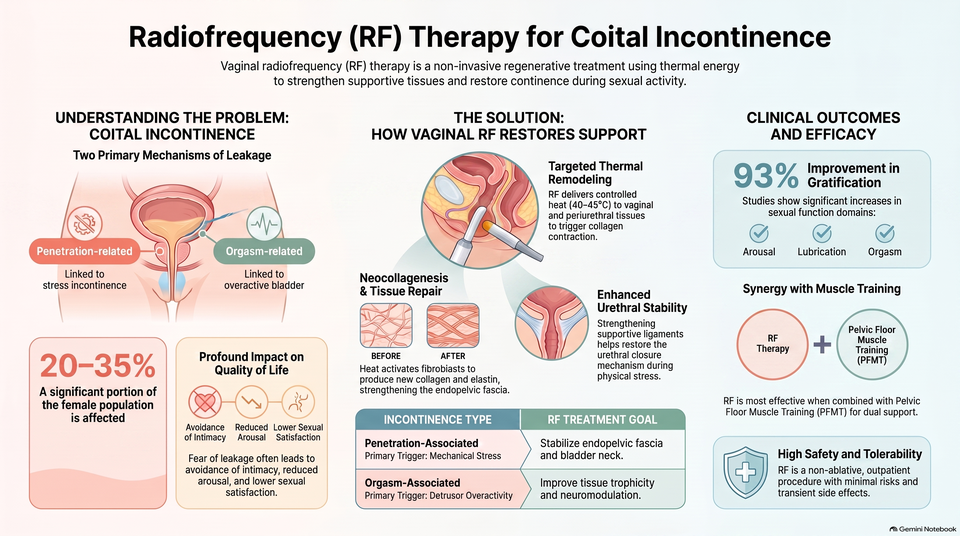
Vaginal RF may be discussed for selected mild urinary or coital leakage symptoms, but it should not replace proper continence assessment. Leakage during sex can relate to stress incontinence, urgency, pelvic-floor dysfunction, prolapse, infections, menopause-related tissue change or other causes. The safest answer is to diagnose the leakage pattern first, review established options such as pelvic-floor physiotherapy, and avoid promising that RF will correct it.
The safest public answer explains the clinical principle without giving RF technical choices, treatment sequences or device-operating instructions. Suitability should be confirmed through consultation, examination where appropriate, discussion of alternatives and informed consent.
Educational only. Suitability must be confirmed after consultation and assessment. Results vary. Not a cure.

Vaginal RF safety
At a glance
These points keep the RF discussion useful, cautious and patient-facing.
At a glance
Clinical summary
Diagnose first
RF should not replace assessment of the underlying condition.
Symptoms overlap
Dryness, leakage, pain and skin disease can have several causes.
Established care matters
Menopause care, pelvic-floor treatment or dermatology review may come first.
Deferral can be right
Active soreness, infection, bleeding or uncertain diagnosis should pause elective treatment.
Important safety note
Do not use public web content to copy RF energy choices, needle choices, temperature rules, pad-placement details, probe movement, product formulas or aftercare schedules.
Skin
Pelvic floor
Hormones
Review
Detailed answer
Detailed answer
The key is to understand diagnosis-led suitability while keeping RF treatment planning clinician-led.
The clinical distinction
Vaginal RF is an energy-based treatment. The relevant question is not just what the device can do, but whether the tissue, symptoms, evidence, contraindications and alternatives make treatment appropriate.
Tissue
Safety
Evidence
Clinical priority
The symptom pattern and tissue findings should guide whether RF is suitable or unnecessary.
Evidence limits
Marketing claims around laxity, lubrication or leakage should be balanced with uncertainty.
Alternatives
Physiotherapy, local menopause treatment, dermatology care or continence assessment may be better first steps.
Follow-up
Persistent or worsening symptoms should prompt reassessment rather than repeat treatment by default.
What this means in practice
Patients can ask how suitability is assessed, why treatment may be delayed, what alternatives exist and what symptoms should trigger medical review.
Healing, symptom change and tissue remodelling vary, so repeat treatment should not be automatic.
Patient safety
Why this matters
Vaginal RF pages often sound simple, but intimate tissue, menopause symptoms and energy-based treatments need careful clinical framing.
It protects fragile tissue
Low-oestrogen, dry, painful, inflamed or scarred tissue may be more sensitive and less predictable.
It avoids unsafe copying
Public technical advice can be unsafe because devices, tissue findings and contraindications differ.
It checks other causes
Bleeding, pain, lesions, infection, urinary symptoms or skin disease may need a different pathway first.
It sets honest expectations
Collagen or heat-response mechanisms do not promise symptom relief for every patient.
A cautious device discussion
The page should help patients understand what to ask and when to pause, rather than making RF sound universally suitable.
Consent is stronger when benefits, limits, alternatives, contraindications and uncertainties are visible.
Considerations
What to consider
Before deciding on vaginal RF, the consultation should cover symptoms, tissue findings, medical history, implanted devices, medicines, alternatives and aftercare.
Consultation priorities
A safe patient journey starts with assessment, consent and a clear plan for aftercare and follow-up.
Tissue
Consent
Follow-up
Before treatment
Tell the clinician about bleeding, pain, infections, implanted devices, nerve stimulators, skin disease, cancer history, medicines and current vaginal treatments.
During planning
The clinician should explain whether RF is suitable, what alternatives exist, and why treatment may be delayed.
Healing expectations
Short-term sensitivity may occur, but worsening pain, discharge, fever, bleeding or burns need review.
When to delay
Active infection, unexplained bleeding, ulcers, suspicious lesions, severe pain, unstable lichen sclerosus or fragile tissue may mean treatment should wait.
What not to assume
Do not assume that stronger heat, deeper treatment, a branded device or an added therapy means better results.
Costs and treatment plans should be confirmed with the clinic before booking.
Common concerns and myths
Common misconceptions
These myths are common because vaginal RF is often marketed more simply than it should be explained.
Myth: RF replaces diagnosis
Reality: suitability depends on assessment, tissue quality, evidence, governance and whether RF is appropriate at all.
Myth: Lichen sclerosus can be treated like normal skin
Reality: technical details should be clinician-led and cannot be reduced to a public rule or device claim.
Myth: Topical hormones and RF always work better together
Reality: symptoms, healing and outcomes vary, so review and alternatives matter.
Mechanism is not a promise
A biological rationale, such as collagen remodelling, does not prove that every symptom will improve.
Safety is not just the device
Training, assessment, tissue condition, aftercare and follow-up are part of safety too.
Safety checklist
Safety checklist
Use these checks before considering vaginal RF treatment.
Has the symptom been assessed?
Dryness, pain, bleeding, urinary symptoms, laxity and recurrent infections can have different causes.
Are red flags absent?
Unexplained bleeding, ulcers, severe pain, infection signs, burns or suspicious lesions should be reviewed first.
Are alternatives clear?
Ask about moisturisers, lubricants, local hormone options where suitable, pelvic-floor care, continence assessment or specialist referral.
Is aftercare clear?
You should know what sensations are expected, what is not expected and who to contact if symptoms worsen.
Reassuring signs
Proceeding is more reasonable when symptoms are explained, tissue is suitable, red flags are absent and the plan includes consent and follow-up.
Suitable
Follow-up
Reasons to pause
Pause for unexplained bleeding, active infection, ulcers, suspicious lesions, severe pain, urinary retention, burns, implanted-device uncertainty or pressure to proceed quickly.
Infection
Severe pain
When to escalate
When to seek medical help
Some symptoms need medical assessment before any elective vaginal RF treatment.
Use NHS 111 online
Bleeding or lesions
Postmenopausal bleeding, bleeding after sex, ulcers, new lumps or suspicious genital lesions should be assessed promptly.
Infection symptoms
Fever, pelvic pain, foul discharge, spreading redness, pus or feeling unwell needs medical advice.
Burns or urinary symptoms
Burning injury, urinary retention, blood in urine or worsening bladder symptoms should not be treated as routine irritation.
Emergency symptoms
Call 999 for life-threatening symptoms such as collapse, chest pain, breathing difficulty or severe allergic reaction.
Use NHS 111 for urgent advice or call 999 in a life-threatening emergency. This page is educational and does not replace individual medical assessment.
More clinical detail
Why diagnosis-led suitability needs careful framing
This question involves a real technical principle, but the patient-facing answer should explain why the principle matters rather than giving treatment numbers, timings or device instructions.What patients can safely ask
Ask how the clinic assesses tissue suitability, what alternatives are available, what safety checks are used, what side effects may occur and how follow-up is handled.What should stay clinician-led
Energy choices, device movement, inserted-device technique, product selection, complication management and repeat-treatment decisions should not be followed from public web content.Regulatory resources
Authoritative resources
These resources support cautious discussion of vaginal RF, GSM, intimate-device safety and evidence limits.
NICE menopause guideline NG23
UK guidance anchor for menopause-related tissue symptoms and assessment-led care.
European Society of Sexual Medicine position statements on RF devices
Peer-reviewed evidence context for RF devices used in vulvovaginal care.
FDA RF microneedling safety communication
Regulatory safety reference for avoiding over-reassurance around intimate RF microneedling.
Next step
Book a consultation
A consultation can confirm whether vaginal RF is suitable, whether another treatment should come first, and what safety checks or alternatives apply.
▶ View Research Sources (12 Sources)
These 12 source names are selected from 79 curated sources. Additional reviewed material included UK clinical guidance, professional society guidance, peer-reviewed clinical papers, evidence reviews; duplicate and low-relevance records were removed before display.
Educational only. This information is for education only and is not a substitute for professional medical advice, diagnosis or treatment. Results vary. Not a cure.
