



How oral ospemifene treats postmenopausal vaginal dryness

How oral ospemifene treats postmenopausal vaginal dryness | WHC Clinical FAQ

Can the O-Shot Help with vaginal mesh complications? | WHC Clinical FAQ
Evidence review
Level 4
Clinically careful draft
Women’s health evidence review
Ozempic, semaglutide and vaginal health: what the evidence does—and does not—show
A definitive review of direct evidence, plausible indirect pathways, infection findings, differential diagnosis and practical clinical assessment.
Questions about dryness, irritation, discharge, infection, pain and bleeding deserve more than a quick list of side effects. This review separates established evidence from biological plausibility—and explains why a symptom can be real even when medication causality remains uncertain.
Key takeaways
- Specific vulvovaginal reactions are not recognised as established Ozempic adverse effects in the product information reviewed in the supplied research.
- Non-listing does not prove impossibility. It means there is no established labelled reaction with a dependable frequency estimate.
- Dehydration during gastrointestinal symptoms and the unmasking of genitourinary syndrome of menopause are plausible indirect pathways, not proof of vaginal toxicity.
- Comparative real-world evidence did not suggest greater vulvovaginal infection risk with semaglutide than with SGLT2 inhibitors; the apparent lower rates remain observational.
- Symptoms should be assessed for common causes, red flags and co-medications before semaglutide is assumed to be responsible.
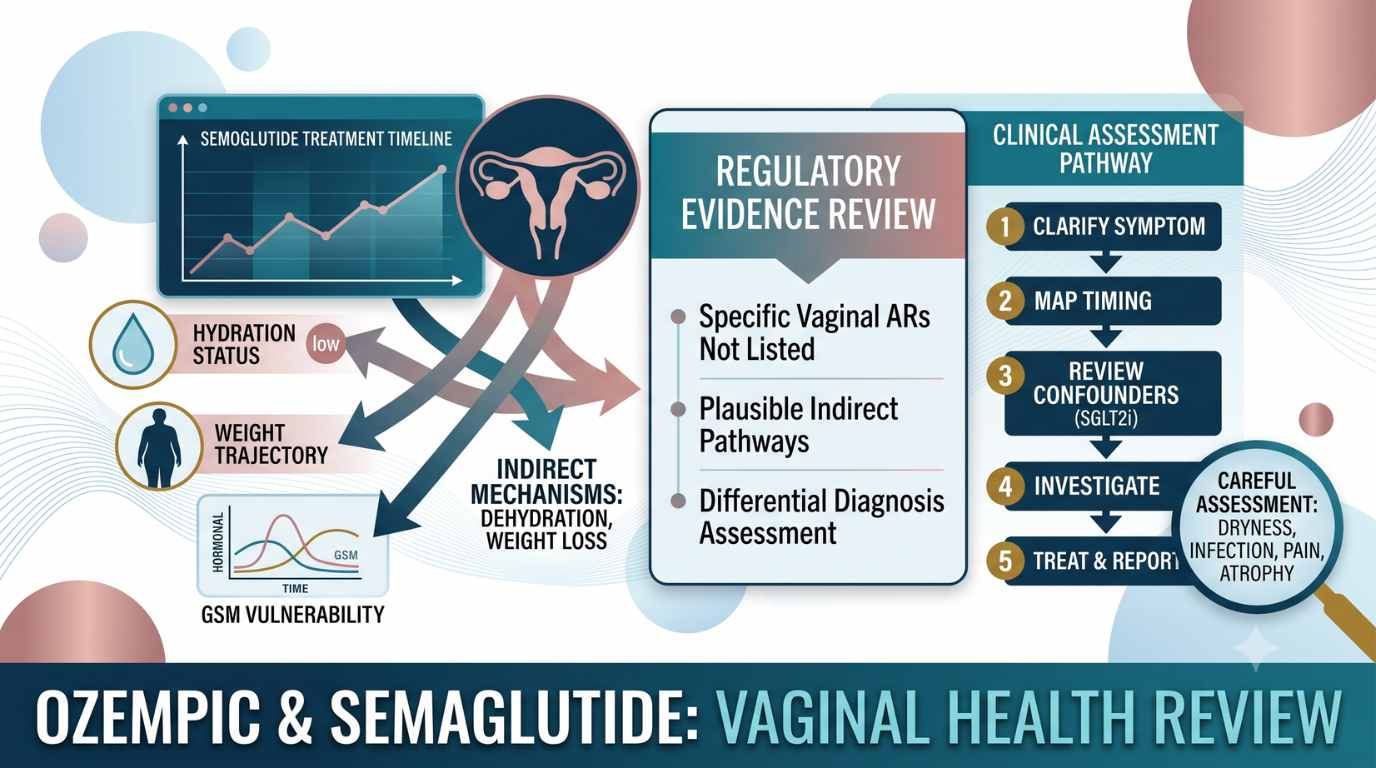
A careful review asks two questions at once: what happened after treatment, and what evidence shows that treatment caused it?
Start with the answer
The evidence verdict
The evidence does not support a simple “yes” or “no”. It supports a disciplined distinction between direct effects, indirect interactions and common alternative diagnoses.
The evidence constellation
Symptoms are real; causality still has to be tested
Four linked lenses prevent both dismissal and over-attribution.
Label evidence
Specific vaginal outcomes are not established listed reactions. This defines the current regulatory position, not a proof of zero possibility.
Indirect pathways
Fluid depletion, weight change and the unmasking of GSM can connect treatment context to symptoms without proving direct tissue toxicity.
Alternative diagnoses
GSM, infection, vulval dermatosis, irritants, urinary disease, pelvic-floor problems and other medicines may better explain the presentation.
Clinical action
Urgency and treatment depend on the symptom, red flags, examination and test results—not on timing alone.
Evidence literacy
How to interpret the evidence
The source review grades evidence from Level A to Level E. These levels answer different questions. A label, a cohort, a spontaneous report and a case report cannot be blended into one undifferentiated claim.
Levels A–B: regulatory information and controlled outcomes
Level A comprises authorised product information and pivotal safety tables. It is strong for systematically collected recognised outcomes, but less granular for uncommon or unsolicited vaginal symptoms. Here, it establishes non-listing—not impossibility.
Level B would include controlled trials with predefined vaginal outcomes such as validated dryness scores, pH or clinician-assessed tissue change. Robust direct outcomes of this kind were not identified in public product information.
Levels C–E: association, signals and hypotheses
Level C observational studies can compare real-world diagnosis patterns, but prescribing decisions, age, menopause, diabetes severity, surveillance and co-medication may differ between groups.
Level D pharmacovigilance detects unusual reporting patterns but lacks a dependable denominator. Level E case reports can suggest timing and mechanism in an individual but cannot establish population risk.
Interpretation rule: reporting proportion is not incidence, association is not causation, and a plausible mechanism is not a demonstrated clinical effect.
Scope and method
The review asks about six different outcome families
Dryness, infection, discharge, pain, atrophy and mucosal change are related in everyday language but not interchangeable in evidence or diagnosis.
Assumptions that limit certainty
Baseline symptoms: pharmacovigilance and summary data may not reveal whether dryness, pain or recurrent infection existed before semaglutide.
Menopause and hormones: menopausal stage, breastfeeding, contraception and hormone therapy are frequently missing despite their strong relevance.
Co-medication: SGLT2 inhibitors, antibiotics, antidepressants and topical products may be unrecorded or incompletely adjusted.
Outcome definition: patient language may combine vulval, vaginal, urinary, pelvic-floor, sexual-function and bleeding symptoms under one label.
Mechanisms
Plausible pathways are not all equally strong
Known treatment effects provide the most credible indirect routes. Laboratory and single-case hypotheses remain much less certain.
Fluid depletion
Nausea, vomiting, diarrhoea and reduced intake can cause dehydration. This may worsen existing mucosal dryness or irritation, particularly during dose escalation, without demonstrating direct vaginal injury.
Weight and hormonal context
Substantial weight change may coincide with sex-hormone and soft-tissue changes. In peri- and post-menopause, it may make previously subtle GSM more apparent; semaglutide’s independent contribution remains uncertain.
Direct receptor effect
The supplied review found limited support for a direct vaginal GLP-1 receptor target. Animal reproductive-tissue findings cannot be translated into human vaginal toxicity.
Microbiome and immunity
Gut-microbiome and immune effects point in competing directions. Better glycaemic control might reduce infection susceptibility; theoretical crosstalk cannot predict a net vaginal effect.
Clinical interpretation
Known effects interacting with existing susceptibility are more credible than a new direct-toxicity claim
The strongest indirect pathways begin with recognised gastrointestinal symptoms or weight change. The weakest leap from a laboratory observation or single case directly to a predictable vaginal adverse effect.
Gastrointestinal effects and the hydration link
The supplied FDA-label data for placebo-controlled type 2 diabetes trials show nausea in 15.8% of participants receiving 0.5 mg and 20.3% receiving 1 mg, compared with 6.1% receiving placebo. Vomiting was reported in 5.0% and 9.2% respectively, compared with 2.3% with placebo. Diarrhoea was reported in 8.5% and 8.8%, compared with 1.9% with placebo.These figures describe gastrointestinal events, not vaginal symptoms. Their relevance is indirect: repeated vomiting, diarrhoea, nausea or markedly reduced intake may cause dehydration, and dehydration could make existing mucosal dryness or irritation feel worse. A pattern around initiation or dose escalation may therefore prompt a hydration review as well as assessment of the vaginal symptoms themselves.Weight, oestrogen context and GSM
The European product information records decreased weight as a common reaction category. In post-menopausal women, adipose tissue contributes to circulating oestrogen through peripheral conversion, and weight-loss interventions can change oestrogens and sex hormone-binding globulin. GSM is driven by low-oestrogen tissue change and may involve dryness, burning, irritation, urinary symptoms, tissue fragility and pain during sex.It is therefore plausible that symptoms become more noticeable during substantial weight change, especially where GSM was already present but under-recognised. This remains an interaction hypothesis. Menopause status, baseline GSM, hormone therapy, breastfeeding, ovarian function and pace of weight loss are frequently absent from safety datasets, limiting causal interpretation.Sexual function is not one outcome
The source includes a case report of female anorgasmia and hypoarousal temporally associated with GLP-1 receptor agonist use, including semaglutide after a switch from liraglutide. Proposed explanations involved genital blood flow and central signalling. This is hypothesis-generating evidence from one report. Desire, arousal, lubrication, orgasm and pain are related but distinct domains and should not be collapsed into a single claim about vaginal health.Outcome by outcome
What the evidence says about specific symptoms
| Symptom | Evidence position | Assessment priority |
|---|---|---|
| Dryness, irritation, atrophy | Not listed; indirect dehydration/GSM routes plausible | Hydration, menopause, dermatoses, irritants, medicines |
| Candidiasis or vaginitis | No increased liability established; lower recorded rates versus SGLT2 inhibitors in one comparative analysis | Testing, glycaemic context, antibiotics and SGLT2 use |
| Discharge or odour | Not listed; no strong semaglutide-specific signal | BV, candidiasis, STI/cervicitis and other causes |
| Pain or dyspareunia | Not listed; direct evidence very limited | GSM, skin disease, vestibulodynia, pelvic floor and deeper pelvic causes |
| Spotting or bleeding | Adjacent endpoint; no disproportionate signal versus tirzepatide in the cited analysis | Independent gynaecological evaluation |
Dryness, fragility and painful sex
Infection, discharge and irritation
Pain, sexual function and bleeding
Why clinical confounding matters so much
Diabetes context
Glycaemic control and the underlying condition can influence infection susceptibility.
Other medicines
SGLT2 inhibitors, antibiotics, hormones and medicines affecting sexual function matter.
Hormonal stage
Menopause, lactation and ovarian or endocrine treatment can dominate the presentation.
Comparator choice
A relative difference may reflect the comparator’s risk rather than protection from semaglutide.
Signal versus frequency
What incidence and pharmacovigilance can—and cannot—tell us
The absence of a vaginal-symptom percentage does not mean zero risk. Online or spontaneous reports do not create a denominator.
- 2017
Ozempic authorised for type 2 diabetes with a gastrointestinally dominated adverse-effect profile.
- 2023
Semaglutide FAERS analyses described unexpected reporting signals, without establishing vaginal dryness as a labelled reaction.
- 2025
Comparative real-world evidence described lower recorded rates of selected vulvovaginal infection diagnoses versus SGLT2 inhibitors; a separate sexual-function case report remained hypothesis-generating.
- 2026
A focused spontaneous-report comparison described no disproportionate gynaecological-haemorrhage signal versus tirzepatide.
Why spontaneous-report data can mislead when read as incidence
No dependable exposure denominator: a reporting database counts submitted reports, not every person who used the medicine. A term appearing in 1% of reports does not mean that 1% of users experienced it.
Stimulated and selective reporting: publicity, social-media attention, litigation, regulatory alerts and the novelty of a medicine can change what people report. Common or expected symptoms may be under-reported, while a newly discussed symptom may rise rapidly.
Missing clinical context: menopause status, baseline symptoms, laboratory confirmation, diabetes control, SGLT2 exposure and antibiotics may be absent. Without these fields, alternative explanations cannot be adequately tested.
What strengthens a report: precise dose timing, objective findings, exclusion of common causes, improvement after supervised withdrawal and recurrence after rechallenge can add weight. Even then, a report remains a signal rather than a population risk estimate.
The key point
Use each evidence type inside its limits
Labels describe established recognised reactions. Cohorts estimate comparative associations. Spontaneous reports detect possible signals. Case reports suggest hypotheses. None of these alone resolves an individual diagnosis.
From evidence to care
Assessment first: a practical pathway
Define
Name the exact symptom, location, trigger and associated features.
Time
Map initiation, dose changes, GI symptoms, weight and symptom onset.
Context
Review menopause, diabetes, medicines, exposures and irritants.
Assess
Examine and test according to presentation and risk.
Act
Treat the diagnosis and review the full medication context.
What a high-yield history can reveal
A dose-linked pattern
Symptoms that repeatedly intensify after escalation at the same time as nausea, vomiting or poor intake strengthen an indirect hydration hypothesis. They still do not identify the tissue diagnosis.
A menopause-linked pattern
Dryness, burning, urinary urgency and penetration pain developing alongside hot flushes, cycle change or established menopause make GSM especially important.
An infection pattern
Itch and characteristic discharge, objective testing, recent antibiotics, poor glucose control or SGLT2 treatment direct attention towards infection rather than a novel mucosal reaction.
A skin or pain pattern
External soreness, visible skin change, fissures, pain on sitting or localised provoked pain may indicate dermatosis, vestibulodynia or pelvic-floor involvement.
Examination and testing should answer a question
External inspection can identify atrophy signs, inflammation, fissures, architectural change or a dermatosis that a symptom label cannot distinguish. A speculum examination may be relevant for discharge, bleeding or deeper pain, but should be used according to clinical need and consent. Vaginal pH and microscopy or nucleic-acid testing may help separate candidiasis, bacterial vaginosis and sexually transmitted infection from non-infectious irritation.Urinary urgency, dysuria and recurrent “infection” symptoms can overlap with GSM. Urinalysis or culture may be appropriate when urinary features dominate. A normal infection test is useful evidence, but it does not by itself prove a medicine reaction; it should redirect attention to tissue, skin, hormonal and pain-related causes.For suspected adverse-reaction reasoning, document objective findings before and after treatment where possible. Symptom response to antifungal treatment, vaginal moisturiser, local hormonal therapy, hydration recovery or removal of an irritant may be more informative than chronology alone. Any medication dechallenge should be supervised and interpreted cautiously because symptoms can fluctuate naturally.Seek prompt assessment when symptoms carry warning features
Urgency depends on the whole presentation. Seek prompt or urgent advice for severe or escalating pelvic pain, fever or systemic illness, significant or unexplained bleeding, pregnancy possibility with concerning symptoms, faintness, severe dehydration, inability to keep fluids down, a new mass or ulcer, or concern about malignancy.
What this means in practice
Assessment first. Stage care. Do not rush attribution.
Stabilise acute gastrointestinal symptoms and hydration. Clarify the diagnosis. Understand whether weight is changing rapidly. Review relevant medicines and procedural risks. Only then consider changes to treatment or elective interventions.
Management and timing
Treat the symptom syndrome while protecting the wider care plan
Medication attribution is only one part of management. Hydration, GSM, confirmed infection, skin disease, pelvic-floor symptoms and procedural planning each need their own response.
Hydration and symptom-directed care
When dryness or irritation tracks with active vomiting, diarrhoea or poor intake, fluid depletion is relevant because it is a recognised treatment-related concern. Severe symptoms or signs of kidney injury require medical assessment. Hydration support must sit alongside—not replace—evaluation for GSM, infection, dermatitis or another cause.For baseline vaginal dryness, moisturisers and lubricants have different roles: moisturisers are generally used regularly for ongoing dryness, while lubricants reduce friction during sexual activity. Persistent symptoms warrant assessment rather than indefinite self-treatment.Menopause, hormone therapy and oral medicines
GSM is common and often under-recognised. Local vaginal oestrogen may be considered for suitable patients through a clinical discussion of history, contraindications, preferences and current guidance. Treating a low-oestrogen syndrome does not prove semaglutide caused it.Semaglutide delays gastric emptying, so the source appropriately raises oral-medication absorption as a review point. Clinical significance varies by medicine and person. Anyone using oral hormone therapy or contraception should not change route or dose because of a general article; the prescriber or pharmacist should review the specific product and current guidance.Foundation first
Address active GI symptoms, hydration and diagnosed GSM or infection before layering on elective care.
Wait for stability
Rapid ongoing weight change can make soft-tissue goals and outcomes a moving target.
Plan sedation individually
Delayed gastric emptying makes symptoms, indication, dose phase and anaesthetic protocol relevant to aspiration-risk planning.
| Care context | Why semaglutide may be relevant | Planning principle |
|---|---|---|
| Moisturisers, lubricants and GSM care | Active GI symptoms may compound perceived dryness | Stabilise hydration and treat the diagnosed symptom pattern first |
| Soft-tissue or volume procedures | Rapid ongoing weight change can shift the target | Avoid treating a moving target; reassess after greater stability |
| Energy-based or regenerative procedures | Evidence and suitability depend on the underlying diagnosis, not medication use alone | Apply procedure-specific guidance and do not bypass foundation care |
| Sedated elective procedures | Delayed gastric emptying can affect aspiration-risk assessment | Use current local anaesthetic guidance and an individual risk review |
| Multi-part elective plans | Hydration, weight, symptoms and expectations may all be changing | Stage decisions rather than combining interventions prematurely |
A boundary worth keeping
Timing and sequencing are not the same as eligibility
Semaglutide is not an automatic contraindication to every vulvovaginal treatment. Equally, medication use should not be treated as irrelevant when active GI symptoms, unstable weight or sedation are involved. The correct question is what must be assessed and stabilised before a particular intervention.
Should semaglutide be stopped?
There is no vaginal-symptom-specific stopping threshold in product information because these symptoms are not established adverse reactions. For mild or moderate symptoms without red flags, it may be possible to continue treatment while investigating and treating common causes.Severe, persistent or recurrent symptoms with a close temporal relationship deserve prescriber review. A supervised interruption may sometimes contribute to causal assessment when clinically safe, but an unsupervised stop–start experiment can disrupt diabetes or weight-management care and may not provide a clear answer. Serious labelled syndromes follow their own authorised safety guidance.Reporting a suspected reaction
In the UK, patients and clinicians can report suspected adverse drug reactions through the MHRA Yellow Card scheme. A useful report includes product and dose, initiation and escalation dates, symptom onset and resolution, menopause status, hormone therapy, diabetes control, SGLT2 inhibitor or antibiotic use, objective findings, treatment response and any supervised dechallenge information. Reporting does not require proof; detail helps signal detection.Calibrated conclusions
What the review supports—and what it does not
Confidence changes by outcome. The wording should change with it.
Dryness and irritation
Causality uncertain
Non-listing in product information plus plausible fluid-depletion and GSM interactions. No direct trial endpoint establishes a semaglutide effect.
Do: assess hydration and common causes.
Do not: call dryness a proven direct reaction.
Atrophy or tissue thinning
Evidence low
GSM supplies a well-established low-oestrogen explanation. The contribution of weight loss and semaglutide cannot be separated without menopause and baseline data.
Do: phenotype GSM.
Do not: infer drug-induced atrophy from timing alone.
Candidiasis or vaginitis
No increased liability shown
Comparative observational evidence points towards lower recorded risk than with SGLT2 inhibitors, but comparator liability and residual confounding limit interpretation.
Do: confirm infection.
Do not: describe semaglutide as protective.
Pain and sexual function
Evidence very low
Common GSM, dermatological and pelvic-floor explanations coexist with one hypothesis-generating sexual-function case report.
Do: separate pain, arousal and orgasm.
Do not: generalise a case report.
Gynaecological bleeding
No comparative signal detected
The focused report analysis did not show disproportionate reporting versus tirzepatide. Reporting proportions cannot estimate incidence.
Do: assess bleeding independently.
Do not: use a negative signal to dismiss it.
What this calibrated language protects against
Over-attribution can lead someone to stop effective diabetes treatment, delay investigation of GSM or infection, or overlook a medicine with a stronger known association. Under-attribution can leave a genuine temporal pattern undocumented and prevent a useful suspected-reaction report. Both errors become more likely when every symptom is treated as either definitive proof or irrelevant coincidence.The middle position is active rather than indecisive. It asks clinicians to define the outcome, look for red flags, document exposure timing, test common explanations and preserve uncertainty in the record. If symptoms improve after treating GSM, correcting dehydration or stopping an irritant, that is clinically useful. If they persist despite appropriate care and remain tightly related to dose exposure, a supervised medication review and pharmacovigilance report become more important.For patients, the same framework offers reassurance without false certainty: the current evidence does not identify a common direct vaginal toxicity syndrome, but a new symptom still deserves attention. The goal is a correct diagnosis and a safe plan, not winning an argument about whether the medicine is “to blame”.What would resolve uncertainty?
Research gaps are specific—and testable
Missing predefined outcomes
Trials need validated vaginal symptom measures, clinical assessment, pH and microbiome outcomes rather than spontaneous terms alone.
Missing menopause context
Menopause, breastfeeding, ovarian function and hormone therapy can dominate dryness risk and must be captured.
Co-medication confounding
SGLT2 inhibitors, antibiotics, hormonal medicines and drugs affecting sexual function can alter the apparent association.
Outcome misclassification
Dryness, dermatosis, infection, urinary symptoms, pelvic-floor pain, arousal change and bleeding require distinct definitions.
Study designs that could test causality
Prospective new-user cohort: compare semaglutide with an active non-SGLT2 comparator and stratify by menopause and baseline GSM. Collect symptom measures before treatment and at defined follow-up points, alongside vaginal pH, clinician assessment, microbiome sampling, HbA1c, hydration markers, hormone context and weight trajectory. This could estimate both overall association and possible mediation through fluid loss or weight change.
Self-controlled case series: among users with an incident diagnosis, compare each person’s risk windows after initiation or dose escalation with their own baseline periods. This reduces confounding by characteristics that remain stable within a person, although time-varying factors such as antibiotics, menopause transition and changing glucose control still require attention.
Target-trial emulation: use electronic health records with an explicit new-user design, washout period, careful comparator selection and high-dimensional adjustment. Outcomes should distinguish confirmed candidiasis, vaginitis, GSM, dyspareunia, bleeding and prescriptions for relevant treatments. Negative-control outcomes and surveillance-bias analyses would test the robustness of results.
Mechanistic and pharmacovigilance refinement: embed prespecified vaginal outcomes in efficacy or pragmatic trials, then improve spontaneous-report analyses with consistent MedDRA groupings, co-medication filters, reporter stratification and time-to-onset modelling. Early symptoms coinciding with GI effects may represent a different pathway from later symptoms during sustained weight change.
Clear answers, without overclaiming
These answers reflect the supplied evidence review. They cannot diagnose an individual symptom.
Does Ozempic cause vaginal dryness?+
The supplied evidence does not establish dryness as a recognised direct adverse reaction. Dehydration during gastrointestinal symptoms and the unmasking of GSM are plausible indirect explanations. Persistent dryness deserves assessment for common causes.
Can semaglutide cause thrush or bacterial vaginosis?+
Neither is established as a listed semaglutide reaction in the reviewed product information. Comparative observational evidence described lower recorded rates of some vulvovaginal infections than with SGLT2 inhibitors, but this does not prove protection.
Why did symptoms begin after a dose increase?+
Dose escalation may coincide with nausea, vomiting, diarrhoea or reduced intake, making dehydration relevant. Timing is worth documenting, but it cannot alone distinguish a medicine effect from GSM, infection, dermatitis or another cause.
Should I stop semaglutide if I develop symptoms?+
Do not stop prescribed treatment solely because of this article. Ask the prescriber to review severe, persistent, recurrent or closely dose-linked symptoms. Warning features require prompt assessment.
Is vaginal bleeding an Ozempic side effect?+
The supplied evidence did not establish a disproportionate gynaecological-haemorrhage signal compared with tirzepatide, but spontaneous-report proportions are not incidence. Unexplained bleeding needs appropriate gynaecological assessment.
Could menopause be the main explanation?+
Yes. GSM commonly causes dryness, burning, painful sex, urinary symptoms and tissue fragility. Gastrointestinal symptoms or weight change during treatment might make an existing problem more noticeable without being its primary cause.
Does semaglutide affect vaginal procedures?+
It is not an automatic contraindication to every procedure. Active GI symptoms, hydration, changing weight, other medicines and sedation plans may influence timing and suitability. Individual assessment and current peri-procedural guidance are required.
How can a suspected reaction be reported?+
In the UK, patients and clinicians can use the MHRA Yellow Card scheme. Record dose timing, other medicines, menopause status, objective findings and what happened when the symptom was treated or the prescription was reviewed.
