
...
 Why us?  Why us? please click dropdown
4.8/5 out of 3,500+ reviews
Regulated: CQC Registered | 1-5796078466
  • Verified Content: Approved by the Women’s Health Clinic Clinical Team.
  • Educational Use: This is not a substitute for professional medical advice, diagnosis, or treatment.
  • Clinical Assessment: Individual suitability is determined by a clinician; results may vary.
  • Non-NHS: Private healthcare provider only. Pricing varies by treatment and site. Availability varies by clinical location.
  • MEDICAL EMERGENCY:

    If you need urgent help, use NHS 111. For a life-threatening emergency, call 999.

 Author  Find more about the author
Dr Farzana Khan

Dr Farzana Khan

Verified

Dr Farzana Khan qualified as an MD from the University of Copenhagen in 2003. She has worked in dermatology and obstetrics & gynaecology across the North of England and completed her MRCGP (CCT, 2013) and the Diploma of the Faculty of Sexual & Reproductive Health (2013). Her clinical focus is vaginal health—including dryness/GSM, sexual function concerns, lichen sclerosus, and comfort or volume changes. She offers careful assessment, discusses medical and conservative options first, and considers selected regenerative or aesthetic treatments where appropriate. Dr Farzana also trains clinicians as a KOL/Trainer with Neauvia, Asclepion Laser, and RegenLab (since 2023). Ongoing CPD includes IMCAS, CCR, ACE and expert training in women’s intimate fillers, PRP, and polynucleotide injectables. Her approach is simple: clear explanations, realistic expectations, and shared decision-making. Authored and medically reviewed by Dr Farzana Khan.

MD MRCGP DFFP
Was this answer helpful?
Rate Dr Farzana's explanation

FAQ
CO2 laser recovery
LED mask safety

Women’s Health Clinic FAQ

Can I use an LED red light mask to speed up recovery?

It is understandable to want to do everything possible to heal well after CO2 laser resurfacing. Red and near-infrared LED light may support inflammation control and skin repair in some settings, but freshly lasered skin is a controlled wound. Timing, device quality, eye protection and your individual healing pattern all matter.

Direct answer

Possibly, but only if your treating clinician says your skin is ready. Red and near-infrared LED may help calm inflammation and support cellular repair after laser treatment, but a home mask should not be used over weeping, crusted, infected, unusually painful or very swollen skin. It also cannot replace cleansing, barrier ointment, sun avoidance and prescribed aftercare. Clinic LED is more controlled than most home masks, so ask when to start, how often to use it, and what eye protection is required.

The safest approach is to treat LED as an optional recovery support, not a shortcut. After CO2 laser, the skin barrier may be open and vulnerable for several days. Adding heat, pressure, unclean surfaces or poorly timed light exposure can irritate healing skin, especially if you are prone to pigmentation or sensitivity.

Educational only. This page is general information and does not replace the aftercare instructions from your treating clinician. Results vary. Not a cure.

Woman holding an LED red light mask while checking laser aftercare advice
Post-laser recovery support

At a glance

Use these points as a quick safety filter before using any LED mask after CO2 laser.

At a glance

What matters most

Best timing

After clinician clearance, usually once the barrier is settling

Avoid if

Skin is weeping, crusted, infected, blistering or increasingly painful

Home mask limit

Dose, fit, wavelength and power vary between devices

Do not skip

Wound care, sun avoidance, eye protection and follow-up advice

Most important safety point

Do not put a home LED mask onto fresh CO2 laser wounds unless your clinic has specifically told you it is appropriate for your treatment depth and healing stage.

Clinician clearance
Eye protection
Barrier care
No heat or pressure
Stop if irritated


Detailed answer

How LED may support healing

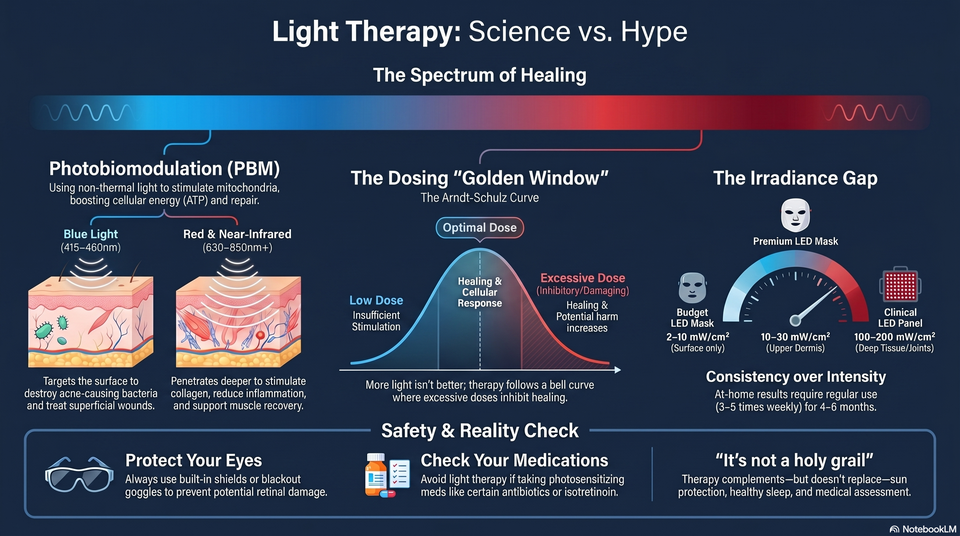
LED light therapy is also called photobiomodulation. It uses selected wavelengths of non-ultraviolet light, usually red and near-infrared for recovery support, to influence cellular signalling. This is different from CO2 laser resurfacing, which deliberately removes columns or layers of damaged skin to trigger healing.

The biology is dose-dependent

Red and near-infrared light may be absorbed by mitochondrial chromophores, including cytochrome c oxidase. In plain English, that means light can influence the cell’s energy system, inflammatory signalling and fibroblast activity. The useful dose sits within a narrow window; more time under a mask is not automatically better.

Red light
Near-infrared
Mitochondria
Dose matters

What it may help with

In appropriate settings, LED may help reduce post-treatment redness, swelling or discomfort and may support the repair processes involved in re-epithelialisation, which is the rebuilding of the skin surface.

What it cannot do

It cannot seal an open wound, prevent every complication, replace prescribed medicines, or make a deep CO2 laser recovery behave like a light facial. Your main recovery still comes from wound care and time.

Why timing matters

Immediately after CO2 laser, the skin may be hot, tender, swollen and open. A mask can add contact pressure, warmth or contamination risk if used too soon or without cleaning and eye protection.

Home mask versus clinic LED

Clinic LED systems allow more control over wavelength, distance, dose and hygiene. Home masks vary widely, so they are better viewed as a cautious support tool once the clinic confirms they fit your aftercare plan.

The practical answer

Ask your treating clinic three questions: when can I start, how long should each session be, and should I avoid any wavelength or device while my skin is healing?

If the answer is unclear, wait. Missing a few LED sessions is much less important than avoiding irritation, infection, pigment change or delayed healing after an ablative procedure.


Patient safety

Why this matters after CO2 laser

CO2 laser recovery is not ordinary skincare recovery. It involves a temporary wound, inflammation and barrier disruption, so seemingly gentle devices still need sensible timing.

Fresh skin is vulnerable

During early healing, the surface barrier is rebuilding. Anything touching the face, including a mask, should be clean, non-irritating and approved for your stage of recovery.

Pigment risk can increase

People with melasma tendency, darker skin tones, recent tanning or post-inflammatory pigmentation history need careful aftercare. Irritation and heat can make pigment problems more likely.

Women’s skin changes over time

Lower oestrogen around menopause can contribute to dryness, reduced collagen and a more reactive barrier for some women. That can affect how comfortable and resilient the skin feels during recovery.

Marketing can overpromise

LED is often sold as a quick recovery boost. The more honest view is that it may be useful in a broader plan, but dose, device quality and correct timing decide whether it is appropriate.

The WHC approach

Recovery support should be individualised. We would rather you heal steadily with clear instructions than add extra devices too early because they sound gentle.

Bring your mask name, wavelength information and instructions to your appointment if you want personalised advice on whether it fits your post-laser plan.


Considerations

When it may be reasonable to use LED

LED may be considered once the skin is stable enough and your clinic has confirmed it will not interfere with healing.

Use healing milestones, not internet timelines

There is no universal safe start day because CO2 laser settings vary. Fractional light resurfacing and deeper ablative resurfacing do not heal at the same speed.

No oozing
No infection signs
Clean device
Clear instructions

Check the skin surface

Wait if there is fresh bleeding, wetness, open skin, thick crusting, blisters, spreading redness or a new rash. Those signs need clinic advice before adding LED.

Check the device

Use a reputable device with clear wavelength, time, cleaning and eye-safety instructions. Avoid unbranded or damaged devices, especially if plugs, wiring or chargers look unsafe.

Check your medical risks

Ask for medical advice first if you have light-triggered epilepsy, active skin cancer concerns, lupus or another photosensitive condition, eye disease, or medicines that increase light sensitivity.

Check the aftercare plan

LED should fit around cleansing, ointment, dressing, sun protection and any prescribed medicines. It should not lead you to restart active skincare or makeup earlier than advised.

A simple decision rule

If your face still feels hot, raw, wet, sharply painful or unstable, do not use a home mask. Contact the clinic instead.

If the skin is settling and your clinician approves LED, use the shortest recommended programme, protect the eyes and stop if irritation increases.


Common concerns and myths

Common myths about LED masks after laser

LED can be useful, but the internet often makes it sound more certain than it is.

Myth: More LED means faster healing

Photobiomodulation follows a dose-response pattern. Too little may do nothing; too much can irritate or inhibit useful cellular signalling. Follow the advised dose rather than extending sessions.

Myth: Home masks are the same as clinic LED

Home masks can be convenient, but they vary in power, wavelength accuracy, fit and hygiene. Clinic systems are usually more controlled and supervised.

Myth: LED replaces aftercare

After CO2 laser, the essentials are gentle cleansing, barrier support, sun avoidance, infection prevention and follow-up. LED is only an add-on if it is appropriate.

The safest wording is “may help”

Evidence for photobiomodulation is promising in wound healing and inflammation, but it does not mean every mask, every dose or every patient will benefit after CO2 laser.

Comfort is not the only measure

Even if LED feels soothing, watch the skin afterwards. Increased redness, stinging, rash, swelling or pain means you should stop and ask for advice.


Safety checklist

Before you use your mask

Use this checklist before the first LED session after CO2 laser.

Has your clinic cleared it?

Ask for specific timing based on your laser settings, treatment area and healing progress. A general online answer is not enough for fresh ablative laser recovery.

Is the skin closed and calm?

Do not use the mask on wet, weeping, bleeding, blistered, infected or very painful skin unless your treating clinician has directly advised it.

Can you protect your eyes?

Use the device’s recommended eye protection and avoid staring into red or near-infrared LEDs. Be extra cautious if you have an eye condition.

Is the device clean and reliable?

Clean it exactly as instructed, avoid sharing it during recovery, and do not use damaged, unbranded or questionable electrical products.

Green flags

Your clinic has approved LED, the skin is dry and settling, discomfort is improving, the device has clear instructions, and you can use proper eye protection.

Clinic approved
Skin settling
Eyes protected

Red flags

Delay LED and contact the clinic if redness is spreading, pain is worsening, the skin is hot or weeping, blisters appear, or you feel feverish or unwell.

Worsening pain
Spreading redness
Blisters or fever


When to escalate

When to seek medical advice

Most laser recovery is planned, but complications can develop. Contact your treating clinic promptly if healing looks worse than expected. Use NHS 111 for urgent advice when your clinic is unavailable, and call 999 for life-threatening symptoms such as breathing difficulty, collapse, severe allergic reaction, or swelling affecting vision or the airway. Use NHS 111 online

Infection signs

Increasing heat, redness, swelling, pus, unpleasant smell, fever, chills or feeling generally unwell should be assessed promptly.

Cold sore-type blisters

Clusters of blisters, tingling, burning or rapidly spreading sores around the mouth or treated area need urgent clinic advice.

Severe irritation after LED

Stop using the mask and seek advice if LED causes marked stinging, rash, swelling, headache, eye pain or worsening redness.

Eye or airway symptoms

Vision change, eye pain, severe facial swelling, breathing difficulty or symptoms of a severe allergic reaction need emergency help.

For urgent but non-emergency medical advice in the UK, use NHS 111. For life-threatening symptoms, call 999.

Additional clinical context

What should I ask my clinician?

Ask whether LED is suitable for your treatment depth, when to start, how long to use it, whether your mask has appropriate red or near-infrared wavelengths, and whether you should avoid it because of your medical history or medication.

Why home masks vary

Home LED masks differ in power density, wavelength accuracy, distance from the skin, hygiene and eye shielding. A mask can feel gentle while still being the wrong tool for freshly treated skin if the barrier is open or inflamed.

What does it feel like?

LED should usually feel calm, warm or uneventful rather than hot or painful. After CO2 laser, new burning, stinging, throbbing or swelling during a session is a reason to stop and contact the clinic.

Can I use blue light too?

Blue light is mainly used for acne-related bacteria and has different tissue targets from red or near-infrared light. It is not automatically appropriate after laser resurfacing, especially for patients prone to pigmentation, so ask before using multi-colour settings.

Next step

Unsure when to restart devices after laser?

Bring your LED mask details to your review or consultation so your clinician can advise on timing, eye protection and whether it belongs in your recovery plan.

Educational only. This information is for general education and should not replace personalised advice from your treating clinician. Results vary. Not a cure.

Loading directory...
