
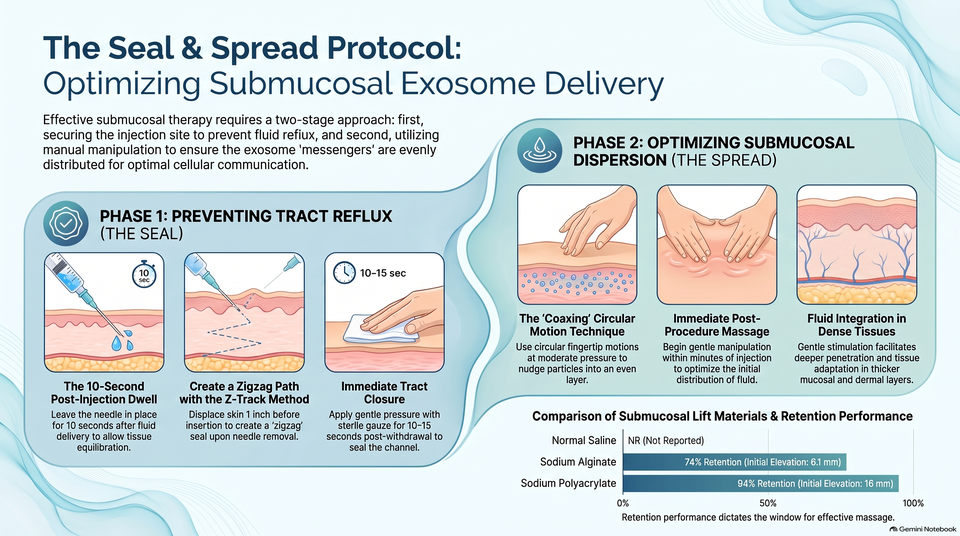


What post-injection manual massage protocol optimises sub-mucosal exosome dispersion while...

What post-injection manual massage protocol optimises sub-mucosal exosome d... | WHC Clinical FAQ

What is the therapeutic rationale for using exosomes to treat chronic, non-healing mucosal...
Aftercare
Fragile mucosa
Individualised
Women’s Health Clinic FAQ
What post-injection manual massage protocol optimises sub-mucosal exosome dispersion while preventing tract reflux
Aftercare questions should give safe principles for fragile intimate tissue without publishing manipulation, cleansing or rest protocols as universal rules.
Direct answer
Aftercare should not become a massage protocol. The safe answer is that manipulation after treatment may affect comfort, bleeding, irritation or infection risk, so patients should follow the clinic's personalised aftercare and seek advice for worsening symptoms. For patients, the key point is that aftercare should be personalised to the procedure, tissue fragility, symptoms and risk factors. Suitability and safety should be confirmed in consultation, especially where symptoms involve pain, bleeding, infection signs, scarring, vascular concerns or previous pelvic treatment.
This page explains the science in patient-safe language and keeps regulatory, evidence and suitability limits visible.
Educational only. This is general education about extracellular vesicle science and does not replace individual clinical assessment. Results vary. Not a cure.

Exosome evidence review
At a glance
These quick points help separate the laboratory concept from what can responsibly be said in clinical practice.
Key context
What the science can and cannot tell us.
Aftercare is individual
Advice depends on treatment type, tissue fragility, bleeding risk and symptoms.
Mucosa can be sensitive
Over-cleansing, friction or irritants may worsen discomfort in fragile tissue.
Manipulation is not benign
Massage or pressure after treatment may increase irritation, bleeding or infection risk.
Warning signs matter
Worsening pain, fever, discharge, ulcers or marked swelling should be reviewed.
Important evidence note
Exosome and EV mechanisms should not be translated into promised intimate-health outcomes without product-specific documentation and clinical evidence.
Barrier
Friction
Irritation
Follow-up
Detailed answer
Detailed answer
The useful answer starts with the underlying biology, then explains how evidence quality, product testing and patient context change interpretation.
Clinical bottom line
Exosome science can be biologically plausible and still not prove a predictable patient result. That distinction is the heart of safe consent.
Quality
Evidence
Consent
Explain the principle
The aim is usually to protect comfort, barrier function and healing while avoiding unnecessary irritation.
Avoid universal schedules
Rest windows, cleansing choices and barrier products should be tailored by the treating clinician.
Keep friction in mind
Penetrative sex, tampons, tight clothing or irritants may be discussed individually when tissue is fragile.
Plan follow-up
Patients should know what is expected, what is not, and who to contact if symptoms worsen.
How to interpret this safely
A responsible discussion should ask whether the claim is based on EV characterisation, laboratory mechanism, early translational evidence or patient outcome data.
If the topic relates to intimate symptoms, GSM, scarring, radiation history or pelvic pain, the symptom still needs clinical assessment before treatment suitability is discussed.
Patient safety
Why this matters
Exosome language sits between advanced cell biology and patient care, so accuracy protects consent, expectations and safety.
It protects consent
Patients should know whether a claim is proven clinically, inferred from mechanism or still uncertain.
It protects safety
Source material, sterility, traceability and documentation matter for any biologically derived product.
It protects expectations
Regenerative wording can sound more certain than the evidence supports, especially for intimate-health outcomes.
It protects diagnosis
Dryness, pain, bleeding, scarring or urinary symptoms should not be bypassed by a treatment label.
The safer interpretation
Exosomes may be discussed as signalling particles with possible biological effects, not as a promised repair system.
The stronger the claim, the more important it is to ask for product-specific evidence, regulatory context and a clear clinical reason.
Considerations
What to consider before treatment
Before considering intimate exosome treatment, the discussion should separate symptom assessment, product documentation, evidence quality and realistic alternatives.
When caution should increase
Be especially cautious with pregnancy, active infection, unexplained bleeding, cancer history, pelvic radiation, scarring, immune conditions or unclear product documentation.
Barrier
Friction
Irritation
The symptom
Clarify whether the concern is dryness, pain, scarring, irritation, urinary change, sexual discomfort or a technical product question.
The evidence
Ask whether evidence is clinical, laboratory-based, product-specific or extrapolated from another tissue or condition.
The product
Source, donor screening, sterility, endotoxin, mycoplasma, viral safety and traceability should be documented.
The alternatives
Standard GSM care, moisturisers, lubricants, pelvic-floor care or specialist review may be more appropriate in some cases.
Practical expectations
A consultation should explain uncertainty plainly, including what is known about the mechanism and what is not yet established for patient outcomes.
Public pages should not provide dosing, storage, reconstitution, administration-route or procedural-planning instructions.
Common concerns and myths
Common misconceptions
These myths are common when laboratory science is translated too quickly into clinical marketing.
Myth: One aftercare schedule suits every patient
Reality: the concept is more nuanced and needs evidence, documentation and clinical context before it can guide patient decisions.
Myth: More manipulation improves dispersion
Reality: one measurement or pathway rarely proves product quality, tissue response or patient benefit on its own.
Myth: Fragile mucosal skin only needs standard cosmetic aftercare
Reality: responsible care separates plausible mechanism from proven outcome and keeps suitability assessment central.
Mechanism versus outcome
A pathway can be biologically plausible without proving a specific improvement in dryness, tissue quality, comfort or sexual function.
Documentation versus marketing
Quality claims should be backed by clear documentation rather than vague terms or product-ranking language.
Safety checklist
Safety checklist
Use these checks before assuming an exosome-based option is appropriate.
Has the symptom been assessed?
Dryness, pain, bleeding, scarring and urinary symptoms can have different causes and may need standard medical care first.
Is the evidence clear?
Ask whether claims are based on patient outcomes, laboratory studies, product tests or extrapolation.
Is documentation available?
Source, donor screening, sterility, endotoxin, mycoplasma, viral safety and traceability should be explainable.
Are expectations realistic?
Treatment should not be framed as certain tissue repair, a substitute for HRT, or a promised sexual or urinary outcome.
Reassuring signs
The plan is more reassuring when symptoms are assessed, documentation is clear, alternatives are discussed and uncertainty is explained.
Documented
Cautious
Reasons to pause
Seek medical advice promptly for severe or worsening pelvic pain, heavy or unexplained bleeding, fever, offensive discharge, sudden swelling, ulcers, urinary retention, allergic symptoms, post-radiation symptoms or feeling very unwell.
Bleeding
Infection
When to escalate
When to seek medical help
Some intimate symptoms need medical review rather than treatment shopping or waiting for a regenerative option.
Use NHS 111 online
Severe or worsening symptoms
Severe pelvic or vulval pain, rapid swelling, heavy bleeding or feeling faint should be assessed urgently.
Infection symptoms
Fever, offensive discharge, ulcers, worsening burning, pelvic pain or feeling very unwell needs prompt review.
Complex history
Cancer treatment, pelvic radiation, immune suppression, scarring or transplant history should lower the threshold for specialist advice.
Emergency symptoms
Call 999 in a life-threatening emergency, including collapse, chest pain, breathing difficulty or sudden neurological symptoms.
Use NHS 111 for urgent advice or call 999 in a life-threatening emergency. This page is educational and does not replace individual medical assessment.
More clinical detail
Why aftercare should not be copied from the internet
Fragile mucosal skin, infection risk, bleeding, allergies and the exact treatment performed all affect aftercare. A generic protocol may be wrong for a particular patient.What patients should leave with
Patients should receive personalised written advice, expected recovery signs, warning symptoms and clear contact details for concerns.Regulatory resources
Authoritative resources
These resources support cautious interpretation of EV science, clinical context and consent.
Next step
Book an intimate health consultation
A consultation can clarify whether symptoms need standard GSM care, pelvic assessment, specialist review, product-documentation checks or a careful discussion about evidence-limited regenerative options.
▶ View Research Sources (12 Sources)
These 12 source names are selected from 141 curated sources. Additional reviewed material included peer-reviewed clinical papers, clinical trial records; duplicate and low-relevance records were removed before display.
Educational only. This information is for education only and is not a substitute for professional medical advice, diagnosis or treatment. Results vary. Not a cure.
