
...
 Why us?  Why us? please click dropdown
4.8/5 out of 3,500+ reviews
Regulated: CQC Registered | 1-5796078466
  • Verified Content: Approved by the Women’s Health Clinic Clinical Team.
  • Educational Use: This is not a substitute for professional medical advice, diagnosis, or treatment.
  • Clinical Assessment: Individual suitability is determined by a clinician; results may vary.
  • Non-NHS: Private healthcare provider only. Pricing varies by treatment and site. Availability varies by clinical location.
  • MEDICAL EMERGENCY:

    If you need urgent help, use NHS 111. For a life-threatening emergency, call 999.

 Author  Find more about the author
Dr Farzana Khan

Dr Farzana Khan

Verified

Dr Farzana Khan qualified as an MD from the University of Copenhagen in 2003. She has worked in dermatology and obstetrics & gynaecology across the North of England and completed her MRCGP (CCT, 2013) and the Diploma of the Faculty of Sexual & Reproductive Health (2013). Her clinical focus is vaginal health—including dryness/GSM, sexual function concerns, lichen sclerosus, and comfort or volume changes. She offers careful assessment, discusses medical and conservative options first, and considers selected regenerative or aesthetic treatments where appropriate. Dr Farzana also trains clinicians as a KOL/Trainer with Neauvia, Asclepion Laser, and RegenLab (since 2023). Ongoing CPD includes IMCAS, CCR, ACE and expert training in women’s intimate fillers, PRP, and polynucleotide injectables. Her approach is simple: clear explanations, realistic expectations, and shared decision-making. Authored and medically reviewed by Dr Farzana Khan.

MD MRCGP DFFP
Was this answer helpful?
Rate Dr Farzana's explanation

FAQ
Pigmentation
Diagnosis first

Women’s Health Clinic FAQ

Can CO2 laser effectively remove deep freckles and solar lentigines?

Freckles, solar lentigines and other brown marks can look similar, but they do not all behave the same way. Some are superficial sun spots; others are deeper pigment, melasma, seborrhoeic keratoses, or lesions that need medical assessment before any cosmetic laser is considered.

Direct answer

CO2 laser may improve some superficial solar lentigines and diffuse sun damage, especially when resurfacing texture at the same time, but it is not always the best or most selective option for individual freckles or deeper pigment. CO2 mainly targets water in skin, whereas pigment-specific lasers target melanin more directly. Any new, changing, irregular, bleeding, itchy, crusting or “different” brown mark should be assessed before laser treatment. Suitability depends on diagnosis, pigment depth, skin tone, melasma tendency and recurrence risk.

The safest answer is not simply “yes” or “no”. A clinician first needs to decide whether the mark is a benign freckle or solar lentigo, whether it is too deep for CO2 to be useful, and whether treating it cosmetically could delay diagnosis of a more serious lesion.

Educational only. This page is general information and does not replace assessment of an individual pigmented lesion. Results vary. Not a cure.

Woman examining facial pigmentation before considering laser treatment
Pigmentation and laser safety

At a glance

These four points help frame whether CO2 laser is the right tool for brown marks.

At a glance

The practical decision points

Best first step

Confirm the diagnosis before cosmetic laser

CO2 target

Water-rich skin tissue, not melanin specifically

Often more selective

Q-switched, picosecond, IPL or other pigment-focused options

Main risk

Missed diagnosis, pigment change, scarring or recurrence

Do not laser an uncertain mark

If a brown mark is new, changing, uneven, bleeding, crusting, painful, itchy or looks unlike your other marks, it should be medically assessed before treatment.

Solar lentigines
Freckles
Melanin
Dermoscopy
Sun protection


Detailed answer

Why CO2 is not always the obvious choice

CO2 laser resurfacing uses a 10,600 nm wavelength that is strongly absorbed by water. It removes controlled layers or columns of skin and creates heat that stimulates repair. That can improve photodamage and texture, but it is different from a pigment-specific laser designed to target melanin inside pigment cells.

Pigment depth decides the treatment match

A solar lentigo is usually a flat, benign sun spot caused by chronic ultraviolet exposure. Freckles, also called ephelides, are usually smaller and more sun-responsive. Deeper dermal pigment or mixed pigmentation may need a different laser strategy and more cautious expectations.

CO2: water target
Pigment lasers: melanin target
Depth matters
Assessment first

Solar lentigines

Solar lentigines are common, benign sun spots on exposed skin. They may respond to laser or light treatments, but they can recur or new ones can appear if ultraviolet exposure continues.

Freckles

Freckles are often small, inherited, sun-responsive patches of melanin activity. They may fade and darken seasonally, which means laser can reduce visible pigment but cannot change your underlying tendency to freckle.

Deep pigment

Pigment sitting deeper in the skin is less predictable. Longer-wavelength pigment-specific lasers may be considered, but deeper pigment can need multiple sessions and carries a higher risk of uneven colour change.

CO2 resurfacing role

CO2 may be useful when pigmentation is part of broader sun damage, roughness, fine lines or resurfacing goals. It is less ideal when the aim is simply to remove a few discrete brown marks as selectively as possible.

The diagnosis-first rule

Before treatment, a clinician should examine the marks, ask about change over time, review sun exposure and skin cancer history, and use dermoscopy or referral where needed.

If there is diagnostic uncertainty, cosmetic laser should wait. Biopsy or specialist review may be more important than fading the mark.


Patient safety

Why this matters for safety

Brown marks can be emotionally frustrating, especially on the face, chest and hands. But the priority is to avoid treating something that needs diagnosis, and to choose a treatment that fits your skin biology.

Some marks mimic harmless sun spots

Melanoma in situ, lentigo maligna, pigmented actinic keratoses and seborrhoeic keratoses can sometimes resemble ordinary sun spots. That is why visual assessment matters before cosmetic treatment.

Laser can alter the appearance

If an uncertain lesion is partially treated, it may become harder to monitor or diagnose later. This is one reason suspicious marks should be assessed before laser.

Skin tone changes the risk profile

Darker skin tones and melasma-prone skin have a higher risk of post-inflammatory hyperpigmentation, which means extra pigment after irritation or heat.

Hormonal pigmentation behaves differently

Melasma and hormonally influenced pigmentation can worsen with heat, inflammation or sun exposure. It should not be treated like an isolated freckle or simple sun spot.

A better outcome starts with the right label

Once the mark is correctly identified, the treatment plan can be more precise: resurfacing for texture and sun damage, pigment-specific lasers for discrete melanin targets, or medical review for suspicious change.

This is particularly important for women managing pigmentation around menopause, pregnancy history, hormonal contraception history, melasma tendency or long-term sun exposure.


Considerations

Choosing between CO2 and other options

The right treatment depends on what the brown mark is, where the pigment sits, and how much downtime and pigment risk you can accept.

CO2 is resurfacing; other devices may be more pigment-specific

For individual sun spots, clinicians may consider Q-switched or picosecond lasers, IPL, Er:YAG, cryotherapy or topical approaches depending on diagnosis, skin tone and the pattern of pigmentation.

Diagnosis
Depth
Skin tone
Downtime

When CO2 may fit

CO2 may be considered when there is wider photodamage, uneven texture, fine lines or resurfacing needs as well as superficial pigmentation.

When another laser may fit better

Discrete lentigines or freckles may be better suited to melanin-targeting lasers or light-based treatments that aim at pigment rather than resurfacing the whole area.

When to pause treatment

Pause cosmetic laser if the lesion has changed, has irregular borders or colour, is larger than expected, bleeds, crusts, itches, hurts, or stands out from your other marks.

When recurrence is likely

Sun spots can return or new ones can develop if ultraviolet exposure continues. Daily broad-spectrum sun protection and avoidance of sunbeds are part of the treatment plan.

Questions to ask at consultation

Ask what diagnosis is being treated, whether dermoscopy or referral is needed, why CO2 is being chosen over pigment-specific options, and what pigment-change risk applies to your skin tone.

Also ask what downtime to expect, whether test spots are sensible, how recurrence will be reduced, and what changes should prompt medical review after treatment.


Common concerns and myths

Common myths

Pigmentation treatment is often advertised as simple spot removal. In reality, safe treatment is more careful than that.

Myth: Deep freckles can always be removed with CO2

CO2 can improve some superficial pigmentation during resurfacing, but deep dermal pigment is less predictable and may need different wavelengths or a different plan.

Myth: Every brown spot is cosmetic

Most freckles and solar lentigines are benign, but some concerning lesions can look similar. New or changing marks should be assessed before laser.

Myth: One session prevents future marks

Laser can reduce existing pigment, but it does not remove your history of ultraviolet exposure or your tendency to produce new pigmentation.

Clearance is not the only endpoint

A safe result also means no missed diagnosis, no unnecessary scarring, and no avoidable post-inflammatory hyperpigmentation.

Photos matter

Baseline photographs, dermoscopy where appropriate and clear follow-up instructions help separate expected fading from concerning change.


Safety checklist

Before you treat a brown mark

Use this checklist before any laser treatment for freckles, sun spots or lentigines.

Has the mark been identified?

Ask what the clinician thinks the lesion is and whether it has any features that need GP, dermatologist or biopsy assessment before cosmetic laser.

Has it changed?

Tell the clinician if the mark is new, growing, changing colour, becoming raised, bleeding, crusting, itching or painful.

Is the chosen device logical?

Ask why CO2 is being used rather than a pigment-specific laser or IPL, and whether the goal is spot clearance, resurfacing, or both.

Is aftercare clear?

You should understand cleansing, moisturising, sun avoidance, makeup timing, follow-up, and what to do if healing seems abnormal.

Green flags

The lesion has been assessed, expectations are realistic, the treatment choice is explained, sun protection is planned, and you know when to seek help.

Assessed mark
Clear rationale
Sun plan

Red flags

Do not proceed with cosmetic laser if the mark is changing, uneven, bleeding, crusting, painful, itchy, very dark, multi-coloured or looks unlike your other marks.

Changing mark
Bleeding or crusting
Uneven colour


When to escalate

When to seek medical advice

Seek medical advice promptly for a new or changing mole, freckle or brown patch, especially if it changes size, shape or colour, becomes painful, itchy, inflamed, bleeding or crusty, or does not go away after a few weeks. Use NHS 111 for urgent advice when you cannot access your usual clinician, and call 999 for life-threatening symptoms such as collapse, severe allergic reaction or breathing difficulty. Use NHS 111 online

Melanoma-style change

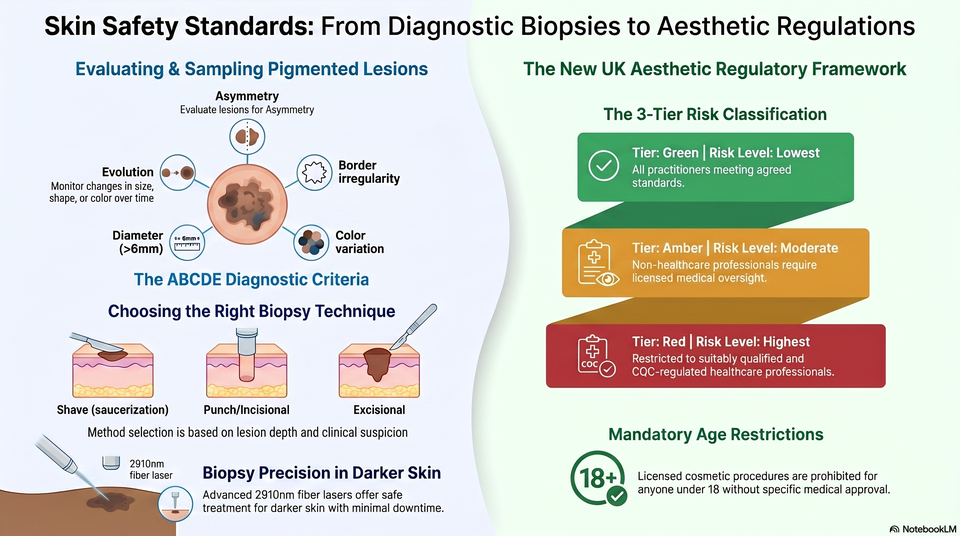
Asymmetry, irregular borders, multiple colours, enlargement or evolution over time should be assessed before any cosmetic treatment.

Bleeding, crusting or pain

A mark that bleeds, crusts, becomes sore, itchy or inflamed needs medical review rather than cosmetic laser first.

Poor healing after laser

Increasing redness, heat, swelling, pus, fever, severe pain, blisters or delayed healing after treatment should be assessed promptly.

Eye or severe swelling symptoms

Eye pain, vision change, severe facial swelling, breathing difficulty or symptoms of a severe allergic reaction need emergency help.

For urgent but non-emergency medical advice in the UK, use NHS 111. For life-threatening symptoms, call 999.

Additional clinical context

Why solar lentigines recur

Solar lentigines reflect cumulative ultraviolet exposure. Even if treatment fades existing marks, the surrounding skin remains sun-damaged and can form new pigmentation unless sun protection is consistent.

What does “deep freckle” mean?

Patients often use this phrase for any stubborn brown mark. Clinically, the important question is whether pigment is mainly epidermal, dermal, mixed, or not a simple freckle at all. That distinction changes the treatment choice.

What happens during assessment?

Your clinician may examine the mark under magnification, compare it with nearby marks, ask about change over time, take photographs, or recommend GP or dermatologist review if the diagnosis is uncertain.

When this may not be suitable

CO2 laser may not be suitable if you are recently tanned, have active infection, have a history of keloid scarring, are prone to melasma flares, cannot avoid sun exposure during healing, or have a lesion that needs diagnostic assessment first.

Next step

Thinking about laser for pigmentation?

Book a consultation so the mark can be assessed first and the right treatment can be matched to the diagnosis, depth, skin tone and downtime you can safely manage.

Educational only. This information is for general education and should not replace personalised medical advice or assessment of a changing pigmented lesion. Results vary. Not a cure.

Loading directory...
