

Why us?  Why us? please click dropdown
4.8/5 out of 3,500+ reviews
Regulated: CQC Registered | 1-5796078466
  • Verified Content: Approved by the Women’s Health Clinic Clinical Team.
  • Educational Use: This is not a substitute for professional medical advice, diagnosis, or treatment.
  • Clinical Assessment: Individual suitability is determined by a clinician; results may vary.
  • Non-NHS: Private healthcare provider only. Pricing varies by treatment and site. Availability varies by clinical location.
  • MEDICAL EMERGENCY:

    If you need urgent help, use NHS 111. For a life-threatening emergency, call 999.

 Author  Find more about the author
Dr Farzana Khan

Dr Farzana Khan

Verified

Dr Farzana Khan qualified as an MD from the University of Copenhagen in 2003. She has worked in dermatology and obstetrics & gynaecology across the North of England and completed her MRCGP (CCT, 2013) and the Diploma of the Faculty of Sexual & Reproductive Health (2013). Her clinical focus is vaginal health—including dryness/GSM, sexual function concerns, lichen sclerosus, and comfort or volume changes. She offers careful assessment, discusses medical and conservative options first, and considers selected regenerative or aesthetic treatments where appropriate. Dr Farzana also trains clinicians as a KOL/Trainer with Neauvia, Asclepion Laser, and RegenLab (since 2023). Ongoing CPD includes IMCAS, CCR, ACE and expert training in women’s intimate fillers, PRP, and polynucleotide injectables. Her approach is simple: clear explanations, realistic expectations, and shared decision-making. Authored and medically reviewed by Dr Farzana Khan.

MD MRCGP DFFP
Was this answer helpful?
Rate Dr Farzana's explanation

Assessment first
Evidence-aware
Safety focused

Women’s Health Clinic FAQ

Can the O-Shot help leaking when sneezing?

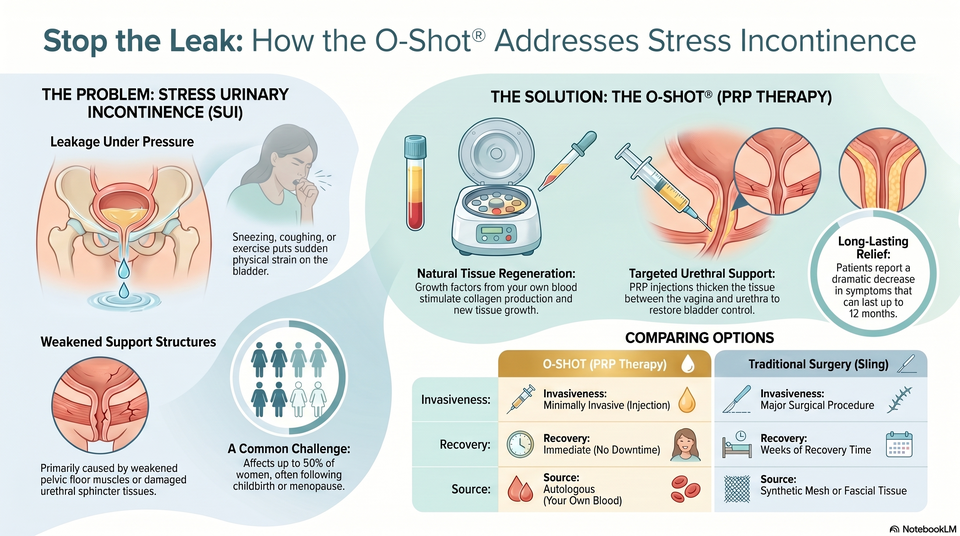
Leaking when sneezing often fits a stress urinary incontinence pattern. The O-Shot may be discussed for selected patients, usually after confirming symptom type and severity, but it should sit within a broader plan that may include pelvic-floor assessment, menopause review, bladder advice, or referral if symptoms are complex.

Direct answer

Leaking when sneezing often fits a stress urinary incontinence pattern. The O-Shot may be discussed for selected patients, usually after confirming symptom type and severity, but it should sit within a broader plan that may include pelvic-floor assessment, menopause review, bladder advice, or referral if symptoms are complex.

The most useful plan starts with the underlying cause, not the treatment name. Your clinician should review symptoms, medical history, alternatives, expected benefits, limitations and safety.

Educational only. Suitability must be confirmed after consultation. Results vary. Not a cure.

Women's Health Clinic consultation for Can the O-Shot help leaking when sneezing?
Consultation-led care

At a glance

These are the main points to understand before deciding whether this option is suitable.

At a glance

Clinical summary

Mechanism of Action

Involves extracting your own blood, concentrating the platelets, and injecting the Platelet-Rich Plasma (PRP) into the anterior vaginal.

Suitability must be confirmed after consultation.

Suitability must be confirmed after consultation.

Suitability must be confirmed after consultation.

Suitability must be confirmed after consultation.

Suitability must be confirmed after consultation.

Suitability must be confirmed after consultation.

Important safety note

Safety Profile: Because PRP is derived from your own blood (autologous), the risk of allergic reactions or rejection is reduced, although not removed.

Consultation
Suitability
Evidence
Safety
Aftercare


Detailed answer

Detailed answer

Investigational Status: Considered 'off-label' and not yet included in standard NICE or BSUG guidelines due to the need for larger randomised controlled trials. Variability in Results: High heterogeneity in outcomes due to different PRP preparation systems and individual patient healing responses.

Clinical context

Investigational Status: Considered 'off-label' and not yet included in standard NICE or BSUG guidelines due to the need for larger randomised controlled trials.

Mechanism
Evidence
Symptoms
Alternatives

What it means

Investigational Status: Considered 'off-label' and not yet included in standard NICE or BSUG guidelines due to the need for larger randomised controlled trials.

Why it happens

Symptoms may be linked to physical, hormonal, medication-related, psychological or relationship factors.

Evidence limits

Evidence may be developing, so the page should avoid promise-based language and explain uncertainty.

Treatment fit

Suitability depends on history, symptoms, examination where appropriate and discussion of alternatives.

What this means in practice

Setting: Outpatient, office-based procedure taking approximately 30 to 60 minutes. Costs should be confirmed on the /pricing/ page before booking

Initial Response (Days 3-7): Immediate change is often temporary while the healing cascade begins. Tissue Development (Week 1+): Regeneration and new blood vessel development accelerate over the following weeks.


Patient safety

Why proper assessment matters

Assessment helps separate marketing claims from safe, individualised clinical decision-making.

It checks the cause

Investigational Status: Considered 'off-label' and not yet included in standard NICE or BSUG guidelines due to the need for larger randomised controlled trials.

It protects safety

Safety Profile: Because PRP is derived from your own blood (autologous), the risk of allergic reactions or rejection is reduced, although not removed.

It reviews alternatives

Setting: Outpatient, office-based procedure taking approximately 30 to 60 minutes. Costs should be confirmed on the /pricing/ page before booking

It sets expectations

Initial Response (Days 3-7): Immediate change is often temporary while the healing cascade begins.

A clinical decision, not a shortcut

The safest final page should explain what the intervention may do, what it cannot promise, and when another route may be better.

Treatment should be discussed with realistic goals, informed consent, clear aftercare and a plan for review.


Considerations

What to consider

Setting: Outpatient, office-based procedure taking approximately 30 to 60 minutes. Costs should be confirmed on the /pricing/ page before booking

Consultation priorities

Step 1: Consultation, clinical history, and baseline symptom questionnaires to rule out underlying pathologies. Step 2: Topical numbing cream is applied 20 minutes before injections.

History
Consent
Aftercare
Follow-up

Before treatment

Step 1: Consultation, clinical history, and baseline symptom questionnaires to rule out underlying pathologies. Step 2: Topical numbing cream is applied 20 minutes before injections.

During care

The clinician should explain the procedure, likely sensations, limits and alternatives.

Aftercare

Written aftercare and follow-up should be clear before the patient leaves.

When to reassess

If expected improvement does not occur, the plan should be reviewed rather than repeated automatically.

Practical expectations

Initial Response (Days 3-7): Immediate change is often temporary while the healing cascade begins.

Costs, access and treatment plans should be confirmed before booking.


Common concerns and myths

Common misconceptions

Clear patient information should correct over-simple claims and keep expectations realistic.

Myth: Sneezing leakage is too small to mention.

Reality: suitability depends on the symptom pattern, medical history, contraindications, alternatives and individual goals.

Myth: All bladder leakage is treated the same way.

Reality: results vary, evidence may be developing, and non-response should prompt reassessment.

Myth: PRP removes the need for pelvic-floor assessment.

Reality: injections, devices and intimate procedures can still carry risks and need proper consent and aftercare.

Evidence and advertising

Marketing language should not outrun clinical evidence.

Alternatives

Setting: Outpatient, office-based procedure taking approximately 30 to 60 minutes. Costs should be confirmed on the /pricing/ page before booking


Safety checklist

Safety checklist

Use these questions to decide whether treatment should be discussed, delayed or redirected.

Has the cause been assessed?

Symptoms should be reviewed in context before selecting a treatment.

Are red flags absent?

Safety Profile: Because PRP is derived from your own blood (autologous), the risk of allergic reactions or rejection is reduced, although not removed.

Are alternatives clear?

Setting: Outpatient, office-based procedure taking approximately 30 to 60 minutes. Costs should be confirmed on the /pricing/ page before booking

Is follow-up planned?

The clinic should explain aftercare, review timing and when to seek help.

Reassuring signs

Proceeding is more reasonable when goals are clear, red flags have been checked, and expectations are realistic.

Clear goals
No red flags
Follow-up plan

Reasons to pause

Safety Profile: Because PRP is derived from your own blood (autologous), the risk of allergic reactions or rejection is reduced, although not removed.

Pain
Bleeding
Infection


When to escalate

When to seek medical help

Some symptoms should be assessed before any elective intimate treatment. Use NHS 111 online

Severe or worsening pain

Safety Profile: Because PRP is derived from your own blood (autologous), the risk of allergic reactions or rejection is reduced, although not removed.

Bleeding or discharge

Unexplained bleeding, unusual discharge or new pelvic symptoms should be reviewed.

Infection signs

Fever, spreading redness, pus or feeling unwell after a procedure needs urgent advice.

Emergency symptoms

Call 999 in a life-threatening emergency, including collapse, chest pain or breathing difficulty.

Use NHS 111 for urgent advice or call 999 in a life-threatening emergency. This page is educational and does not replace individual medical assessment.

More clinical detail

Benchmark positioning

  • The winning page is practical and discreet: it answers the exact sneeze-leak question and guides the reader into proper assessment.

Clinical reality

  • Investigational Status: Considered 'off-label' and not yet included in standard NICE or BSUG guidelines due to the need for larger randomised controlled trials.

Timeline and expectations

  • Initial Response (Days 3-7): Immediate change is often temporary while the healing cascade begins. Tissue Development (Week 1+): Regeneration and new blood vessel development accelerate over the following weeks.

Practical logistics

  • Setting: Outpatient, office-based procedure taking approximately 30 to 60 minutes. Costs should be confirmed on the /pricing/ page before booking

Research sources

  • Utama, B. I., et al. (2026). 'Therapeutic efficacy and safety of injectable platelet-rich plasma in women with stress urinary incontinence: a systematic review and meta-analysis.' Frontiers in Medicine, 13:1728478.
  • Jiang, Y. H. , et al. (2021). 'Therapeutic Efficacy of Urethral Sphincter Injections of Platelet-Rich Plasma for the Treatment of Stress Urinary Incontinence due to Intrinsic Sphincter Deficiency: A Proof-of-Concept Clinical Trial.'
  • Kochhar, N., & Tomar, A. (2026). 'A Prospective Pilot Interventional Study to Evaluate the Role of Platelet-Rich Plasma in Female Stress Urinary Incontinence.' CME Journal Geriatric Medicine, 18(5): 46-51.

Next step

Book a clinical consultation

A consultation can confirm whether this treatment may be suitable, whether another pathway should come first, and what realistic outcomes and aftercare would look like.

View Research Sources (12 Sources)
• Utama, B. I., et al. (2026). 'Therapeutic efficacy and safety of injectable platelet-rich plasma in women with stress urinary incontinence: a systematic review and meta-analysis.' Frontiers in Medicine, 13:1728478. Jiang, Y. H., et al. (2021). 'Therapeutic Efficacy of Urethral Sphincter Injections of Platelet-Rich Plasma for the Treatment of Stress Urinary Incontinence due to Intrinsic Sphincter Deficiency: A Proof-of-Concept Clinical Trial.' International Neurourology Journal, 25(1): 51-58. Kochhar, N., & Tomar, A. (2026). 'A Prospective Pilot Interventional Study to Evaluate the Role of Platelet-Rich Plasma in Female Stress Urinary Incontinence.' CME Journal Geriatric Medicine, 18(5): 46-51.
• Therapeutic efficacy and safety of injectable platelet-rich plasma in women with stress urinary incontinence: a systematic review and meta-analysis - PubMed
• HTG435 Sacrocolpopexy with hysterectomy using mesh to repair uterine prolapse: Overview final - NICE
• HTG581 Transvaginal laser therapy for stress urinary incontinence: Overview final - NICE
• Overview | Urinary incontinence and pelvic organ prolapse in ... - NICE
• Study Details | NCT07184307 | Platelet-Rich Plasma Versus Botulinum Toxin for Refractory Overactive Bladder: A randomised Trial | ClinicalTrials.gov
• Surgery and procedures for urinary incontinence - NHS
• Urethral Bulking Injection (Bulkamid) - North Tees and Hartlepool NHS Foundation Trust
• A mixed methods study to assess the feasibility of a randomised controlled trial of invasive urodynamic testing versus clinical assessment and non-invasive tests prior to surgery for stress urinary incontinence in women: the INVESTIGATE-I study - PMC
• The effects of combination therapy with electroacupuncture and pelvic floor muscle exercise on stress urinary incontinence following radical prostatectomy: the protocol for a randomised controlled trial - PMC
• 11th Emirates Urological Conference and 18th Pan Arab Continence Society Conference, 28–30 October 2022: Abstracts - PMC
• PRP Therapy for Stress Urinary Incontinence and Pelvic Organ Prolapse: A New Frontier in personalised Treatment? - PMC

These 12 source names are selected from 24 display-ready sources, with a raw audit trail of 144 imported records. Additional reviewed material included peer-reviewed clinical papers, evidence reviews, clinical trial records; duplicate, low-relevance and non-clinical records were removed before display.

Educational only. Disclaimer: The information provided in this document is for educational purposes only and does not constitute professional medical advice, diagnosis, or treatment. The O-Shot (PRP therapy) is currently an off-label, investigational procedure for stress urinary incontinence. Individual suitability must be determined by a qualified healthcare provider or urogynaecologist. Always consult your doctor before beginning any new medical treatment, and call emergency services if you experience a medical emergency. Results vary. Not a cure.

Loading directory...
