
Why us?  Why us? please click dropdown
4.8/5 out of 3,500+ reviews
Regulated: CQC Registered | 1-5796078466
  • Verified Content: Approved by the Women’s Health Clinic Clinical Team.
  • Educational Use: This is not a substitute for professional medical advice, diagnosis, or treatment.
  • Clinical Assessment: Individual suitability is determined by a clinician; results may vary.
  • Non-NHS: Private healthcare provider only. Pricing varies by treatment and site. Availability varies by clinical location.
  • MEDICAL EMERGENCY:

    If you need urgent help, use NHS 111. For a life-threatening emergency, call 999.

 Author  Find more about the author
Dr Farzana Khan

Dr Farzana Khan

Verified

Dr Farzana Khan qualified as an MD from the University of Copenhagen in 2003. She has worked in dermatology and obstetrics & gynaecology across the North of England and completed her MRCGP (CCT, 2013) and the Diploma of the Faculty of Sexual & Reproductive Health (2013). Her clinical focus is vaginal health—including dryness/GSM, sexual function concerns, lichen sclerosus, and comfort or volume changes. She offers careful assessment, discusses medical and conservative options first, and considers selected regenerative or aesthetic treatments where appropriate. Dr Farzana also trains clinicians as a KOL/Trainer with Neauvia, Asclepion Laser, and RegenLab (since 2023). Ongoing CPD includes IMCAS, CCR, ACE and expert training in women’s intimate fillers, PRP, and polynucleotide injectables. Her approach is simple: clear explanations, realistic expectations, and shared decision-making. Authored and medically reviewed by Dr Farzana Khan.

MD MRCGP DFFP
Was this answer helpful?
Rate Dr Farzana's explanation

Assessment first
Evidence-aware
Safety focused

Women’s Health Clinic FAQ

Can the O-Shot improve natural lubrication?

The O-Shot may support natural lubrication for selected patients where local tissue quality, arousal response, blood flow, and low-oestrogen change are part of the picture. It cannot promise a predictable lubrication response.

Direct answer

The O-Shot may support natural lubrication for selected patients where local tissue quality, arousal response, blood flow, and low-oestrogen change are part of the picture. It cannot promise a predictable lubrication response.

The most useful plan starts with the underlying cause, not the treatment name. Your clinician should review symptoms, medical history, alternatives, expected benefits, limitations and safety.

Educational only. Suitability must be confirmed after consultation. Results vary. Not a cure.

Women's Health Clinic consultation for Can the O-Shot improve natural lubrication?
Consultation-led care

At a glance

These are the main points to understand before deciding whether this option is suitable.

At a glance

Clinical summary

Mechanism

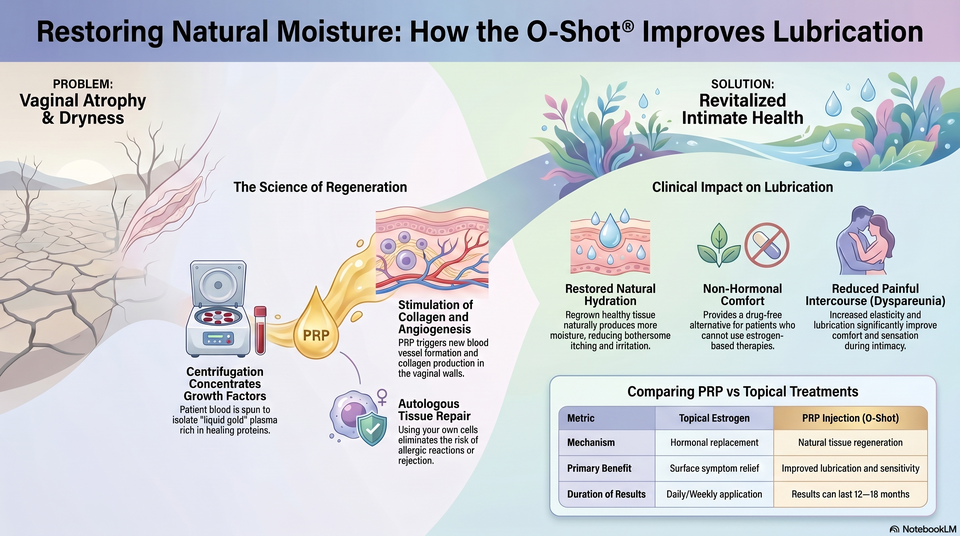
Harvests powerful growth factors (such as VEGF and PDGF) from a patient's blood to trigger tissue regeneration.

Benefits

Patients commonly report increased natural lubrication, reduced vaginal dryness, heightened sexual sensitivity, stronger orgasms, and relief from mild.

Target Audience

Ideal for women experiencing Genitourinary Syndrome of Menopause (GSM), postpartum changes, dyspareunia (painful sex), or those who prefer.

Efficacy

Systematic reviews indicate that improvements in vaginal lubrication can range from 20% to 60% from baseline.

Important safety note

Safety Profile: The procedure is considered very low-risk because it uses an autologous biologic (the patient's own blood), virtually eliminating the risk of allergic or immune reactions.

Consultation
Suitability
Evidence
Safety
Aftercare


Detailed answer

Detailed answer

Regulatory Status: The use of PRP for vaginal atrophy and sexual dysfunction is currently considered an "off-label" use of the technology and is not specifically FDA-approved for these indications.

Clinical context

Regulatory Status: The use of PRP for vaginal atrophy and sexual dysfunction is currently considered an "off-label" use of the technology and is not specifically FDA-approved for these.

Mechanism
Evidence
Symptoms
Alternatives

What it means

Regulatory Status: The use of PRP for vaginal atrophy and sexual dysfunction is currently considered an "off-label" use of the technology and is not specifically FDA-approved for these.

Why it happens

Clinical Trials: A 2026 randomised controlled trial (RCT) found a statistically significant improvement in total Female Sexual Function Index (FSFI) scores at 6 weeks and 6 months.

Evidence limits

Variable Outcomes: Some studies, such as a recent trial comparing PRP to topical oestrogen, showed reported improvements in dyspareunia (painful sex) but no statistically significant difference in dryness.

Treatment fit

Standardisation Needs: While clinical evidence is promising, the medical community emphasises the need for more large-scale RCTs to standardise PRP preparation protocols, injection depths, and dosages.

What this means in practice

Time Commitment: The entire appointment is brief, typically taking 30 to 45 minutes from door to door, with the actual injection taking only 5 to 10 minutes. Cost: As an elective, off-label procedure, it is generally not covered by health insurance.

Initial Response: Some patients report noticing an immediate increase in sensation and moisture, though heightened sensitivity and early tissue changes typically begin 3 to 7 days or 2 to 6 weeks post-treatment.


Patient safety

Why proper assessment matters

Assessment helps separate marketing claims from safe, individualised clinical decision-making.

It checks the cause

Regulatory Status: The use of PRP for vaginal atrophy and sexual dysfunction is currently considered an "off-label" use of the technology and is not specifically FDA-approved for these.

It protects safety

Safety Profile: The procedure is considered very low-risk because it uses an autologous biologic (the patient's own blood), virtually eliminating the risk of allergic or immune reactions.

It reviews alternatives

Time Commitment: The entire appointment is brief, typically taking 30 to 45 minutes from door to door, with the actual injection taking only 5 to 10 minutes.

It sets expectations

Initial Response: Some patients report noticing an immediate increase in sensation and moisture, though heightened sensitivity and early tissue changes typically begin 3 to 7 days or 2.

A clinical decision, not a shortcut

The safest final page should explain what the intervention may do, what it cannot promise, and when another route may be better.

Treatment should be discussed with realistic goals, informed consent, clear aftercare and a plan for review.


Considerations

What to consider

Time Commitment: The entire appointment is brief, typically taking 30 to 45 minutes from door to door, with the actual injection taking only 5 to 10 minutes. Cost: As an elective, off-label procedure, it is generally not covered by health insurance.

Consultation priorities

Consultation: The process begins with a thorough evaluation of the patient's medical history, sexual health goals, and symptoms to ensure candidate suitability.

History
Consent
Aftercare
Follow-up

Before treatment

Consultation: The process begins with a thorough evaluation of the patient's medical history, sexual health goals, and symptoms to ensure candidate suitability.

During care

Preparation: A topical numbing cream (often a highly concentrated BLT compound) is applied to the clitoris and vaginal wall for 15-20 minutes to ensure a painless experience.

Aftercare

The Injection: The provider uses ultra-fine needles to precisely inject the concentrated PRP. Most patients report feeling only mild pressure or a slight pinch.

When to reassess

Aftercare: Patients can resume normal daily activities immediately.

Practical expectations

Initial Response: Some patients report noticing an immediate increase in sensation and moisture, though heightened sensitivity and early tissue changes typically begin 3 to 7 days or 2.

Cost: As an elective, off-label procedure, it is generally not covered by health insurance.


Common concerns and myths

Common misconceptions

Clear patient information should correct over-simple claims and keep expectations realistic.

Myth: Lubrication is only a physical problem.

Reality: suitability depends on the symptom pattern, medical history, contraindications, alternatives and individual goals.

Myth: PRP creates the same response in every patient.

Reality: results vary, evidence may be developing, and non-response should prompt reassessment.

Myth: More lubrication automatically means every part of sex improves.

Reality: injections, devices and intimate procedures can still carry risks and need proper consent and aftercare.

Evidence and advertising

Clinical Trials: A 2026 randomised controlled trial (RCT) found a statistically significant improvement in total Female Sexual Function Index (FSFI) scores at 6 weeks and 6 months.

Alternatives

Time Commitment: The entire appointment is brief, typically taking 30 to 45 minutes from door to door, with the actual injection taking only 5 to 10 minutes.


Safety checklist

Safety checklist

Use these questions to decide whether treatment should be discussed, delayed or redirected.

Has the cause been assessed?

Symptoms should be reviewed in context before selecting a treatment.

Are red flags absent?

Safety Profile: The procedure is considered very low-risk because it uses an autologous biologic (the patient's own blood), virtually eliminating the risk of allergic or immune reactions.

Are alternatives clear?

Time Commitment: The entire appointment is brief, typically taking 30 to 45 minutes from door to door, with the actual injection taking only 5 to 10 minutes.

Is follow-up planned?

The clinic should explain aftercare, review timing and when to seek help.

Reassuring signs

Proceeding is more reasonable when goals are clear, red flags have been checked, and expectations are realistic.

Clear goals
No red flags
Follow-up plan

Reasons to pause

Safety Profile: The procedure is considered very low-risk because it uses an autologous biologic (the patient's own blood), virtually eliminating the risk of allergic or immune reactions.

Pain
Bleeding
Infection


When to escalate

When to seek medical help

Some symptoms should be assessed before any elective intimate treatment. Use NHS 111 online

Severe or worsening pain

Safety Profile: The procedure is considered very low-risk because it uses an autologous biologic (the patient's own blood), virtually eliminating the risk of allergic or immune reactions.

Bleeding or discharge

Common Side Effects: Minor, temporary effects may include brief spotting, mild swelling, redness, or a slight pinching sensation that usually resolves within 1 to 2 days.

Infection signs

Contraindications: The treatment is not suitable for women who are pregnant, have an active pelvic infection, suffer from blood-clotting or platelet disorders, or have a history of untreated.

Emergency symptoms

Call 999 in a life-threatening emergency, including collapse, chest pain or breathing difficulty.

Use NHS 111 for urgent advice or call 999 in a life-threatening emergency. This page is educational and does not replace individual medical assessment.

More clinical detail

Benchmark positioning

  • The best page owns the distinction between lubrication, arousal, dryness, and pain, giving the reader a clinically literate way to understand her symptom.

Clinical reality

  • Regulatory Status: The use of PRP for vaginal atrophy and sexual dysfunction is currently considered an "off-label" use of the technology and is not specifically FDA-approved for these indications.
  • Clinical Trials: A 2026 randomised controlled trial (RCT) found a statistically significant improvement in total Female Sexual Function Index (FSFI) scores at 6 weeks and 6 months in the PRP group, though changes.
  • Variable Outcomes: Some studies, such as a recent trial comparing PRP to topical oestrogen, showed reported improvements in dyspareunia (painful sex) but no statistically significant difference in dryness specifically.
  • Standardisation Needs: While clinical evidence is promising, the medical community emphasises the need for more large-scale RCTs to standardise PRP preparation protocols, injection depths, and dosages.

Timeline and expectations

  • Initial Response: Some patients report noticing an immediate increase in sensation and moisture, though heightened sensitivity and early tissue changes typically begin 3 to 7 days or 2 to 6 weeks post-treatment.
  • Peak Results: Because the treatment relies on cellular regeneration and new tissue development, the full, optimal effects usually manifest around the 3-month mark.
  • Duration: The rejuvenating effects are not expected to be indefinite; they generally last between 12 and 18 months, with some women experiencing benefits for up to 3 years.
  • Maintenance: To sustain optimal lubrication and sexual function, patients often repeat the procedure annually or every 18 months.

Practical logistics

  • Time Commitment: The entire appointment is brief, typically taking 30 to 45 minutes from door to door, with the actual injection taking only 5 to 10 minutes.
  • Costs should be confirmed on the /pricing/ page before booking
  • The Process: It involves a simple blood draw (10-20 mL), 10-15 minutes of centrifugation to isolate the PRP, and injection into the anaesthetised clitoris and anterior vaginal wall.

Research sources

  • Clarke et al. (2026), Obstetrics & gynaecology: "Vaginal Injection of Platelet-Rich Plasma for Sexual Function: A randomised Controlled Trial"
  • Ismail et al. (2025), Revista Iberoamericana de Psicología del Ejercicio y el Deporte: "Role of Platelet-Rich Plasma in Female Sexual Health and Recovery: A Systematic Review"
  • Atlihan et al. (2025), Frontiers in Medicine: "Comparison of topical oestrogen and platelet-rich plasma injections in the treatment of postmenopausal vaginal atrophy"
  • De Ponte et al. (2026), Journal of Sexual Medicine: "Platelet-rich plasma in the management of vulvovaginal disorders: a systematic review"

Next step

Book a clinical consultation

A consultation can confirm whether this treatment may be suitable, whether another pathway should come first, and what realistic outcomes and aftercare would look like.

View Research Sources (12 Sources)
• Clarke et al. (2026), Obstetrics & gynaecology: "Vaginal Injection of Platelet-Rich Plasma for Sexual Function: A randomised Controlled Trial"
• Ismail et al. (2025), Revista Iberoamericana de Psicología del Ejercicio y el Deporte: "Role of Platelet-Rich Plasma in Female Sexual Health and Recovery: A Systematic Review"
• Atlihan et al. (2025), Frontiers in Medicine: "Comparison of topical oestrogen and platelet-rich plasma injections in the treatment of postmenopausal vaginal atrophy"
• De Ponte et al. (2026), Journal of Sexual Medicine: "Platelet-rich plasma in the management of vulvovaginal disorders: a systematic review"
• Application of Platelet-Rich Plasma in Gynaecologic Disorders: A Scoping Review - PubMed
• Gynaecological conditions | Topic | NICE
• Menopause - Treatment - NHS
• Vaginal Injection of Platelet-Rich Plasma for Sexual Function: A randomised Controlled Trial - PubMed
• Critical Sources in gynaecology, Volume 2: RCOG Scientific Impact Paper - Routledge
• Scientific Impact Papers | RCOG
• Stem Cell Therapies in Obstetrics and Gynaecology (Scientific Impact Paper No. 38) - RCOG
• Urology & Continence Care Today - Article: Genitourinary syndrome of menopause: new consensus statement from the British Menopause Society

These 12 source names are selected from 24 display-ready sources, with a raw audit trail of 135 imported records. Additional reviewed material included professional society guidance, peer-reviewed clinical papers, evidence reviews, clinical trial records; duplicate, low-relevance and non-clinical records were removed before display.

Educational only. The information provided in this document is for educational and informational purposes only and does not constitute professional medical advice. While PRP therapy has early clinical evidence for improving natural lubrication and sexual function, the use of PRP for vaginal rejuvenation is considered an off-label procedure. Always consult with an appropriately qualified gynaecologist or urogynaecologist to properly diagnose symptoms, review potential risks, and determine the most appropriate treatment for your individual health profile. Results vary. Not a cure.

Loading directory...
