
Why us?  Why us? please click dropdown
4.8/5 out of 3,500+ reviews
Regulated: CQC Registered | 1-5796078466
  • Verified Content: Approved by the Women’s Health Clinic Clinical Team.
  • Educational Use: This is not a substitute for professional medical advice, diagnosis, or treatment.
  • Clinical Assessment: Individual suitability is determined by a clinician; results may vary.
  • Non-NHS: Private healthcare provider only. Pricing varies by treatment and site. Availability varies by clinical location.
  • MEDICAL EMERGENCY:

    If you need urgent help, use NHS 111. For a life-threatening emergency, call 999.

 Author  Find more about the author
Dr Farzana Khan

Dr Farzana Khan

Verified

Dr Farzana Khan qualified as an MD from the University of Copenhagen in 2003. She has worked in dermatology and obstetrics & gynaecology across the North of England and completed her MRCGP (CCT, 2013) and the Diploma of the Faculty of Sexual & Reproductive Health (2013). Her clinical focus is vaginal health—including dryness/GSM, sexual function concerns, lichen sclerosus, and comfort or volume changes. She offers careful assessment, discusses medical and conservative options first, and considers selected regenerative or aesthetic treatments where appropriate. Dr Farzana also trains clinicians as a KOL/Trainer with Neauvia, Asclepion Laser, and RegenLab (since 2023). Ongoing CPD includes IMCAS, CCR, ACE and expert training in women’s intimate fillers, PRP, and polynucleotide injectables. Her approach is simple: clear explanations, realistic expectations, and shared decision-making. Authored and medically reviewed by Dr Farzana Khan.

MD MRCGP DFFP
Was this answer helpful?
Rate Dr Farzana's explanation

Assessment first
Evidence-aware
Safety focused

Women’s Health Clinic FAQ

Can the O-Shot cause excessive sensitivity?

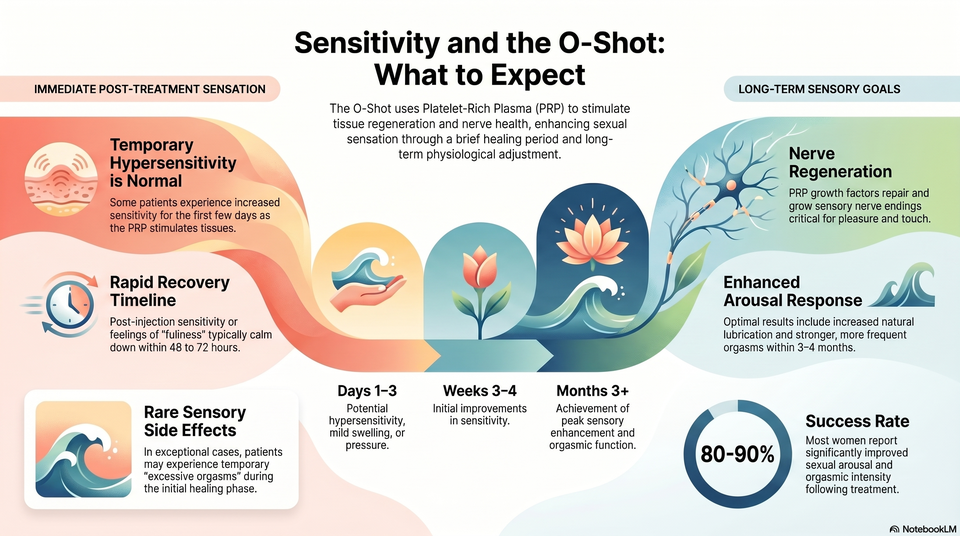
Temporary tenderness, swelling, bruising, pressure, or heightened awareness can happen after intimate injections, but persistent excessive sensitivity, pain, burning, numbness, or unwanted arousal symptoms are not outcomes to ignore.

Direct answer

Temporary tenderness, swelling, bruising, pressure, or heightened awareness can happen after intimate injections, but persistent excessive sensitivity, pain, burning, numbness, or unwanted arousal symptoms are not outcomes to ignore. The page should explain that the O-Shot is intended to support tissue quality and sensitivity in selected patients, not to create uncontrolled hypersensitivity.

The most useful plan starts with the underlying cause, not the treatment name. Your clinician should review symptoms, medical history, alternatives, expected benefits, limitations and safety.

Educational only. Suitability must be confirmed after consultation. Results vary. Not a cure.

Women's Health Clinic consultation for Can the O-Shot cause excessive sensitivity?
Consultation-led care

At a glance

These are the main points to understand before deciding whether this option is suitable.

At a glance

Clinical summary

Laser Modalities

Non-ablative Erbium:YAG (Er:YAG, 2940 nm) and microablative fractional CO2 lasers.

Biologic Modality

Autologous Platelet-Rich Plasma (PRP) injections.

Primary Outcome Metrics

Statistically significant reductions in ICIQ-UI SF scores and 1-hour pad test weights.

Target Population

Optimized for women with mild-to-moderate SUI (Stamey’s Grade 1–2).

Important safety note

Common Adverse Effects: Increased vaginal discharge (reported by 88% in laser trials), transient de novo urgency, mild pain, and pinpoint bleeding.

Consultation
Suitability
Evidence
Safety
Aftercare


Detailed answer

Detailed answer

Success is highly contingent upon baseline severity and patient characteristics. Outcome Data Density: Objective Success: In Grade 1 SUI, Kuszka (2019) reported a 91% objective cure/improvement rate at 6 months.

Clinical context

Outcome Data Density:

Mechanism
Evidence
Symptoms
Alternatives

What it means

Outcome Data Density:

Why it happens

Objective Success: In Grade 1 SUI, Kuszka (2019) reported a 91% objective cure/improvement rate at 6 months.

Evidence limits

Comparative Pad Weights: Okui (2019) demonstrated that laser therapy reduced 1-hour pad test weights from 34g to 2g, which is comparable to mid-urethral slings (TVT/TOT), which reduced weights.

Treatment fit

PRP Specificity: Tahoon (2021) found that while SUI symptoms improved, sexual function (FSFI scores) showed no significant change (p=0.25).

What this means in practice

Procedure Setting: Outpatient clinical environment. No general anesthesia is required, though topical lidocaine (spray or cream) is standard. Laser Equipment: Specialized probes such as the XS Dynamis (Er:YAG) or MonaLisa Touch (CO2). PRP Processing: Standard Preparation: Centrifugation (e. g.

Laser Regimen: Typically 3 to 5 sessions spaced 4 to 6 weeks apart. PRP Regimen: A single-session outpatient procedure involving the centrifugation of 15cc of peripheral blood to yield approximately 4cc of PRP for immediate paraurethral injection.


Patient safety

Why proper assessment matters

Assessment helps separate marketing claims from safe, individualised clinical decision-making.

It checks the cause

Outcome Data Density:

It protects safety

Common Adverse Effects: Increased vaginal discharge (reported by 88% in laser trials), transient de novo urgency, mild pain, and pinpoint bleeding.

It reviews alternatives

Procedure Setting: Outpatient clinical environment. No general anesthesia is required, though topical lidocaine (spray or cream) is standard.

It sets expectations

Laser Regimen: Typically 3 to 5 sessions spaced 4 to 6 weeks apart.

A clinical decision, not a shortcut

The safest final page should explain what the intervention may do, what it cannot promise, and when another route may be better.

Treatment should be discussed with realistic goals, informed consent, clear aftercare and a plan for review.


Considerations

What to consider

Procedure Setting: Outpatient clinical environment. No general anesthesia is required, though topical lidocaine (spray or cream) is standard. Laser Equipment: Specialized probes such as the XS Dynamis (Er:YAG) or MonaLisa Touch (CO2). PRP Processing: Standard Preparation: Centrifugation (e. g.

Consultation priorities

Screening: Patients require a normal PAP smear, negative urine culture, and baseline ICIQ-UI SF and/or urodynamics.

History
Consent
Aftercare
Follow-up

Before treatment

Screening: Patients require a normal PAP smear, negative urine culture, and baseline ICIQ-UI SF and/or urodynamics.

During care

Intra-procedure:

Aftercare

Laser: Involves circular irradiation of the vaginal canal followed by targeted treatment of the urethrovesical junction, anterior vaginal wall, and introitus.

When to reassess

PRP: Injections are administered at a 10mm depth into the paraurethral area, specifically targeting the region near the external urethral sphincter (typically three points on each side).

Practical expectations

Laser Regimen: Typically 3 to 5 sessions spaced 4 to 6 weeks apart.

Laser Equipment: Specialized probes such as the XS Dynamis (Er:YAG) or MonaLisa Touch (CO2).


Common concerns and myths

Common misconceptions

Clear patient information should correct over-simple claims and keep expectations realistic.

Myth: More sensitivity is always better.

Reality: suitability depends on the symptom pattern, medical history, contraindications, alternatives and individual goals.

Myth: Because PRP uses my own blood, it cannot cause uncomfortable.

Reality: results vary, evidence may be developing, and non-response should prompt reassessment.

Myth: Excessive sensitivity means the treatment has worked too well.

Reality: injections, devices and intimate procedures can still carry risks and need proper consent and aftercare.

Evidence and advertising

Objective Success: In Grade 1 SUI, Kuszka (2019) reported a 91% objective cure/improvement rate at 6 months.

Alternatives

Procedure Setting: Outpatient clinical environment. No general anesthesia is required, though topical lidocaine (spray or cream) is standard.


Safety checklist

Safety checklist

Use these questions to decide whether treatment should be discussed, delayed or redirected.

Has the cause been assessed?

Symptoms should be reviewed in context before selecting a treatment.

Are red flags absent?

Common Adverse Effects: Increased vaginal discharge (reported by 88% in laser trials), transient de novo urgency, mild pain, and pinpoint bleeding.

Are alternatives clear?

Procedure Setting: Outpatient clinical environment. No general anesthesia is required, though topical lidocaine (spray or cream) is standard.

Is follow-up planned?

The clinic should explain aftercare, review timing and when to seek help.

Reassuring signs

Proceeding is more reasonable when goals are clear, red flags have been checked, and expectations are realistic.

Clear goals
No red flags
Follow-up plan

Reasons to pause

Common Adverse Effects: Increased vaginal discharge (reported by 88% in laser trials), transient de novo urgency, mild pain, and pinpoint bleeding.

Pain
Bleeding
Infection


When to escalate

When to seek medical help

Some symptoms should be assessed before any elective intimate treatment. Use NHS 111 online

Severe or worsening pain

Common Adverse Effects: Increased vaginal discharge (reported by 88% in laser trials), transient de novo urgency, mild pain, and pinpoint bleeding.

Bleeding or discharge

Urogynaecological Red Flags: Rare but documented risks include vesicovaginal fistula, transverse vaginal septum, and vaginal shortening. Chronic pain, burning, and dyspareunia are reported in the FDA MAUDE database.

Infection signs

Surgical Interference: A critical concern is laser-induced vaginal mucosa scarring. Al-Badr (2019) reported that post-laser tissue becomes thin, friable, and rigid, losing its natural rugae.

Emergency symptoms

Call 999 in a life-threatening emergency, including collapse, chest pain or breathing difficulty.

Use NHS 111 for urgent advice or call 999 in a life-threatening emergency. This page is educational and does not replace individual medical assessment.

More clinical detail

Benchmark positioning

  • WHC can win by owning the safety question competitors avoid: the goal is comfortable, wanted sexual sensation, not uncontrolled hypersensitivity.

Clinical reality

  • Outcome Data Density:
  • Objective Success: In Grade 1 SUI, Kuszka (2019) reported a 91% objective cure/improvement rate at 6 months.
  • Comparative Pad Weights: Okui (2019) demonstrated that laser therapy reduced 1-hour pad test weights from 34g to 2g, which is comparable to mid-urethral slings (TVT/TOT), which reduced weights from ~38g to 3–4g.
  • PRP Specificity: Tahoon (2021) found that while SUI symptoms improved, sexual function (FSFI scores) showed no significant change (p=0.25).
  • Urodynamic Shifts: Following PRP, significant increases were noted in residual urine (RU) (9.7ml to 46.7ml; p=0.028) and volume at first sensation to void (FS) (135.8ml to 163.8ml; p=0.001).
  • Success Predictors:

Timeline and expectations

  • Laser Regimen: Typically 3 to 5 sessions spaced 4 to 6 weeks apart.
  • PRP Regimen: A single-session outpatient procedure involving the centrifugation of 15cc of peripheral blood to yield approximately 4cc of PRP for immediate paraurethral injection.
  • Result Durability:
  • Short-term: Significant improvements are typically realized between 1 and 3 months. For example, Gambacciani (2018) noted ICIQ-SF scores dropping from a baseline of 12.2 to 4.8 at 1 month post-treatment.
  • Long-term: Laser efficacy often wanes over time. Scores may return toward baseline at 18–24 months (e.g., Gambacciani reported a return to 9.9 by 24 months, losing statistical significance).
  • PRP: Current data (Tahoon, 2021) demonstrates efficacy up to 3 months; longer-term data is pending.

Practical logistics

  • Procedure Setting: Outpatient clinical environment. No general anesthesia is required, though topical lidocaine (spray or cream) is standard.
  • Laser Equipment: Specialized probes such as the XS Dynamis (Er:YAG) or MonaLisa Touch (CO2).
  • PRP Processing:
  • Standard Preparation: Centrifugation (e.g., Golden VAC at 3000 RPM for 10 minutes) creates a three-layer separation (RBCs, PRP/Leukocytes, and PPP).
  • Protocol Variability: Parameters vary by manufacturer. Systems like Cascade, Plateltex, and SmartPrep 2 require a double-spin protocol. Consultants must adhere to specific G-force vs. RPM instructions provided by the kit manufacturer.

Research sources

  • Blaganje M, et al. (2018) Non-ablative Er:YAG laser therapy effect on stress urinary incontinence: A randomized controlled trial.
  • Wang Y, et al. (2021) Safety and efficacy of vaginal laser therapy for stress urinary incontinence: a meta-analysis.
  • Tahoon AS, et al. (2021) The Role of Platelet Rich Plasma Injections in Cases of Stress Incontinence.
  • Gambacciani M, et al. (2020) Safety of vaginal erbium laser: A review of 113,000 patients treated in the past 8 years.

Next step

Book a clinical consultation

A consultation can confirm whether this treatment may be suitable, whether another pathway should come first, and what realistic outcomes and aftercare would look like.

View Full Research Bibliography (10 Sources)
• ABSTRACTS - AMWC
• Application of clitoris exposure + episioplasty + dermabrasion + platelet-rich plasma injection + chemexfoliation in vulvar lichen sclerosus - Semantic Scholar
• Can platelet-rich plasma (PRP) support sensitivity or orgasms in selected patients?
• HTG435 Sacrocolpopexy with hysterectomy using mesh to repair uterine prolapse: Overview final - NICE
• HTG581 Transvaginal laser therapy for stress urinary incontinence: Overview final - NICE
• AFBEAA22-359B-4D34-86E2-AD000C2BDA0A
• Menopause - Current Awareness Bulletin - Royal United Hospitals Bath
• Patient Information Leaflet - Platelet Rich Plasma - ACE Group
• 3747bda0-e12f-412a-95f6-f8daf2f87eea
• Value of Injection of Plasma-Rich Platelets in the vaginal and the clitoris in cases with female sexual dysfunction - Ginekologia i Poloznictwo

Educational only. These procedures are supported by limited clinical evidence. Long-term safety and efficacy profiles are not yet established, particularly regarding the durability of results beyond 24 months. Traditional conservative management (pelvic floor muscle training) and validated surgical interventions (mid-urethral slings) remain the gold standard. Clinicians should only offer these therapies within the context of robust clinical trials or after comprehensive counseling regarding their experimental status. Results vary. Not a cure.

Loading directory...
