
...
 Why us?  Why us? please click dropdown
4.8/5 out of 3,500+ reviews
Regulated: CQC Registered | 1-5796078466
  • Verified Content: Approved by the Women’s Health Clinic Clinical Team.
  • Educational Use: This is not a substitute for professional medical advice, diagnosis, or treatment.
  • Clinical Assessment: Individual suitability is determined by a clinician; results may vary.
  • Non-NHS: Private healthcare provider only. Pricing varies by treatment and site. Availability varies by clinical location.
  • MEDICAL EMERGENCY:

    If you need urgent help, use NHS 111. For a life-threatening emergency, call 999.

 Author  Find more about the author
Dr Farzana Khan

Dr Farzana Khan

Verified

Dr Farzana Khan qualified as an MD from the University of Copenhagen in 2003. She has worked in dermatology and obstetrics & gynaecology across the North of England and completed her MRCGP (CCT, 2013) and the Diploma of the Faculty of Sexual & Reproductive Health (2013). Her clinical focus is vaginal health—including dryness/GSM, sexual function concerns, lichen sclerosus, and comfort or volume changes. She offers careful assessment, discusses medical and conservative options first, and considers selected regenerative or aesthetic treatments where appropriate. Dr Farzana also trains clinicians as a KOL/Trainer with Neauvia, Asclepion Laser, and RegenLab (since 2023). Ongoing CPD includes IMCAS, CCR, ACE and expert training in women’s intimate fillers, PRP, and polynucleotide injectables. Her approach is simple: clear explanations, realistic expectations, and shared decision-making. Authored and medically reviewed by Dr Farzana Khan.

MD MRCGP DFFP
Was this answer helpful?
Rate Dr Farzana's explanation

Assessment first
Evidence-aware
Safety focused

Women’s Health Clinic FAQ

How many intimate exosome sessions are needed?

Intimate exosome treatment is still an emerging area. The key clinical issue is not just the word exosomes, but the product source, the delivery route and the symptom being treated.

Direct answer

There is no universally established number of intimate exosome sessions. Promotional protocols often describe a short course, especially when exosomes are used after laser, RF or microneedling, but session planning should be based on assessment, treatment route, product source and the reason symptoms are present. Avoid any clinic that sells a resolved package before checking red flags such as cancer history, infection, unexplained bleeding or pelvic pain.

The safest plan starts by clarifying the symptom, checking red flags, explaining alternatives and agreeing realistic expectations before any procedure is booked.

Educational only. Suitability must be confirmed after consultation and assessment. Results vary. Not a cure.

Women's Health Clinic consultation about How many intimate exosome sessions are needed?
Consultation-led care

At a glance

These are the main points to understand before deciding whether this option is suitable.

Exosomes at a glance

Emerging and regulated carefully

What they are

Exosomes are extracellular vesicles (30 to 150 nanometers) released by cells that carry proteins, lipids, and genetic material (mRNA/miRNA) to.

Mechanism

They do not replace cells, but rather instruct recipient cells to activate repair mechanisms, potentially stimulating angiogenesis, modulating inflammation, and.

Regulatory Status

Exosome products are regulated as biological medicinal products; currently, zero exosome products are FDA-approved or MHRA-licensed for conditions like alopecia.

Key point 4

Suitability must be confirmed after consultation and assessment.

Important safety note

Mild Reactions: Common, transient side effects include localised redness, mild swelling, itching, or minor discomfort resolving within 24 to 48 hours.

Product route
Source
Evidence
Red flags
Aftercare


Detailed answer

Why exosome safety depends on route and source

Exosomes are cell-signalling vesicles. In intimate health, the important clinical distinction is whether a product is topical or injected, what it is derived from, and what claim is being made.

Product transparency matters

A responsible consultation should explain product source, sterility, regulation, delivery route, evidence limits and alternatives before discussing possible tissue-quality benefits.

Mechanism
Evidence
Symptoms
Alternatives

What it means

Evidence Base: The clinical evidence for intimate-health outcomes is considered early and emerging; there are no large-scale, long-term randomised controlled trials proving promised efficacy.

Why it happens

Multifactorial Conditions: Claims that exosomes can single-handedly 'cure' FSAD or ED are misleading. Intimate health issues are multifactorial, involving nerves, hormones, blood flow, and psychological factors.

Evidence limits

Erectile Dysfunction: Some pilot studies and retrospective analyses combining mesenchymal stem cells (MSCs) and shockwave therapy report improvements in SHIM (Sexual Health Inventory for Men) and IIEF scores, but these.

Treatment fit

UK Compliance: UK clinics operating legally must use compliant, non-human (e.g., plant or animal-derived) exosomes applied topically, often assisted by microneedling, as injecting human-derived exosomes is prohibited.

What this means in practice

Legally compliant care should explain the exact product, avoid injectable human-derived offers and make the delivery route clear before any session plan is discussed.

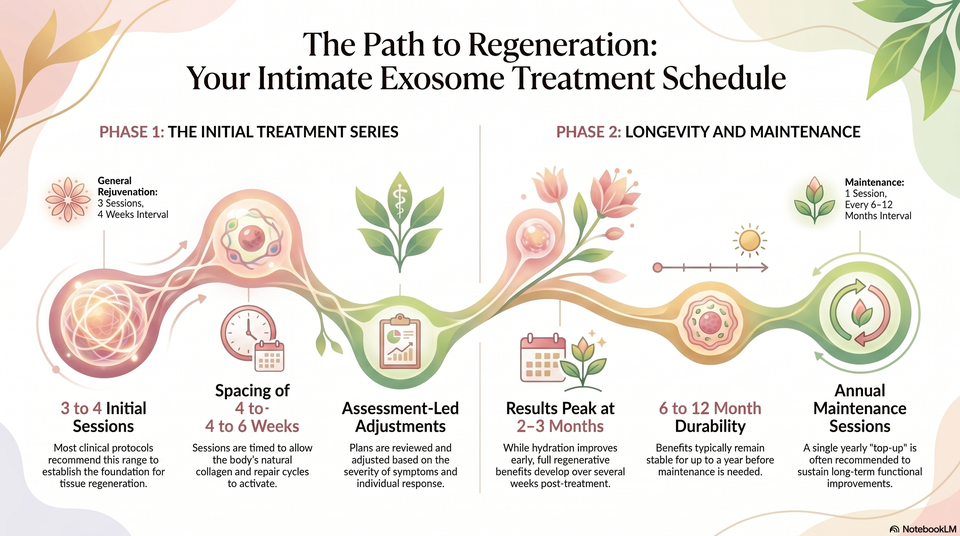
Session Quantity: A typical regenerative protocol involves a series of 3 to 6 sessions.


Patient safety

Why cautious assessment matters

Regenerative language can sound reassuring, but intimate symptoms still need diagnosis and exosome products should not be treated as a universal solution.

It checks the cause

Evidence Base: The clinical evidence for intimate-health outcomes is considered early and emerging; there are no large-scale, long-term randomised controlled trials proving promised efficacy.

It protects safety

Mild Reactions: Common, transient side effects include localised redness, mild swelling, itching, or minor discomfort resolving within 24 to 48 hours.

It reviews alternatives

Alternatives such as moisturisers, local hormonal care, pelvic-floor input or specialist review may be more appropriate depending on the diagnosis.

It sets expectations

Session Quantity: A typical regenerative protocol involves a series of 3 to 6 sessions.

Do not let marketing outrun safety

Claims about rejuvenation, sensitivity, lubrication or recovery should be checked against product route, regulatory status and the reason symptoms are present.

Cancer history, immunosuppression, active infection, unexplained bleeding, severe pain or vulval lesions should redirect the discussion to medical assessment first.


Considerations

What to consider

Before agreeing to sessions, clarify the symptom, diagnosis, product source, delivery route, expected recovery and when treatment should be delayed.

Consultation priorities

The consultation should identify the symptom pattern, medical history, product route and any reason to delay treatment before discussing session numbers.

History
Consent
Aftercare
Follow-up

Before treatment

Before treatment, check for infection, unexplained bleeding, pelvic pain, cancer history and whether established care should come first.

During care

Procedure: A topical numbing cream is applied. The exosomes are then delivered (lawfully via topical application with microneedling in many jurisdictions) to target tissues.

Aftercare

Aftercare: Patients are generally advised to keep the area clean, avoid strenuous exercise, intense heat (saunas), and sexual intercourse for 24 to 48 hours post-procedure.

When to reassess

If the expected response does not occur, reassessment is safer than automatic repeat treatment.

Practical expectations

Session Quantity: A typical regenerative protocol involves a series of 3 to 6 sessions.

US Compliance: In the US, lawful therapeutic administration of exosomes requires an active Investigational New Drug (IND) application as part of a registered clinical trial.


Common concerns and myths

Common misconceptions

Clear patient information should correct over-simple claims and keep expectations realistic.

Myth: exosomes are automatically safe

Reality: safety depends on product source, sterility, route, regulation, symptom cause and medical history.

Myth: natural signalling means no risk

Reality: biological signalling products still need scrutiny and should not be used to bypass diagnosis.

Myth: one procedure suits every symptom

Reality: dryness, pain, arousal changes, infection and cancer history require different clinical pathways.

Evidence and limits

Mechanism-of-action language should not be treated as proof of a predictable clinical result.

Alternatives still matter

Moisturisers, local hormonal care, pelvic-floor physiotherapy, infection treatment or specialist review may be more appropriate for some patients.


Safety checklist

Safety checklist

Use these questions to decide whether treatment should be discussed, delayed or redirected.

Has the cause been assessed?

Symptoms should be reviewed in context before selecting a treatment.

Are red flags absent?

Do not claim intimate exosomes are a cure, promised rejuvenation method, cancer-safe treatment, infection-prevention treatment, sexual-function treatment or proven replacement for recognised care. Distinguish topical/adjunct application from injection.

Are alternatives clear?

Ask what established or conservative options apply before committing to a resolved exosome package.

Is follow-up planned?

The clinic should explain aftercare, review timing and when to seek help.

Reassuring signs

Proceeding is more reasonable when goals are clear, red flags have been checked, and expectations are realistic.

Clear goals
No red flags
Follow-up plan

Reasons to pause

Pause for unclear product source, injectable or human-derived exosome offers, cancer history without clearance, active infection, unexplained bleeding or severe pelvic pain.

Pain
Bleeding
Infection


When to escalate

When to seek medical help

Some symptoms should be assessed before any elective intimate treatment. Use NHS 111 online

Severe or worsening pain

Severe burning, escalating pelvic pain or pain that feels out of proportion needs prompt clinical review.

Bleeding, lesions or discharge

Unexplained bleeding, vulval lesions, unusual discharge or suspected infection should be assessed before elective intimate treatment.

Infection signs

Severe Risks: The FDA has documented severe adverse events—including hospitalization for systemic infections and potential tumor formation—linked to unapproved human-derived exosome and stem cell products.

Emergency symptoms

Call 999 in a life-threatening emergency, including collapse, chest pain or breathing difficulty.

Use NHS 111 for urgent advice or call 999 in a life-threatening emergency. This page is educational and does not replace individual medical assessment.

Next step

Book a clinical consultation

A consultation can confirm whether this treatment may be suitable, whether another pathway should come first, and what realistic outcomes, risks and aftercare would look like.

View Research Sources (12 Sources)
• FDA Public Safety Alert (2019): Details serious adverse events and confirms that there are currently no FDA-approved exosome products for therapeutic use. Save Face: Exosome Therapy in the UK: A Patient Safety Warning on the New Injectables, outlining the regulatory prohibition of injecting human-derived exosomes for cosmetic and aesthetic purposes in the UK and EU. Frontiers in Reproductive Health (2025): Enhancing penile function: the impact of a regenerative multimodal protocol on erectile dysfunction, evaluating the use of UC-MSCs alongside shockwave therapy for ED. The Tweakments Guide / Consulting Room: Industry reports outlining the compliance challenges and legal boundaries of using exosome cosmetics worldwide.
• Clinical Advances in Exosome-Based Therapies for Aesthetic Medicine: A Systematic Review and Meta-analysis of Human Clinical Trials - PubMed
• Detection of Extracellular Vesicles in the Mouse Vaginal Fluid: Their Delivery of Sperm Proteins that stimulate Capacitation and modulate Fertility - PMC
• Exosomal therapy—a new frontier in regenerative medicine - PMC - NIH
• Navigating the Global Regulatory Landscape for Exosome-Based Therapeutics: Challenges, Strategies, and Future Directions - PMC
• The global regulatory landscape of stem cell medical aesthetics: challenges, comparisons, and pathways to coordination - PMC
• The urgent need for clear and concise regulations on exosome-based interventions - PMC
• Dental Stem Cells in Regenerative Dentistry: A Narrative Review of Therapeutic Strategies and Biomaterials - The Journal of Contemporary Clinical Practice
• Enhancing penile function: the impact of a regenerative multimodal protocol on erectile dysfunction - Frontiers
• 111 Skin Ltd - ASA | CAP
• A real step towards regulation - The Tweakments Guide
• Are UK Clinics Using Illegal Human-Derived Exosomes? - Consulting Room

These 12 source names are selected from 24 display-ready sources, with a raw audit trail of 71 imported records. Additional reviewed material included clinical papers, guidance documents and patient-facing medical resources; duplicate, low-relevance and non-clinical records were removed before display.

Educational only. This information is for education only and is not a substitute for professional medical advice, diagnosis or treatment. Results vary. Not a cure.

Loading directory...