
...
 Why us?  Why us? please click dropdown
4.8/5 out of 3,500+ reviews
Regulated: CQC Registered | 1-5796078466
  • Verified Content: Approved by the Women’s Health Clinic Clinical Team.
  • Educational Use: This is not a substitute for professional medical advice, diagnosis, or treatment.
  • Clinical Assessment: Individual suitability is determined by a clinician; results may vary.
  • Non-NHS: Private healthcare provider only. Pricing varies by treatment and site. Availability varies by clinical location.
  • MEDICAL EMERGENCY:

    If you need urgent help, use NHS 111. For a life-threatening emergency, call 999.

 Author  Find more about the author
Dr Farzana Khan

Dr Farzana Khan

Verified

Dr Farzana Khan qualified as an MD from the University of Copenhagen in 2003. She has worked in dermatology and obstetrics & gynaecology across the North of England and completed her MRCGP (CCT, 2013) and the Diploma of the Faculty of Sexual & Reproductive Health (2013). Her clinical focus is vaginal health—including dryness/GSM, sexual function concerns, lichen sclerosus, and comfort or volume changes. She offers careful assessment, discusses medical and conservative options first, and considers selected regenerative or aesthetic treatments where appropriate. Dr Farzana also trains clinicians as a KOL/Trainer with Neauvia, Asclepion Laser, and RegenLab (since 2023). Ongoing CPD includes IMCAS, CCR, ACE and expert training in women’s intimate fillers, PRP, and polynucleotide injectables. Her approach is simple: clear explanations, realistic expectations, and shared decision-making. Authored and medically reviewed by Dr Farzana Khan.

MD MRCGP DFFP
Was this answer helpful?
Rate Dr Farzana's explanation

Assessment first
Evidence-aware
Safety focused

Women’s Health Clinic FAQ

Polynucleotides vs Hyaluronic Acid Fillers

Intimate polynucleotides are non-hormonal biostimulatory treatments used in some clinics for vulvovaginal tissue quality. The key decision is whether the symptom has been properly assessed first.

Direct answer

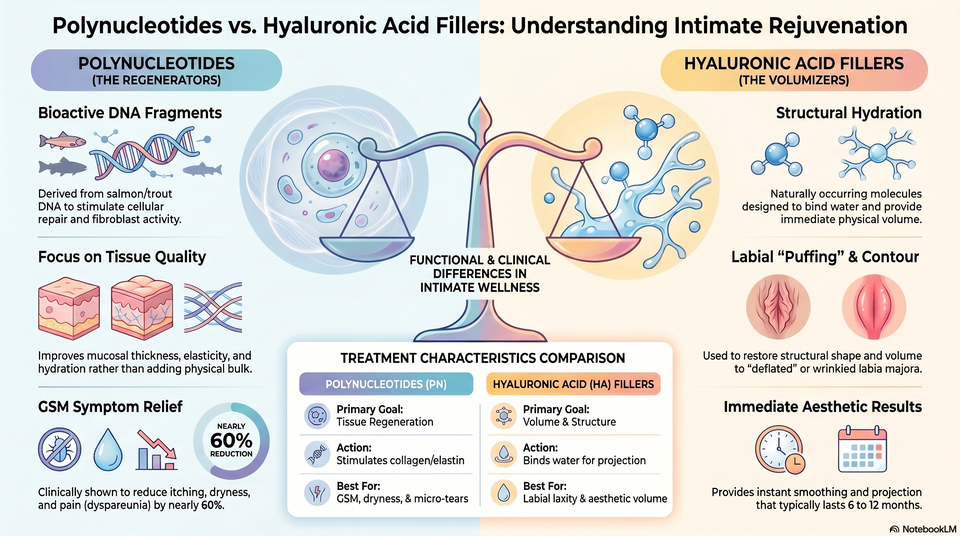
Polynucleotides and hyaluronic acid fillers or skin boosters work differently. Hyaluronic acid mainly attracts and holds water; cross-linked fillers can add volume. Polynucleotides are biostimulatory DNA fragments intended to support gradual tissue repair, fibroblast activity and extracellular-matrix quality. In intimate health, the choice should depend on the symptom, tissue findings, product type and safety profile, not on a generic rejuvenation promise.

The safest plan starts by clarifying the symptom, checking red flags, explaining alternatives and agreeing realistic expectations before any procedure is booked.

Educational only. Suitability must be confirmed after consultation and assessment. Results vary. Not a cure.

Women's Health Clinic consultation about Polynucleotides vs Hyaluronic Acid Fillers
Consultation-led care

At a glance

These are the main points to understand before deciding whether this option is suitable.

Polynucleotides at a glance

Non-hormonal biostimulation

Polynucleotides (PNs)

Bioactive molecules derived from highly purified fish DNA (salmon or trout) that act as biostimulators to upregulate collagen and.

Hyaluronic Acid (HA) Boosters

Non-crosslinked HA formulations primarily intended to attract and bind water within the superficial mucosa for enhanced hydration .

Combination Therapies (e.g., NewGyn)

specialised products that combine PNs, HA, and mannitol (an antioxidant that protects HA from rapid degradation) to maximize both.

Standard Fillers

Crosslinked HA gels used strictly for aesthetic contouring and volume replacement in the labia .

Important safety note

Common Side Effects: Transient localised swelling, pinpoint bruising, spotting, and mild tenderness at the injection sites, which typically resolve within 24 to 72 hours .

Diagnosis
Allergy
Technique
Timeline
Aftercare


Detailed answer

How polynucleotides fit into intimate care

Polynucleotides are best explained as biostimulatory DNA fragments rather than fillers. The clinical question is whether they match the diagnosis, tissue findings and safety profile.

Not a standard filler

The aim is gradual tissue-quality support through repair signalling, hydration and extracellular-matrix activity, not instant volume or a promised sexual-function outcome.

Mechanism
Evidence
Symptoms
Alternatives

What it means

Foundational Care: Injectables are considered an adjunct therapy. The clinical gold standard and first-line treatment for GSM and vaginal atrophy remains non-hormonal moisturisers/lubricants and low-dose local vaginal oestrogen .

Why it happens

Medical Organization Stance: The American College of Obstetricians and gynaecologists (ACOG) cautions that many cosmetic vaginal procedures are "not medically indicated" and highlights a lack of robust, long-term data supporting.

Evidence limits

Regulatory Oversight: In the UK, dermal fillers and skin boosters are classified as Class III medical devices. Ensuring that a product is properly UKCA/CE-marked for intended vulvovaginal use is essential.

Treatment fit

Pre-Procedure: Patients are advised to stop Aspirin, NSAIDs, and supplements that increase bleeding risk (e.g., Vitamin E, fish oil) up to 1 week prior . A topical anaesthetic cream is.

What this means in practice

Medication and supplement planning should be individualised, especially if bruising or bleeding risk is higher.

Procedure Duration: Treatments are performed in an outpatient clinic and typically take 10 to 30 minutes .


Patient safety

Why diagnosis comes first

Dryness, soreness, tearing or painful sex may reflect GSM, infection, dermatoses, pelvic-floor guarding or medication effects, so the treatment choice depends on assessment.

It checks the cause

Foundational Care: Injectables are considered an adjunct therapy. The clinical gold standard and first-line treatment for GSM and vaginal atrophy remains non-hormonal moisturisers/lubricants and.

It protects safety

Common Side Effects: Transient localised swelling, pinpoint bruising, spotting, and mild tenderness at the injection sites, which typically resolve within 24 to 72 hours.

It reviews alternatives

The comparison should include alternatives such as moisturisers, local hormonal care, pelvic-floor therapy or specialist review.

It sets expectations

Procedure Duration: Treatments are performed in an outpatient clinic and typically take 10 to 30 minutes .

Non-hormonal does not mean automatic

A hormone-free treatment may still be unsuitable if there is active infection, unexplained bleeding, pregnancy, recent surgery, severe fish allergy or unclear pelvic pain.

The consultation should cover product source, allergy risk, alternatives such as moisturisers or local hormonal care, and realistic timelines for tissue response.


Considerations

What to consider

The decision should start with the symptom and tissue findings, then compare hydration, biostimulation, volume effect, safety and aftercare.

Consultation priorities

Initial Consultation: A thorough medical evaluation by a qualified practitioner to assess GSM symptoms, review medical history, confirm suitability, and manage realistic expectations .

History
Consent
Aftercare
Follow-up

Before treatment

Initial Consultation: A thorough medical evaluation by a qualified practitioner to assess GSM symptoms, review medical history, confirm suitability, and manage realistic expectations .

During care

Treatment Session: After local numbing, the practitioner uses fine needles (e.g., 30G) to deliver the product. Skin boosters/PNs are injected superficially (micro-wheal or linear retrograde technique) into the.

Aftercare

Follow-Up and Maintenance: Patients generally return to normal daily activities immediately. A clinical review is typically scheduled at 6 to 12 weeks to evaluate symptom improvement, with maintenance.

When to reassess

If the expected response does not occur, reassessment is safer than automatic repeat treatment.

Practical expectations

Procedure Duration: Treatments are performed in an outpatient clinic and typically take 10 to 30 minutes .

Post-Procedure Care: Patients should avoid sexual intercourse, intense physical activity, tight clothing, and hot baths/saunas for 48 to 72 hours to prevent friction and infection .


Common concerns and myths

Common misconceptions

Clear patient information should correct over-simple claims and keep expectations realistic.

Myth: polynucleotides are fillers

Reality: they are biostimulatory DNA fragments, usually used for gradual tissue-quality support rather than volume.

Myth: hormone-free means suitable for everyone

Reality: allergy, infection, bleeding, pregnancy, recent surgery and unexplained pain can still make treatment unsuitable.

Myth: hydration means instant repair

Reality: hydration may be noticed earlier, but collagen and tissue-quality changes are gradual and variable.

Evidence and limits

Mechanism-of-action language should not be treated as proof of a predictable clinical result.

Alternatives still matter

Moisturisers, local hormonal care, pelvic-floor physiotherapy, infection treatment or specialist review may be more appropriate for some patients.


Safety checklist

Safety checklist

Use these questions to decide whether treatment should be discussed, delayed or redirected.

Has the cause been assessed?

Symptoms should be reviewed in context before selecting a treatment.

Are red flags absent?

Do not claim intimate polynucleotides cure dryness, laxity, sexual dysfunction, pelvic symptoms, scarring or menopause-related tissue change. Explain that PN products are often fish/marine-derived and allergy history matters.

Are alternatives clear?

Ask whether a hydrating product, a biostimulatory product or no injectable treatment is the safest option for the concern.

Is follow-up planned?

The clinic should explain aftercare, review timing and when to seek help.

Reassuring signs

Proceeding is more reasonable when goals are clear, red flags have been checked, and expectations are realistic.

Clear goals
No red flags
Follow-up plan

Reasons to pause

Pause treatment for active infection, unexplained bleeding, severe fish allergy, pregnancy, recent pelvic surgery or severe pain that has not been assessed.

Pain
Bleeding
Infection


When to escalate

When to seek medical help

Some symptoms should be assessed before any elective intimate treatment. Use NHS 111 online

Allergy symptoms

Swelling of the lips or tongue, breathing difficulty, widespread hives, faintness or collapse after exposure needs urgent medical help.

Bleeding or infection

New post-menopausal bleeding, unusual discharge, fever, pelvic pain, thrush, BV or UTI symptoms should be assessed before injectable treatment.

Infection signs

Filler-Specific Risks: Deep crosslinked fillers carry risks of granuloma or nodule formation, contour irregularities, and rare but severe arterial occlusion .

Emergency symptoms

Call 999 in a life-threatening emergency, including collapse, chest pain or breathing difficulty.

Use NHS 111 for urgent advice or call 999 in a life-threatening emergency. This page is educational and does not replace individual medical assessment.

Next step

Book a clinical consultation

A consultation can confirm whether this treatment may be suitable, whether another pathway should come first, and what realistic outcomes, risks and aftercare would look like.

View Research Sources (12 Sources)
• Palmieri IP, Raichi M. "Biorevitalization of postmenopausal labia majora, the polynucleotide/hyaluronic acid option." Obstet Gynecol Rep, 2019. (Details the 90-day clinical protocol and symptom reduction metrics) . ACOG Committee Opinion No. 378: "Vaginal 'Rejuvenation' and Cosmetic Vaginal Procedures." (Highlights the lack of medically indicated evidence and potential complications) . Khan, F. "Are vulvo-vaginal skin boosters different from fillers for dryness?" The Women's Health Clinic*. (Differentiates between superficial hydration boosters and deeper structural fillers) .
• RCOG position statement Virginity testing and hymenoplasty
• Labiaplasty (vulval surgery) - NHS
• Labiaplasty / Vaginoplasty - NHS North Yorkshire CCG
• Labiaplasty, vaginoplasty and hymenorrhaphy - NHS Cheshire and Merseyside
• A Novel Hyaluronic Acid Filling Technique for Restoring Volume of the Labia Majora - PMC
• ACOG Committee Opinion No. 378: Vaginal "rejuvenation" and cosmetic vaginal procedures - PubMed
• Efficacy of intradermal hyaluronic acid plus polynucleotides in vulvovaginal atrophy: a pilot study - PubMed
• Hyaluronic Acid Fillers for Vaginal Augmentation: Efficacy and Safety - PubMed
• The Globally Rising Tide of Cosmetic Gynaecology: Are Providers Aware of the Ethical Aspects? - PMC
• Use of moisturisers and Lubricants for Vulvovaginal Atrophy - PMC
• Vaginal rejuvenation: current perspectives - PMC - NIH

These 12 source names are selected from 24 display-ready sources, with a raw audit trail of 59 imported records. Additional reviewed material included peer-reviewed clinical papers; duplicate, low-relevance and non-clinical records were removed before display.

Educational only. This information is for education only and is not a substitute for professional medical advice, diagnosis or treatment. Results vary. Not a cure.

Loading directory...