Content approved by: Dr Farzana Khan, MD, MRCGP, DFFP — Specialist in vaginal health with 20+ years’ medical experience across dermatology and gynaecology. Care is balanced, evidence-aware, and patient-centred.
Dr Farzana Khan qualified as an MD from the University of Copenhagen in 2003. She has worked in dermatology and obstetrics & gynaecology across the North of England and completed her MRCGP (CCT, 2013) and the Diploma of the Faculty of Sexual & Reproductive Health (2013).
Her clinical focus is vaginal health—including dryness/GSM, sexual function concerns, lichen sclerosus, and comfort or volume changes. She explains conservative and medical options first, then discusses regenerative or aesthetic procedures where appropriate.
Dr Farzana is a key opinion leader on women’s intimate health and been featured in the press including the daily mail and on BBC radio. Dr Farzana also trains clinicians as a Trainer with Neauvia, NuV Laser, Asclepion Juliet Laser, and RegenLab. Ongoing CPD includes IMCAS, CCR, ACE and expert training in intimate fillers, PRP and polynucleotides.
Authored and medically reviewed by Dr Farzana Khan. Last updated: 1 November 2025.
Your Guide to Vaginal Wellness Treatments: An Empowered Approach to Your Health
Medically Authored and Reviewed by Dr Farzana Khan, MD, MRCGP, DFSRH
This leaflet is designed to provide you with clear, evidence-based information about vaginal wellness, empowering you to make informed and confident choices about your health. Sexual wellbeing is a vital part of your overall health, and it deserves to be addressed with compassion and expertise.
Key Takeaways
- You Are In Control: Consultations follow a "Trauma-Informed" approach. You are in charge of the pace, using a 'Traffic Light' system for consent.
- Multimodal Care: We use a synergistic approach, combining conservative therapies (physio, hormones) with advanced options (lasers, injectables) for best results.
- Safety First: Regulatory marks like UKCA and CE are legal safety guarantees. We strictly avoid uncertified "cosmetic" devices.
- Holistic Recovery: True wellness involves addressing the mind-body connection, retraining pain responses, and supporting relationship dynamics.
Table of Contents
1.0 The Consultation: Your First Step
The initial consultation is a confidential, collaborative conversation designed to understand your unique symptoms. This conversation forms the foundation of a personalised treatment plan tailored specifically to you.
1.1 What to Expect
- Your Pain Story: Is the pain superficial (entrance) or deep? Is it sharp or burning?
- Medical History: We discuss menstrual cycles, contraception, childbirth, and medications like antidepressants.
- Emotional Wellbeing: A safe space to acknowledge how pain affects confidence and relationships.
1.2 The Gentle Physical Examination
A physical exam is only performed with explicit consent. We use a "Trauma-Informed" approach including a 'Traffic Light' system:
 Book Consultation
 2.0 Understanding Potential Causes of Your Symptoms
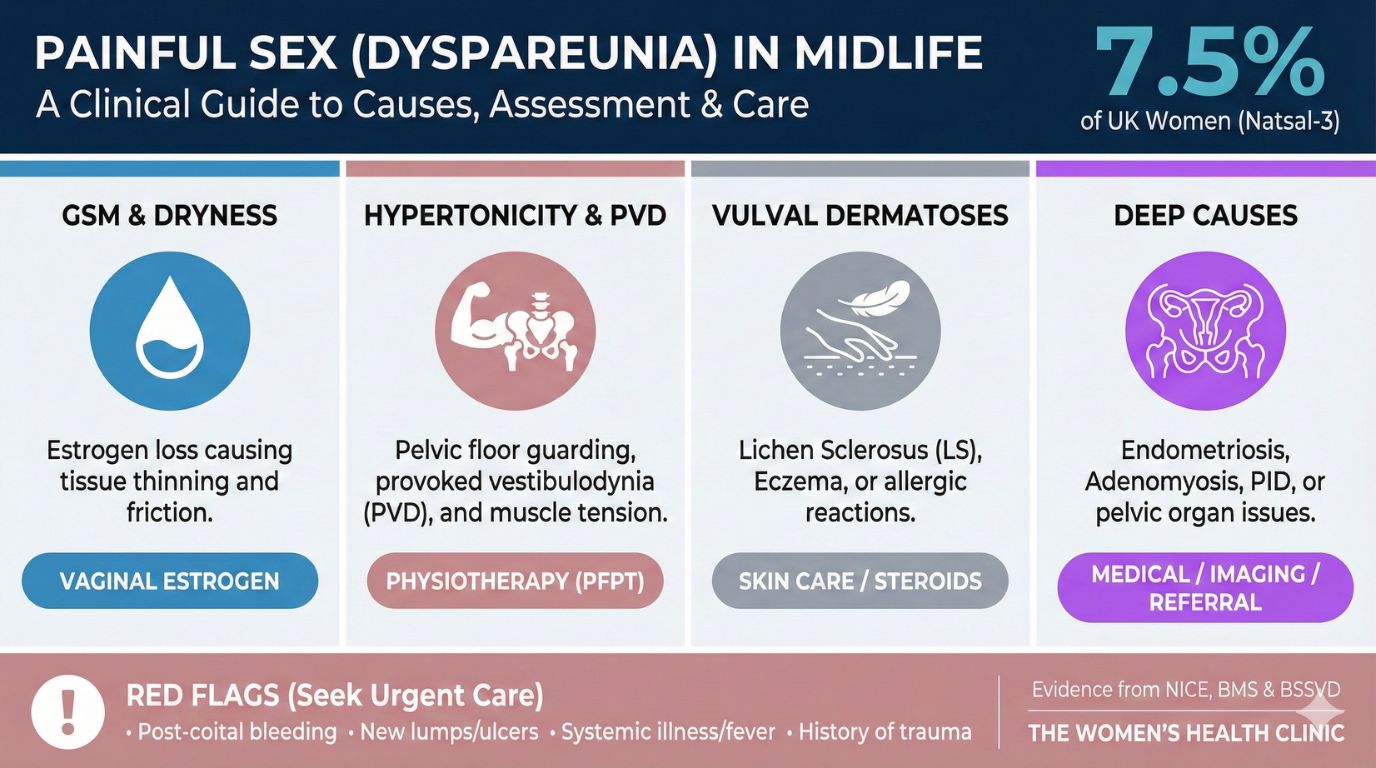
Your experience is valid. In most cases, a clear reason for symptoms can be found and treated.
Hormonal Changes
Low oestrogen (menopause, breastfeeding) causes Genitourinary Syndrome of Menopause (GSM). Tissues become thin and dry, causing "burning" or "sandpaper" friction.
Muscular & Nerve
Pelvic Floor Overactivity: Chronic tightness/spasm.
Provoked Vestibulodynia: Nerve hypersensitivity at the entrance.
Pudendal Neuralgia: Burning pain worsened by sitting.
2.4 Medication Side-Effects
| Medication | Impact on Comfort |
|---|---|
| Hormonal Contraceptives | Can lower free testosterone, leading to tissue thinning and reduced libido. |
| Antidepressants (SSRIs) | Can blunt genital sensation and delay orgasm. |
| Antihistamines | Systemic drying effect reduces natural lubrication. |
3.0 Exploring Your Treatment Options
Our philosophy is "multimodal," often combining therapies. Care always begins with evidence-based, conservative options.
3.1 First-Line Conservative Therapies
- Topical Vaginal Oestrogen: The "gold standard" for GSM. Safe for long-term use, restoring thickness and elasticity.
- Pelvic Health Physiotherapy: Specialist techniques to "down-train" tension and release trigger points.
- Psychosexual Therapy: Talking therapy to break the "fear-pain cycle" and address anxiety.
3.2 Advanced Regenerative Treatments
Vaginal Laser & RF
Uses heat to stimulate collagen. Suitable for post-menopausal women who cannot use hormones. Not a routine first-line therapy (per NICE/FDA).
PRP ("The O-Shot")
Uses your blood's growth factors to stimulate neurogenesis (nerves) and angiogenesis (blood vessels). Good for sensation loss or Lichen Sclerosus.
Injectable Skin Boosters vs. Fillers
| Feature | Skin Boosters | Fillers |
|---|---|---|
| Goal | Rehydrate & Repair | Volumize & Cushion |
| Best For | Dryness, Stinging | Chafing, Deflated Labia |
Unsure which treatment is right for you?
Get Support4.0 Your Safety is Our Priority
Understanding medical device regulation helps you protect yourself. UKCA and CE marks are not optional marketing logos; they are legal guarantees of safety.
Myth: "The clinic said it’s FDA-approved, so that’s fine."
Reality: FDA approval is legally meaningless in the UK without a valid UKCA or CE mark.
Myth: "All clinics use certified devices."
Reality: Some clinics use imported "cosmetic" devices that bypass crucial patient safety regulations. We only use certified gynaecological devices.
5.0 Informed Consent & Expectations
We adhere to the "Montgomery Standard," discussing risks personally relevant to you. We mandate a "Cooling Off" period between consultation and treatment.
5.2 Realistic Healing Timelines
| Process | Timeline | What This Means |
|---|---|---|
| Collagen Remodelling | Peaks at 12 weeks | True results take 3 months. Initial tightness is often just swelling. |
| Nerve Regeneration | 1mm per day | Improvement in sensation is very gradual over months. |
6.0 Your Recovery: What to Expect
Normal (Resolves 2-5 days)
- Localised swelling & tenderness
- Light spotting or pink/brown discharge
- Mild, period-like cramping
- Increased watery discharge (after laser)
Red Flags (Seek Care)
- Severe pain not helped by painkillers
- Heavy bleeding (soaking a pad/hour)
- Fever (>38°C), shivering
- Foul-smelling, green/pus-like discharge
6.2 Essential Aftercare
- Pain Relief: PRP Patient Alert: Avoid Ibuprofen (NSAIDs) for 5-7 days as it blocks the treatment. Use Paracetamol.
- The "Jug Trick": Pour lukewarm water over the vulva while urinating to prevent stinging.
- Pelvic Rest: Abstain from intercourse for 5-7 days (Laser), 3-5 days (Fillers), or 24-72 hours (PRP).
Holistic Recovery Starts Here
We support the mind-body connection to help you regain confidence and comfort.
7.0 A Holistic Approach: Mind-Body & Intimacy
Chronic pain can create a "Fear-Pain Cycle" where the brain anticipates pain and tightens muscles defensively. We use mindfulness and graded exposure to retrain this response.
Communication Tools
The Traffic Light System: Use "Green" (good), "Amber" (slow), "Red" (stop) during intimacy to build trust.
The Sexual Menu: Agree on a "menu" of non-penetrative activities to remove performance pressure.
Managing Therapies
Pause Dilators: During active infection (Thrush/BV) or severe pain flares.
Continue Dilators: During your period (safe) or after radiotherapy (critical to prevent stenosis).
8.0 About Your Clinician: Dr Farzana Khan
Dr Farzana Khan specialises in all aspects of vaginal health, with a patient-centred philosophy of shared decision-making.
- Qualifications: MD (Copenhagen), MRCGP, DFSRH (RCOG).
- Focus: GSM, sexual function, Lichen Sclerosus, and regenerative medicine.
- expertise: Key Opinion Leader (KOL) and Trainer for leading regenerative technologies.