
Urinary Incontinence Treatment UK – Non-Surgical Laser & Radiofrequency Solutions for Stress Urinary Incontinence
Assessment-led care across our CQC-regulated UK clinics
If you leak urine when you cough, laugh, sneeze, run, or lift—please know this: it’s common, it’s real, and it’s not something you have to “just live with.” For many women across the UK, urinary leakage quietly reshapes daily life: what you wear, how you exercise, how you travel, even whether you feel relaxed during intimacy.
But here’s the part most people don’t tell you clearly enough: “incontinence” isn’t one condition. It’s a pattern—and the pattern matters.
- Stress urinary incontinence (SUI): leakage with physical pressure such as coughing, sneezing, laughing, exercising, or lifting heavy objects
- Urgency incontinence/Overactive bladder (OAB): leakage accompanied by a sudden, intense urge to urinate, often with increased bathroom frequency throughout the day and night waking
- Mixed urinary incontinence: a combination of both stress and urgency patterns occurring together
At The Women’s Health Clinic, we take an assessment-led, medically governed approach to urinary incontinence treatment across our UK clinics. For women seeking non-surgical options for stress urinary incontinence, we may discuss two clinic-based interventions used in carefully selected cases: Vaginal Laser Treatment (Nu-V) and Radiofrequency (RF) Treatment.
We’ll also discuss conservative measures such as pelvic floor physiotherapy and bladder retraining programmes, because in the UK they’re a core part of first-line care for many women with urinary incontinence. (NICE)
Important note: This page provides educational information only about urinary incontinence treatments available in the UK. Results vary from person to person and no treatment is guaranteed. A consultation with our medical team is required to confirm your diagnosis, assess suitability, and develop the most appropriate treatment plan for your individual needs.
Why Women Choose Our UK Urinary Incontinence Clinics
- CQC-regulated medical clinics across the UK
- GP-led women’s intimate health care (assessment first)
- Non-surgical urinary incontinence treatment options
- Evidence-informed counselling (benefits, limits, evidence)
- Clinics nationwide – London (Harley Street), Canary Wharf, Leicester, Leeds, Birmingham, Harrogate, Bristol, Exeter, Manchester
Practitioner-led urinary incontinence care
Treatments delivered by Dr Farzana Khan (GP & Women’s Health Specialist).
Medical oversight
Compliance led by Dr Kamaljit Singh (Clinical Oversight) and Katy Pitt Allen (Clinical Director).
Treatment Summary
Not One-Size-Fits-All
Urinary incontinence simply means leaking urine involuntarily. In the UK, urinary incontinence affects millions of women, yet many suffer in silence. The key to effective treatment is understanding what triggers your leakage—because that’s what points to the most appropriate treatment pathway.
This matters because Laser and RF treatments are most commonly discussed for stress-type urinary incontinence patterns, whereas urgency-dominant symptoms are usually managed first with bladder training programmes and other conservative pathways. (NICE)
Clinical Overview
Continence is a system—pelvic support, tissue quality, muscle coordination, and pressure management all working together. When one part of this system changes, urinary leakage can develop.
The 3 main types of urinary incontinence:
1) Stress urinary incontinence (SUI)
Leakage happens with physical pressure or exertion: coughing, sneezing, laughing, running, jumping, lifting weights, or even standing up quickly.
Often linked to childbirth or changes in pelvic floor support and coordination.
2) Urgency incontinence / OAB
Leakage occurs with a sudden, intense urge to urinate that’s difficult or impossible to postpone—often alongside frequent bathroom trips during the day and waking multiple times at night.
This pattern is usually prioritised with bladder-pathway care first.
3) Mixed urinary incontinence
A combination of both stress and urgency urinary incontinence patterns occurring together.
Many women experience symptoms of both types, which requires a tailored treatment approach addressing multiple factors.
Why Urinary Incontinence Happens (Common Contributing Factors)
Think of continence like a system: the pelvic floor, the tissues, the urethra, and the pressure management all working together. When one part of this system changes, urinary leakage can develop.
- Pregnancy and childbirth – vaginal delivery can stretch and weaken pelvic floor muscles and tissues
- Postpartum recovery period – many women experience temporary or ongoing incontinence after giving birth
- Perimenopause and menopause-related tissue changes – declining oestrogen affects vaginal and urethral tissue quality
- Pelvic floor muscle weakness or poor coordination – muscles may be weak, overactive, or not coordinating properly
- Chronic constipation – ongoing straining puts pressure on pelvic floor structures
- Chronic cough or smoking – persistent coughing weakens pelvic support over time
- Weight changes and obesity – increased abdominal pressure on the bladder and pelvic floor
- High-impact exercise – activities like running, jumping, and CrossFit can contribute to stress incontinence
- Previous pelvic surgery – hysterectomy or other surgeries can affect pelvic support structures
- Ageing – natural weakening of tissues and muscles over time
Where Laser & RF Fit in a UK-Responsible Urinary Incontinence Care Pathway
- Women with stress urinary incontinence or mixed incontinence are offered a supervised pelvic floor muscle training programme lasting at least 3 months as first-line treatment. (NICE)
- Women with urgency incontinence or mixed symptoms are offered bladder training for a minimum of 6 weeks as first-line treatment. (NICE)
- The NHS also highlights pelvic floor exercises as an important way to reduce urinary leaks when done correctly and consistently over time. (nhs.uk)
Vaginal laser and radiofrequency treatments may then be discussed as non-surgical, clinic-based options for carefully selected women—most often those with mild to moderate stress-pattern urinary incontinence who want alternatives to surgery or who remain symptomatic despite completing conservative treatment steps. These treatments are not suitable for everyone with urinary incontinence, and a thorough assessment is essential to determine whether you’re a good candidate.
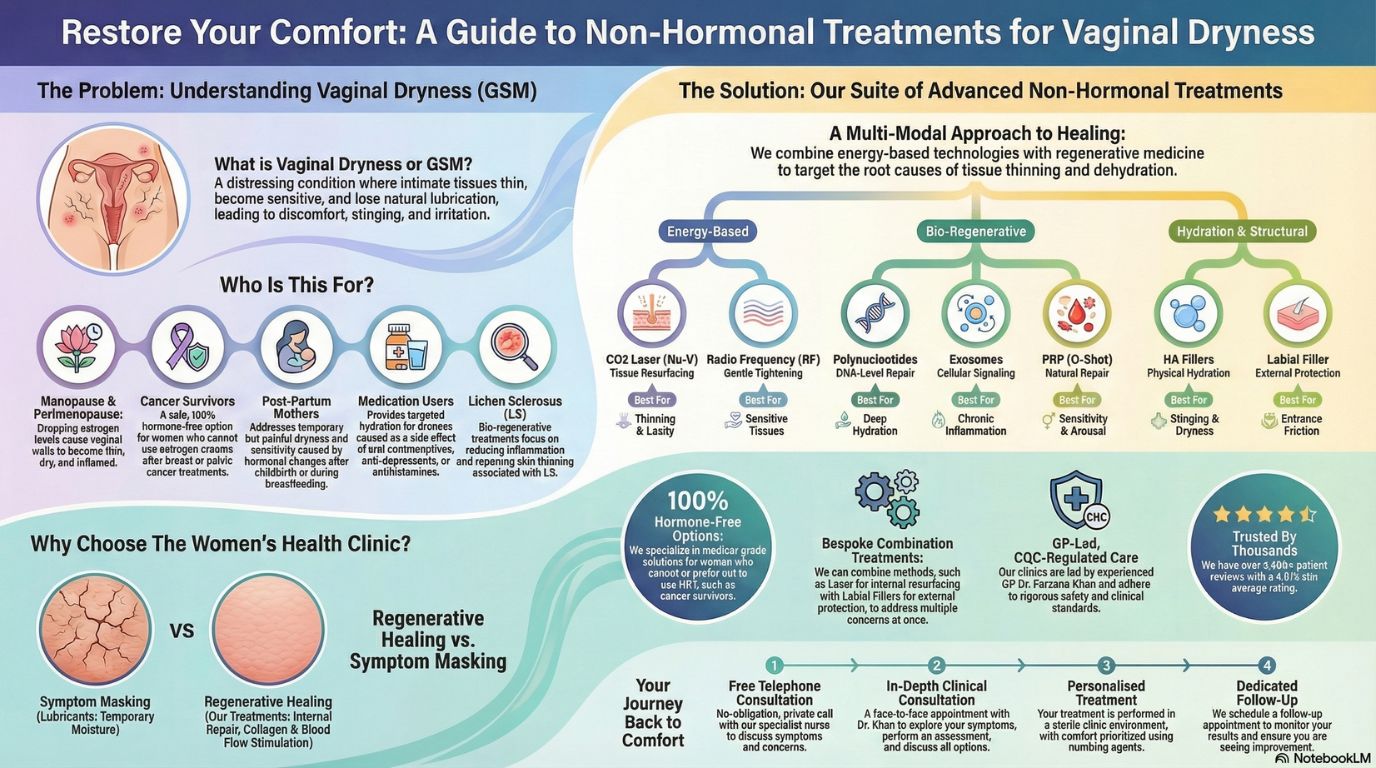
Precision Tissue Restoration
Our GP-led approach targets the biological triggers of tissue thinning. By stimulating natural collagen and elastin production at the cellular level, we provide a long-term medical alternative to daily topical treatments.
Get Clinical SupportWho Is This For?
These non-surgical urinary incontinence treatment options may be considered for carefully selected women—especially when symptoms match a stress-pattern leakage profile.
Stress-pattern leaks
Experience leakage with coughing, sneezing, exercise, or lifting (stress urinary incontinence symptoms).
Mild to moderate leakage
Have mild to moderate urinary leakage that affects confidence, quality of life, and daily activities.
Postpartum women (after recovery)
Are in the postpartum period and feel they’ve “never fully returned” to baseline (after an appropriate recovery window of at least 6 months).
Perimenopause & menopause
Notice urinary leakage changes alongside vaginal tissue comfort changes during perimenopause or menopause.
Non-surgical options
Want clinician-led, non-surgical urinary incontinence treatment options with minimal disruption to daily life.
Tried conservative measures
Have tried conservative measures like pelvic floor exercises but continue to experience bothersome symptoms.
If urgency incontinence / OAB is your main problem
If your primary issue is sudden urge to urinate, frequent bathroom trips throughout the day, and waking multiple times at night to urinate, we’ll usually prioritise a bladder-pathway treatment approach first, including structured bladder training programmes. (NICE)
Who these urinary incontinence treatments may not be suitable for
- Active urinary tract infection (UTI) or vaginal infection
- Undiagnosed vaginal bleeding or abnormal discharge
- Current pregnancy or breastfeeding
- Certain medical conditions requiring specialist input before treatment
- Implanted electronic devices (particularly relevant to radiofrequency treatment)
- Red-flag symptoms requiring medical investigation first (see Safety section below)
- Severe or complete urinary incontinence that may require surgical intervention
- Untreated pelvic organ prolapse requiring assessment
A Hormone-Free Future
The UK’s most advanced non-hormonal regenerative suite. We prioritize medical solutions that stimulate your body's own healing mechanisms for long-term intimate wellness.
Choosing a Treatment
Pads, panty liners, and careful planning can help you cope day-to-day. But many women don’t just want to cope—they want to move freely, laugh without worry, run confidently, travel spontaneously, and feel relaxed in intimate situations again.
The difference between “managing leaks” and rebuilding confidence
- Exercising without fear of leakage during workouts or sports
- Leaving the house without “just in case” planning and constant awareness of bathroom locations
- Returning to sexual intimacy without worry or embarrassment
- Feeling like yourself again rather than defined by urinary incontinence
- Reducing or eliminating the need for pads and protective underwear
- Regaining confidence in social situations and public spaces
- Improving sleep quality by reducing nighttime bathroom trips
Think of it like rebuilding a trampoline: you’re strengthening the springs (pelvic support) and restoring the fabric tension (tissue quality), so you can jump without things giving way.
Assessment-led, evidence-informed, and honest
Some clinics are device-first, pushing treatments before properly understanding your condition. We’re not. We start with a detailed assessment of your symptom pattern (stress vs urgency vs mixed incontinence), your triggers, life stage factors, and broader pelvic health context—plus screening for red flags and realistic goal-setting.
We discuss all available options, including conservative measures.
A transparent note on evidence and NICE guidance (UK)
NICE guidance on transvaginal laser therapy for stress urinary incontinence states that while short-term safety concerns have not been shown, the evidence on long-term safety and efficacy is inadequate, and therefore it should only be used in the context of research. (NICE)
We take this guidance seriously. If vaginal laser treatment is discussed for stress-type urinary incontinence, we provide clear, balanced counselling, careful patient selection, and an honest discussion of alternatives, realistic expectations, and expected outcomes.
Our approach to urinary incontinence treatment
- Detailed assessment first (pattern, triggers, life stage, pelvic context)
- Screening for red flags and ensuring appropriate investigation when needed
- Discussion of conservative measures alongside clinic-based options
- Realistic goal-setting with transparent discussion of benefits, limitations, and evidence
How It Works
Our process is divided into two parts: the methods we may discuss (where appropriate) and the clinical journey we guide you through.
Part A: Methods We May Discuss
Urinary Incontinence Treatment Comparison Table
Vaginal Laser Treatment (Nu-V)
What happens: A smooth medical probe is gently inserted into the vagina. The laser device delivers controlled laser energy to the vaginal tissue according to a structured treatment protocol designed for urinary incontinence.
Why it’s used: Intended to stimulate a tissue response in the vaginal walls that may provide improved support and function for selected stress-type urinary incontinence patterns.
What it feels like: Most women describe warmth and tingling rather than pain.
Plan: Usually discussed as a course of treatments; maintenance may be considered depending on response.
Downtime: We typically advise a short period of pelvic rest (often around 5 days) after each session.
Radiofrequency (RF) Treatment
What happens: RF uses controlled warmth to heat deeper vaginal tissue layers without breaking the surface of the skin or mucosa.
Why it’s used: Commonly positioned as a gentler option and may be discussed for selected mild to moderate stress-type urinary incontinence symptoms.
What it feels like: A gentle warmth sensation—many women describe RF treatment as surprisingly manageable and comfortable.
Plan: Often delivered as a course of sessions, with follow-up appointments to assess response and decide next steps.
Downtime: Usually minimal. Most women return to normal activities the same day with tailored aftercare advice.
Conservative pathways (first-line)
In the UK, conservative care is typically first-line treatment for many women with urinary incontinence.
Stress or mixed symptoms: supervised pelvic floor muscle training programme lasting at least 3 months. (NICE)
Urgency or mixed symptoms: bladder training for a minimum of 6 weeks. (NICE)
The NHS also highlights pelvic floor exercises as important when done correctly and consistently over time. (nhs.uk)
Part B: Your 6-Step Patient Journey
Step 1: Free Telephone Consultation for Urinary Incontinence
You begin with a no-obligation call with one of our specialist nurses. Discuss your symptoms in a private, confidential setting, ask initial questions without pressure, learn about relevant options, and see whether our approach feels right.
Step 2: Book Your Urinary Incontinence Treatment Appointment
If you’d like to proceed (either immediately or later), we book your in-person consultation with Dr Farzana Khan or one of our specialist practitioners. You’ll receive digital health questionnaires, information on what to expect, and clinic details before you arrive.
Step 3: Initial Urinary Incontinence Consultation
This is where the real work begins. During this in-depth, face-to-face appointment:
Dr Khan will: take a comprehensive medical history focusing on your urinary incontinence; discuss symptoms, concerns and goals; perform a physical examination (only with your consent) to assess pelvic floor function; explain relevant options; discuss benefits, realistic expectations and limitations; answer questions openly; and never pressure you.
You’ll receive: clear explanations, honest advice, a bespoke recommendation, transparent cost information, and time to think and ask questions. This consultation typically lasts 30–45 minutes.
Step 4: Urinary Incontinence Treatment
If you choose to proceed and have provided informed consent, your practitioner will carry out the treatment.
What we prioritise: your comfort (medical-grade numbing agents, breaks, check-ins), sterility (fully sterile clinical environment), professionalism (dignity, respect, privacy), and transparency (we explain as we go).
Timing: most procedures take 30–60 minutes, depending on complexity.
Step 5: Feedback on Your Urinary Incontinence Treatment
After your procedure, we ask for your feedback—how you felt about the consultation process, whether treatment met your comfort expectations, if anything could be improved, and how you’re feeling emotionally and physically.
Step 6: Urinary Incontinence Treatment Follow-Up
We book a dedicated follow-up appointment to monitor progress, address concerns, adjust your plan if needed, and discuss maintenance or additional treatments if appropriate. Follow-ups are typically scheduled 4–8 weeks after your initial treatment.
Ongoing support: if you have questions between appointments, our team is always available to help.
About Our Clinical Team
Expert care for intimate health requires a combination of high-level medical expertise and a compassionate, patient-centered approach.

Dr. Farzana Khan
BSc (Hons), MD, DFFP, MRCGP
Dr. Farzana Khan is a highly experienced GP with a special interest in women’s vaginal health, bringing over 20 years of medical expertise across dermatology, obstetrics, and gynaecology.
- Qualifications: MD (University of Copenhagen), MRCGP, and Diploma of the Faculty of Sexual & Reproductive Health.
- Clinical Focus: Specialist in managing Vaginal Dryness (GSM), sexual dysfunction, Lichen Sclerosus, and vulval volume concerns.
- Approach to Care: Dr. Khan believes in "listening first." She ensures all conservative and medical options are explored before proceeding with clinical treatments.
- Expert Training: Dr. Khan is a Key Opinion Leader (KOL) and trainer for leading medical technologies, including Neauvia, Asclepion Laser, and RegenLab.
Our Clinical Management & Compliance Team

Katy Pitt Allen
Clinical Director (RN, BMS)
With over a decade of nursing excellence in oncology, gynaecology, and palliative care, Katy ensures our clinic maintains rigorous clinical standards and compassion.

Dr. Kamaljit Singh
Clinical Oversight (MBChB)
Dr. Singh provides medical oversight. With over 25 years of healthcare experience and 18 years as a member of BAAPS, he ensures top-tier safety protocols.

Jill Crowe
Director of Relationships
Jill manages the seamless coordination between practitioners and patients, ensuring every woman feels supported from the first call to follow-up.
"Our specialist regenerative treatments are delivered across our CQC-regulated clinics in London (Harley Street), Canary Wharf, Leicester, Leeds, Birmingham, Harrogate, Bristol, Exeter, and Manchester."
Authored and medically reviewed by Dr. Farzana Khan. Last updated: November 2025.
Transparent Pricing
Because urinary incontinence is highly individual, final pricing depends on your symptom type (stress vs urgency vs mixed), the recommended method (laser vs RF), and whether a course of treatments is advised.
Vaginal Laser (Nu-V)
Course of 3 Laser Sessions
Course pricing is designed for women who are advised a structured protocol. Final suitability and recommendation are confirmed after clinical assessment.
- Clinical time and consumables
- Aftercare guidance
- Planned follow-up appointments
Radiofrequency (RF)
RF treatment pricing is confirmed after assessment because protocols can vary depending on urinary incontinence symptoms and treatment area requirements.
What’s included: clinical time, consumables, aftercare guidance, and planned follow-up appointments.
Concerns & Safety
When you should seek medical review first (important)
- Blood in urine (haematuria): requires urgent medical assessment
- Recurrent urinary tract infections (UTIs)
- New or worsening pelvic pain
- Unexplained vaginal bleeding
- New neurological symptoms (numbness, weakness, changes in bladder emptying)
- Complete loss of bladder control
- Difficulty starting urination or weak urine stream
General contraindications (often include)
- Pregnancy or breastfeeding
- Active urinary tract infection or vaginal infection
- Undiagnosed vaginal bleeding or abnormal discharge
- Certain medical conditions requiring specialist input
- Recent pelvic surgery (timing assessed clinically)
- Untreated pelvic organ prolapse
- Active cancer or history of gynaecological cancer (requires specialist clearance)
Method-specific considerations
Laser: temporary sensitivity, discharge, or mild irritation can occur; pelvic rest is usually advised for a short period (often around 5 days) after each session; rare risks include infection, pain, burns, or adverse tissue response.
RF: implanted electronic devices (pacemakers, defibrillators) may be a contraindication; temporary warmth and mild tenderness can occur; metal IUDs may need to be considered in planning.
Most important safety point: your treatment plan is clinician-led. We prioritise informed consent, realistic expectations, and appropriate follow-up. If conservative measures or alternative pathways are more suitable, we’ll tell you plainly. (NICE)
Frequently Asked Questions
General & pathways
How do I know if I have stress urinary incontinence or urge incontinence?
Will you still discuss pelvic floor training and bladder training for my urinary incontinence?
Treatment experience & outcomes
How many urinary incontinence treatment sessions will I need?
Does urinary incontinence treatment hurt?
What’s the downtime after urinary incontinence treatment?
Will my urinary incontinence treatment results be permanent?
How long does it take to see results from urinary incontinence treatment?
Evidence, suitability & NHS options
What does NICE say about vaginal laser for stress urinary incontinence?
What if I’m not suitable for laser or RF urinary incontinence treatment?
Is urinary incontinence treatment available on the NHS?
Can I have urinary incontinence treatment if I’m planning another pregnancy?
Patient Resource Hub
Bladder Diary
Quality of Life
Life Stages
Choosing a Clinic
Myths
Understanding your urinary incontinence symptoms (Bladder diary)
If you’re experiencing urinary incontinence, keeping a bladder diary can be incredibly helpful for your consultation. Track:
- When leakage occurs (time of day)
- What you were doing when leakage happened
- How much fluid you’re drinking daily
- How many times you urinate during the day and night
- The severity of leakage (drops, small amount, or complete emptying)
This information helps Dr Khan understand your urinary incontinence pattern and develop the most appropriate treatment plan.
Urinary incontinence and quality of life
Research shows that urinary incontinence significantly impacts quality of life, affecting:
- Physical activity – avoiding exercise, sports, or activities you enjoy
- Social engagement – declining invitations or feeling anxious in public
- Emotional wellbeing – experiencing embarrassment, shame, or low self-esteem
- Sexual health – avoiding intimacy due to fear of leakage
- Sleep quality – waking multiple times at night (particularly with urgency incontinence)
- Work performance – struggling with concentration or frequent bathroom breaks
- Travel and leisure – carefully planning trips around bathroom access
Urinary incontinence across life stages
Postpartum urinary incontinence:
Many women experience urinary incontinence after childbirth, particularly stress urinary incontinence. While pelvic floor exercises are essential, some women continue to experience symptoms despite completing supervised programmes. Non-surgical treatments may be discussed once you’ve completed the postpartum recovery period (typically at least 6 months after delivery).
Perimenopausal and menopausal urinary incontinence:
Declining oestrogen levels during perimenopause and menopause affect vaginal tissue quality, urethral support, and bladder function. This can lead to new or worsening urinary incontinence symptoms. Treatment approaches may address both tissue quality and functional support.
Urinary incontinence in active women:
Athletes and women who regularly engage in high-impact activities (running, CrossFit, trampolining) often experience stress urinary incontinence. This doesn’t mean you need to stop exercising—appropriate treatment and pelvic floor coordination can help you return to the activities you love.
Finding the right urinary incontinence treatment in the UK
When choosing where to receive urinary incontinence treatment, consider:
- Medical regulation – Is the clinic CQC-regulated with proper clinical oversight?
- Practitioner qualifications – Are treatments delivered by qualified medical professionals?
- Assessment approach – Does the clinic prioritise diagnosis before treatment?
- Evidence transparency – Are you given honest information about success rates and limitations?
- Conservative care discussion – Are non-invasive options explored first?
- Follow-up commitment – Does the clinic provide ongoing support after treatment?
At The Women’s Health Clinic, we meet all these standards across our UK locations.
Common myths about urinary incontinence (debunked)
Myth: “Urinary incontinence is a normal part of ageing”
Truth: While urinary incontinence becomes more common with age, it’s not inevitable and it’s always worth seeking treatment.
Myth: “Surgery is the only effective urinary incontinence treatment”
Truth: Many women benefit from conservative measures like pelvic floor training, and non-surgical options like laser and RF may help selected cases.
Myth: “Urinary incontinence always requires invasive treatment”
Truth: Conservative approaches are first-line treatment in the UK and many women see significant improvement with supervised pelvic floor programmes.
Myth: “If you’ve had children, urinary incontinence is inevitable”
Truth: While childbirth is a risk factor, many women who’ve given birth never experience urinary incontinence, and those who do have treatment options.
Myth: “Kegel exercises alone will fix urinary incontinence”
Truth: Pelvic floor exercises must be done correctly and consistently. Supervised training is more effective than unsupervised attempts, and some women need additional support.
Myth: “You should just accept urinary incontinence and use pads”
Truth: Pads are a management strategy, not a treatment. You deserve proper assessment and discussion of all available treatment options.
Urinary incontinence treatment locations across the UK
London urinary incontinence clinics
Harley Street Clinic
Our flagship London location offers comprehensive urinary incontinence assessment and treatment in the heart of London’s medical district. Easily accessible via public transport with discreet, professional facilities.
Canary Wharf Clinic
Convenient East London location for urinary incontinence treatment, perfect for working professionals seeking care close to the financial district.
Regional urinary incontinence clinics
Leicester Urinary Incontinence Clinic
Serving the East Midlands with expert urinary incontinence care.
Leeds Urinary Incontinence Clinic
Comprehensive women’s health services for Yorkshire and surrounding areas.
Birmingham Urinary Incontinence Clinic
Central England’s premier destination for urinary incontinence treatment.
Harrogate Urinary Incontinence Clinic
Discreet, professional urinary incontinence care in North Yorkshire.
Bristol Urinary Incontinence Clinic
Expert treatment serving the South West of England.
Exeter Urinary Incontinence Clinic
Accessible urinary incontinence care for Devon and Cornwall.
Manchester Urinary Incontinence Clinic
Serving Greater Manchester and the North West with specialist urinary incontinence treatment.
All our clinics maintain identical standards of care, clinical protocols, and treatment quality. No matter which location you choose, you’ll receive the same expert, compassionate care from Dr Farzana Khan and our specialist team.
Ready to address your urinary incontinence?
Living with urinary incontinence doesn’t have to be your reality. Whether you’re experiencing stress urinary incontinence, urgency incontinence, or mixed symptoms—there are pathways to improvement.
The Women’s Health Clinic offers:
- Free initial telephone consultation to discuss your urinary incontinence
- Comprehensive assessment by experienced women’s health specialists
- Evidence-based treatment options including conservative and non-surgical approaches
- CQC-regulated clinics across the UK
- Transparent pricing with no hidden costs
- Ongoing support throughout your urinary incontinence treatment journey
Don’t let urinary incontinence control your life any longer.
Sources (NICE / NHS)
- NICE – Quality statement 4: Supervised pelvic floor muscle training
- NICE – Quality statement 5: Bladder training
- NHS – 10 ways to stop leaks (Urinary incontinence)
- NICE – Transvaginal laser therapy for stress urinary incontinence (Recommendations)
- NICE – Urinary incontinence and pelvic organ prolapse in women (Recommendations)
Ready to Address Your Urinary Incontinence?
Urinary incontinence can feel isolating—but it’s a medical issue with structured pathways and real treatment options. The first step is simply understanding your symptom pattern and what’s driving your urinary incontinence.
What happens next in your urinary incontinence treatment journey is entirely up to you:
- Start with a free, no-obligation telephone consultation about urinary incontinence
- Book an in-person assessment for a clear urinary incontinence diagnosis and bespoke treatment plan
- Move forward with urinary incontinence treatment only if it feels right for you
Start your journey to confidence today.
All urinary incontinence treatments are delivered in CQC-regulated clinics with full medical oversight. Individual results vary. A consultation is required to assess suitability for treatment.
This page is for educational purposes only and does not constitute medical advice about urinary incontinence. Results vary. Not a cure.
The Women’s Health Clinic – Expert Urinary Incontinence Treatment Across the UK
CQC-regulated | GP-led | Evidence-informed | Nationwide locations
