

When can I resume sex after a tear, episiotomy or C-section?
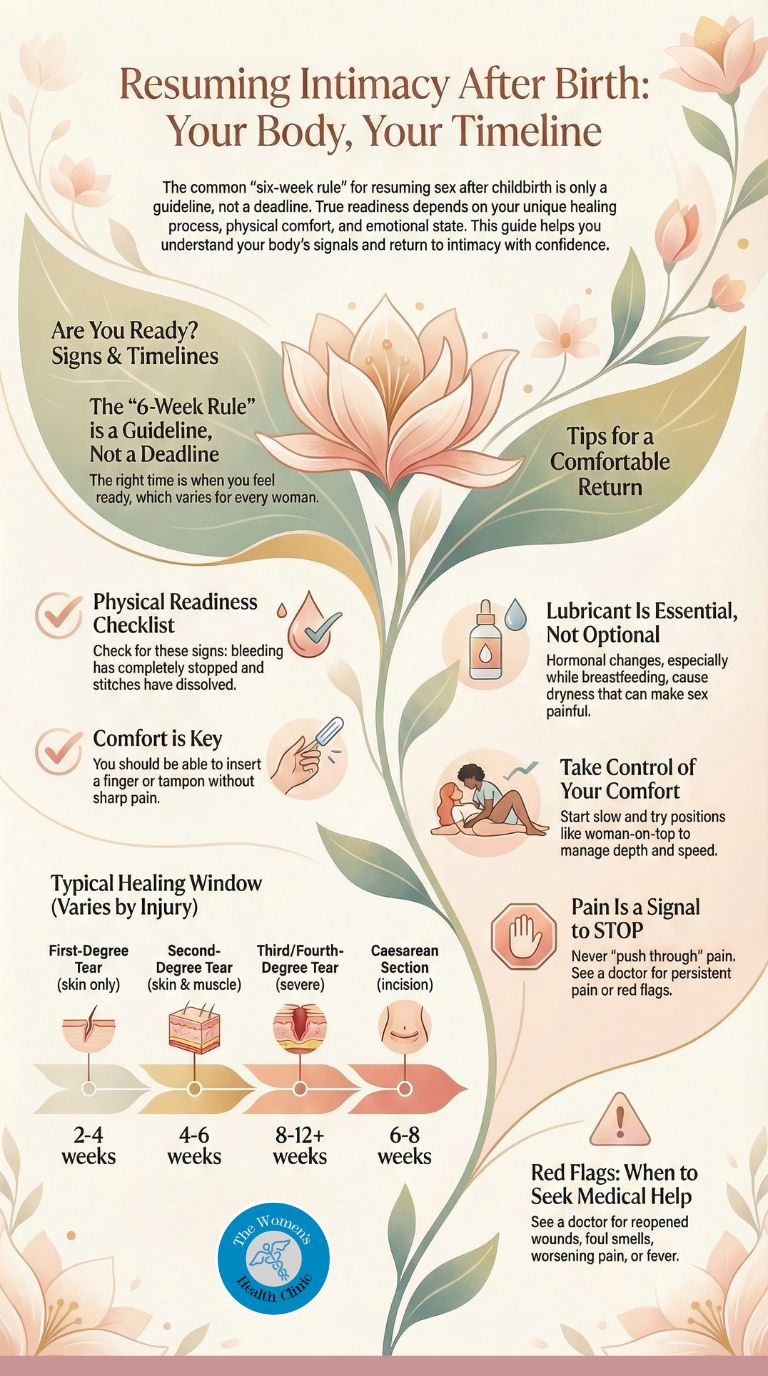
Most women are advised to wait until after their six-week postnatal check before resuming penetrative sex, but this is a guideline, not a strict rule. The best time to resume intimacy is when your perineal or caesarean wound has healed, any bleeding has stopped, and you feel physically and emotionally ready—which may be earlier or later than six weeks. Healing timelines vary depending on the type and severity of injury, and rushing can lead to pain, re-injury, or long-term complications.
Show Detailed Answer
After giving birth, your body undergoes significant physical change and trauma—whether you tore naturally, had an episiotomy, or delivered via caesarean section. The traditional advice to wait six weeks stems from the typical timeframe for wound healing and lochia (postnatal bleeding) to resolve, but individual recovery is highly variable.
For many new parents, the idea of resuming sex feels overwhelming. Between sleep deprivation, hormonal fluctuations, breastfeeding, and the emotional intensity of caring for a newborn, desire may be low. It is completely normal—and medically sensible—to take your time. Conversely, some women feel ready sooner, and if wounds have healed and bleeding has stopped, earlier resumption is not inherently harmful, provided it is comfortable.
Healing Timeline by Birth Trauma Type
The nature of your birth injury directly influences how long tissues need to recover:
- First-Degree Tear: Affects only the skin of the perineum. These typically heal within 1–2 weeks and may cause minimal discomfort. Many women feel comfortable resuming sex before the six-week mark.
- Second-Degree Tear: Involves the perineal muscle as well as the skin. Healing usually takes 3–4 weeks, though tenderness may persist longer. The six-week guideline is appropriate here.
- Third- or Fourth-Degree Tear: Extends into the anal sphincter or rectal lining. These require specialist surgical repair and can take 8–12 weeks to heal fully. Sexual activity should be postponed until cleared by a consultant or specialist physiotherapist.
- Episiotomy: A surgical cut through skin and muscle. Recovery is similar to a second-degree tear, typically 3–6 weeks, though scar tissue can cause lasting tightness or sensitivity.
- Caesarean Section: The abdominal incision usually heals within 4–6 weeks, but internal healing of the uterine scar continues for months. Deep penetration may cause discomfort if it tugs on internal scar tissue or if the bladder or bowel adhesions have formed.
Physical Signs You're Ready
Before resuming penetrative sex, check for the following:
- Lochia (postnatal bleeding) has stopped completely.
- The perineal or abdominal wound has closed and is no longer tender to touch.
- You can insert a finger or tampon comfortably without pain or resistance.
- You have regained some pelvic floor awareness and control (ability to contract and relax).
Hormonal & Emotional Factors
Even when tissues have healed, hormonal changes—especially if breastfeeding—can cause vaginal dryness, thinning, and reduced elasticity due to low oestrogen. This can make sex uncomfortable or painful (dyspareunia), even in the absence of visible trauma. Emotional readiness is equally important: postnatal anxiety, body image concerns, fear of pain, and exhaustion all affect desire and arousal. There is no "normal" timeline for feeling emotionally ready.
Common Concerns & Myths
"Will my partner be able to tell I've changed down there?"
The vagina is highly elastic and designed to recover. While some women notice mild changes in sensation or tone, most partners do not perceive a difference. Pelvic floor exercises can restore muscle tone.
"If I had a C-section, can I have sex sooner since my vagina wasn't affected?"
Not necessarily. The uterus still needs time to heal internally, and many women experience deep pelvic discomfort or bladder sensitivity after caesarean delivery. The six-week guideline still applies.
"If it hurts the first time, does that mean I'm broken?"
No. Pain during the first postpartum attempt is common and usually due to dryness, scar tissue sensitivity, or pelvic floor tension. It does not mean permanent damage—it means you need more time, more lubrication, or specialist support.
Clinical Context
Perineal trauma occurs in up to 90% of first-time vaginal births, with around 85% involving some degree of tearing. Episiotomy rates vary widely by region and clinical practice. Caesarean section accounts for approximately 30% of UK births. Recovery is influenced by the extent of injury, whether breastfeeding, maternal age, infection risk, and access to postnatal physiotherapy. Scar tissue, whether perineal or abdominal, can affect sensation and comfort long-term. Educational only. Results vary. Not a cure.
Evidence-Based Approaches
Self-Care & Lifestyle
Gentle, patient self-care can dramatically improve comfort and confidence when resuming intimacy.
- Pelvic Floor Exercises: Start gently after delivery to restore tone and awareness. Avoid straining or over-contracting.
- Perineal Massage: After healing, gentle external massage with a body-safe oil can soften scar tissue and reduce hypersensitivity.
- Lubrication: Essential, especially if breastfeeding. Use generous amounts of pH-balanced, non-perfumed lubricant to reduce friction.
- Gradual Reintroduction: Begin with non-penetrative intimacy, then progress to shallow, controlled penetration using positions that allow you to set the pace and depth.
- Communication: Talk openly with your partner about fear, discomfort, and readiness. Emotional connection supports physical healing.
Medical & Specialist Options
If pain persists beyond initial attempts, or if you feel anxious about resuming sex, specialist input can help.
- Postnatal Physiotherapy: Specialist women's health physios assess scar tissue, pelvic floor tension, and teach relaxation and desensitisation techniques.
- Topical Oestrogen: For breastfeeding mothers with vaginal dryness or atrophy, localised oestrogen cream or pessaries can restore tissue health (safe while breastfeeding).
- Scar Tissue Release: Manual therapy or laser treatments can improve mobility and reduce pain around episiotomy or perineal scars.
- Psychosexual Counselling: Addresses fear, trauma, and relationship dynamics that may be affecting intimacy.
For comprehensive support following birth trauma, you may wish to view our step-by-step treatment plan. If you are considering private care, you can book a consultation to discuss your individual recovery.
Red Flags (When to see a GP or Midwife)
Seek medical review if you experience increasing pain, foul-smelling discharge, fever, wound breakdown, urinary or faecal incontinence, or severe pain that does not improve with rest and analgesia. These may indicate infection, haematoma, or incomplete healing.
External Resources:
- NHS – Sex and contraception after birth
- RCOG – Perineal tears and episiotomies (Patient Information)
- NICE – Postnatal care up to 8 weeks after birth
- Pelvic, Obstetric and Gynaecological Physiotherapy (POGP)
- Birth Trauma Association – Support and information
- PubMed – Resumption of sexual activity after childbirth
Educational only. Results vary. Not a cure.
Clinical Insight: Beyond the standard 6-week check, three hidden factors often affect readiness: hormonal drops during breastfeeding, rigid scar tissue requiring mobilization, and the psychological "fear-tension" cycle.
Additional information
MYTH: "If the doctor says I am healed, sex shouldn't hurt."
REALITY: A "healed" wound only means the skin is closed. The underlying tissue may still be rigid, and hormonal changes can thin the vaginal lining, causing friction pain (dyspareunia) even without an open wound.
Many women are unprepared for the physiological impact of breastfeeding on libido and comfort. Prolactin (the milk-producing hormone) naturally suppresses estrogen production.
Why you might feel "dry" despite healing
- Temporary Menopause: Low estrogen can cause atrophic vaginitis, where tissues become thinner, drier, and less elastic.
- Lubrication is Non-Negotiable: Natural lubrication is often chemically blocked by lactation hormones. Use a water-based lubricant (if using condoms) or an oil-based moisturizer (if not) to compensate.
- Timeline: This hypoestrogenic state typically lasts as long as you are exclusively breastfeeding.
Once your wound has fully closed (usually after the 6-week check), the scar tissue may feel thick, ropey, or sensitive. "Mobilizing" the scar is a clinically validated technique to reduce pain.
How to perform scar desensitization
Note: Only perform this after your GP confirms the wound is fully closed.
- The Goal: To realign collagen fibers and soften rigid tissue that pulls during intercourse.
- Technique: Using a natural oil (like almond or olive oil), use your thumb to apply firm but comfortable pressure to the scar line. Massage in small circular motions or "U" shapes for 5-10 minutes daily.
- Result: Evidence suggests this reduces dyspareunia (painful sex) and increases tissue elasticity over time.
It is common to subconsciously tense the pelvic floor muscles in anticipation of pain. This "guarding" reflex makes the vaginal opening tighter, which indeed causes pain, reinforcing the fear.
If physical healing is complete but pain persists, Pelvic Floor Physiotherapy may be required to learn how to relax (down-train) these hypertonic muscles, rather than tighten them.