


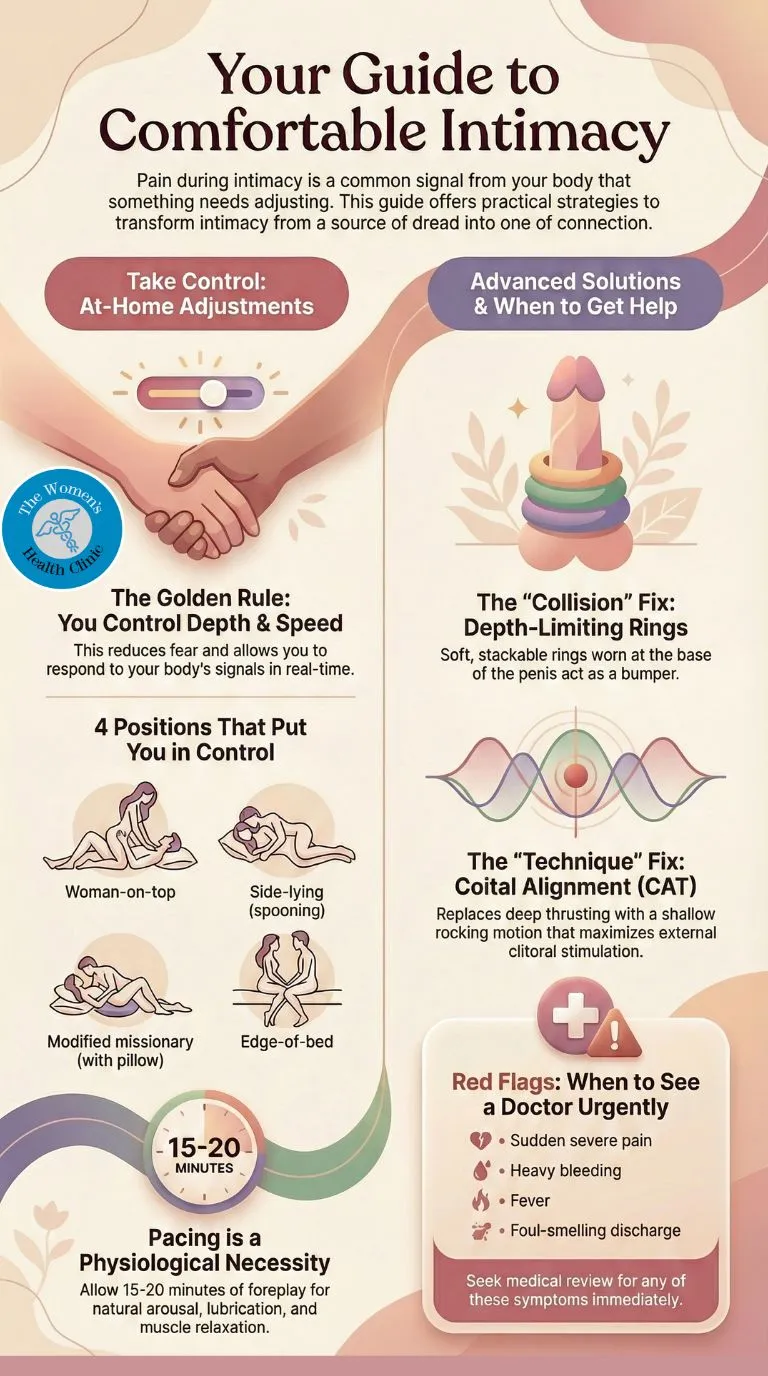
What positions or pacing can make intimacy more comfortable?
The most comfortable positions are those that give you full control over depth, angle, and speed of penetration, reducing pressure on sensitive areas. Woman-on-top, side-lying, and modified missionary with pillow support allow you to dictate pacing and avoid deep thrusting that can trigger pain. Slower pacing, extended foreplay, and generous lubrication are equally important—they allow tissues to relax, engorge naturally, and reduce friction-related discomfort.
Show Detailed Answer
Pain during intimacy—whether at the entrance, deep inside, or both—can transform sex from a source of connection into something you dread. Many people assume they simply need to “push through,” but pain is your body’s way of signalling that something needs adjusting. The good news is that thoughtful positioning and pacing can dramatically improve comfort without sacrificing intimacy.
Understanding the anatomical “why” helps enormously. The vagina is not a rigid tube—it tilts, stretches, and changes shape depending on arousal, pelvic floor tone, and hormonal status. Deep thrusting in certain positions can collide with the cervix or compress ovaries, uterus, or endometriosis lesions. Shallow or angled penetration avoids these collision points. Similarly, positions that allow your pelvic floor muscles to stay relaxed (rather than bracing defensively) reduce entry pain and muscular guarding.
Positions That Enhance Comfort & Control
The golden rule is simple: you control depth and speed. This reduces fear, allows you to respond to your body’s signals in real time, and prevents sudden painful thrusting.
- Woman on Top (Cowgirl or Reverse Cowgirl): You set the rhythm, angle, and depth. You can pause instantly if something hurts, shift your hips to avoid tender spots, and lean forward or backward to change the angle of penetration. This position is especially helpful if deep thrusting causes pelvic pain.
- Side-by-Side (Spooning): Both partners lie on their side, with penetration from behind. This limits depth naturally and keeps the pelvis in a neutral, relaxed position. It is gentle, low-effort, and ideal if you experience fatigue or pelvic floor tension.
- Modified Missionary with Pillow Support: Place a firm pillow or wedge under your hips to tilt your pelvis. This changes the angle of the vaginal canal, often reducing cervical collision. You can also wrap your legs around your partner’s waist to control depth, or place your feet flat on the bed to adjust tilt dynamically.
- Edge of Bed (Seated or Standing Partner): You lie on your back at the edge of the bed; your partner stands or kneels. You maintain control by adjusting how far forward you slide, and your pelvic floor stays relaxed because your legs are supported.
Pacing: The Often-Overlooked Key
Rushing penetration—even in a “good” position—can trigger pain. Here’s why pacing matters physiologically:
- Arousal Increases Vaginal Length: During sexual arousal, the upper two-thirds of the vagina expand and lengthen (called “tenting”). This takes time—typically 15–20 minutes of sustained arousal. If penetration happens too early, the vagina is shorter and tighter, increasing the chance of painful cervical contact.
- Natural Lubrication Needs Time: Even if you feel “mentally ready,” physical lubrication lags behind. Oestrogen levels, hydration, and pelvic blood flow all affect how quickly tissues become slippery. Using additional lubricant is not a failure—it is smart anatomy.
- Pelvic Floor Relaxation: If you are anxious or bracing for pain, your pelvic floor muscles tighten protectively (called guarding). Slower pacing, breathing exercises, and non-penetrative touch help these muscles soften.
Practical Adjustments to Try Tonight
- Start with Outercourse: Spend at least 10–15 minutes on clitoral stimulation, kissing, massage, or mutual touching before any penetration. This primes the nervous system and increases blood flow to the pelvis.
- Use Lubricant Generously: Apply a body-safe, non-glycerin lubricant to both the vulva and the penis or toy. Reapply as needed. Silicone-based options last longer; water-based are easier to clean.
- Communicate in Real Time: Use simple words like “slower,” “shallower,” or “pause” rather than enduring pain silently. Many partners feel relief when given clear guidance.
- Experiment with Angles: Even a 10–15 degree pelvic tilt can move penetration away from a tender cervix or anterior wall. Try placing a folded towel, yoga block, or positioning pillow under your lower back or hips.
- Avoid “Jackhammer” Thrusting: Deep, fast thrusting is a common culprit in deep dyspareunia. Instead, try slow, shallow movements, circular grinding, or rocking motions that stimulate the clitoris and vaginal entrance without deep impact.
Common Concerns & Myths
“If I need to control everything, isn’t that less spontaneous or romantic?”
Not at all. Many couples find that slowing down, communicating, and experimenting together actually increases emotional intimacy and trust. Spontaneity that leads to pain is not sustainable—deliberate pleasure is.
“Will my partner think I’m being difficult or demanding?”
A caring partner wants you to feel good, not hurt. Framing it as “let’s try this together” rather than “you’re doing it wrong” helps. If your partner dismisses your pain, that is a relationship issue, not a physical one.
“Do I just need to ‘loosen up’ or have more wine?”
No. Alcohol does not treat the underlying causes of pain (such as atrophy, infection, or muscle tension) and can dehydrate tissues, worsening dryness. Relaxation helps, but it must be paired with physical adjustments and, where needed, medical care.
Clinical Context
Painful intercourse (dyspareunia) is a medical condition, not a personality flaw or lack of desire. It can stem from hormonal changes (especially low oestrogen during menopause or breastfeeding), pelvic floor dysfunction, vulvodynia, endometriosis, or skin conditions like lichen sclerosus. Positional adjustments work best when combined with treatment of the underlying cause. Pelvic health physiotherapists often teach specific stretches, breathing techniques, and dilator protocols to complement positioning strategies. Educational only. Results vary. Not a cure.
Evidence-Based Approaches
Self-Care & Lifestyle
Start with low-cost, evidence-backed changes you can implement immediately:
- Extend Foreplay: Aim for 15–20 minutes to allow full arousal and vaginal tenting.
- High-Quality Lubricant: Choose pH-balanced, body-safe products without glycerin, parabens, or fragrance. Brands like YES, Sylk, or Sliquid are well-tolerated.
- Pelvic Floor Awareness: Practice diaphragmatic breathing (slow belly breaths) to help release pelvic tension. Apps like Squeezy or online physiotherapy videos can guide you.
- Temperature & Comfort: A warm bath before intimacy can relax muscles. Dim lighting, comfortable pillows, and removing time pressure all help the nervous system shift out of “threat” mode.
Medical & Specialist Options
If positional changes help but do not fully resolve pain, clinical assessment is the next step. Treatment may include:
- Topical Oestrogen: For vaginal dryness or atrophy (common in menopause), localised oestrogen creams or pessaries restore tissue elasticity and lubrication. These are different from systemic HRT and are considered very safe.
- Pelvic Health Physiotherapy: Specialist physios assess muscle tone, teach relaxation techniques, and may use internal manual therapy or dilator training to desensitise painful areas.
- Psychosexual Therapy: Cognitive-behavioural approaches help break the fear-pain cycle and rebuild confidence. This is especially useful if pain has led to avoidance or relationship strain.
- Advanced Treatments: In cases where standard therapies are insufficient, options like platelet-rich plasma (PRP), laser therapy, or trigger point injections may be discussed.
If you are exploring treatment pathways, you can view our step-by-step treatment plan or book a consultation to discuss your symptoms in a confidential, compassionate setting.
Red Flags (When to See a GP Urgently)
Seek medical review if you experience sudden severe pelvic pain, heavy or irregular bleeding, fever, foul-smelling discharge, or if the pain is new and progressively worsening. These may indicate infection, ovarian cysts, or other conditions needing prompt assessment.
External Resources:
Educational only. Results vary. Not a cure.
Clinical Strategy: Comfort isn't just about the position; it's about the angle and depth. Techniques like "Coital Alignment" (CAT) replace deep thrusting with shallow grinding, while tools like "Buffer Rings" eliminate collision pain entirely without changing your favourite position.
Additional information
MYTH: "A glass of wine will help me relax."
REALITY: While alcohol lowers inhibition, it dehydrates mucous membranes. This reduces natural lubrication and can increase friction pain. It also depresses the central nervous system, making orgasm harder to achieve.
If you experience sharp, deep pain (Collision Dyspareunia) because your partner hits your cervix, changing positions isn't the only fix.
Depth-Limiting Rings (The Ohnut)
- What they are: Soft, stackable silicone rings worn at the base of the penis or toy. They act as a bumper, physically preventing penetration from going deeper than is comfortable.
- The Benefit: You can return to positions that were previously "too deep" (like doggy style) without the anxiety of anticipating pain. This reduces the "guarding" reflex.
Standard missionary position angles the penis directly towards the cervix (Pouch of Douglas), which is often painful for women with Endometriosis.
- The Adjustment: Your partner moves their body higher up, so the base of their pelvis rests against your clitoris.
- The Movement: Instead of "in-and-out" thrusting, the motion becomes a "grinding" or "rocking" pressure.
- Why it helps: This maximizes external clitoral stimulation while keeping penetration shallow and consistent, avoiding repetitive impact on deep tissues.
Most women instinctively clench (Kegel) when they anticipate entry. This narrows the opening and increases pain.
How to "Drop" the Pelvic Floor
- The Action: During intimacy, consciously push your pelvic floor down and out, exactly as if you were starting to urinate or release gas.
- The Result: This "bulging" action opens the vaginal entrance (introitus) and relaxes the muscles, making penetration significantly easier.
If pain has caused a fear of sex, "taking it slow" isn't enough. Sensate Focus is a clinical pacing method to retrain your brain.
- Stage 1 (Non-Genital): Touching anywhere except the genitals. The goal is connection without the "threat" of sex.
- Stage 2 (Genital, No Goal): Touching genitals but with a ban on intercourse or orgasm. This removes performance pressure.
- Stage 3 (Integration): Only moving to intercourse when the body is fully relaxed and lubricated.