


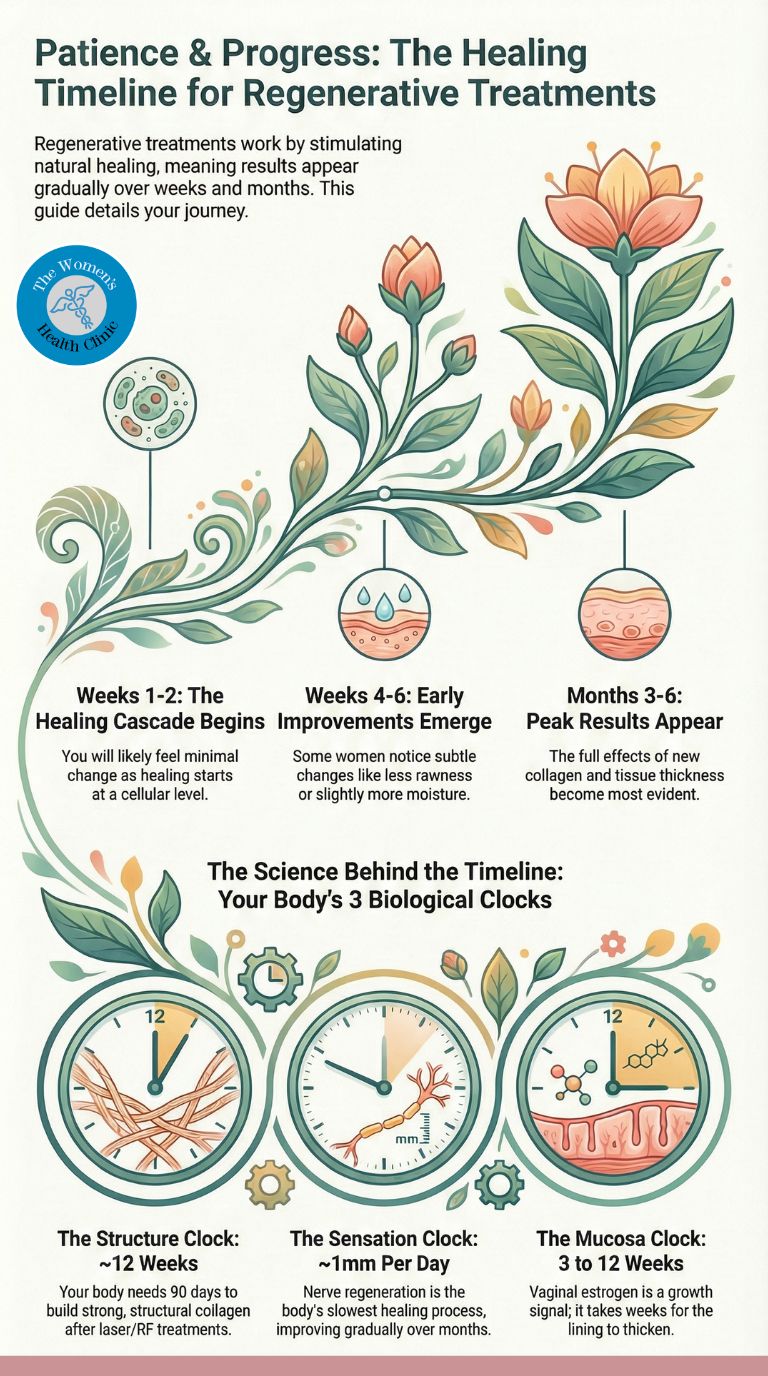
What outcomes are realistic and how soon might I notice change?
Realistic outcomes from regenerative vaginal treatments include gradual improvements in tissue thickness, lubrication, elasticity, and reduced discomfort during intimacy. Most women notice initial changes within 4–6 weeks, with peak results typically appearing between 3–6 months as collagen remodelling and cellular regeneration take effect. Individual timelines vary based on the severity of atrophy, age, hormonal status, and whether you combine treatments with topical oestrogen or physiotherapy.
Show Detailed Answer
Understanding what to expect—and when—is crucial for managing expectations and staying motivated through your treatment journey. Regenerative therapies work by triggering your body’s natural healing mechanisms: stimulating fibroblasts to produce collagen, improving blood flow, and encouraging tissue hydration and elasticity. These biological processes take time and unfold in stages.
It is important to recognise that these treatments are not “quick fixes.” They work with your physiology, which means results build gradually. Some women feel frustrated in the early weeks, especially if they have been suffering for years, but clinical evidence and patient feedback consistently show that improvements become more noticeable and sustained over the first few months.
Realistic Outcomes: What Can Improve
Based on clinical studies and real-world patient reports, the following improvements are commonly observed:
- Tissue Quality: The vaginal lining becomes thicker, pinker, and more resilient. Atrophy-related thinning and pallor reverse as oestrogen receptors respond and collagen is rebuilt.
- Lubrication: Natural moisture production increases, reducing dryness and the need for external lubricants during intimacy.
- Elasticity & Comfort: The vaginal walls become more flexible and less fragile, reducing tearing, burning, or the sensation of tightness during penetration.
- Urinary Symptoms: Many women also report fewer episodes of urgency, frequency, or stress incontinence as the bladder neck and urethral tissues strengthen.
- Sexual Function & Satisfaction: Pain during sex diminishes, arousal improves, and confidence returns, often positively impacting intimacy and relationships.
Timeline: When to Expect Change
The biological timeline for regenerative vaginal treatments typically follows this pattern:
- Week 1–2: Minimal change. Your body is beginning the inflammatory and healing cascade at a cellular level, but you are unlikely to feel different yet.
- Week 4–6: Early responders begin to notice subtle improvements—less rawness, slightly more moisture, or reduced irritation. This is when new blood vessels start forming and fibroblast activity increases.
- Month 2–3: More noticeable changes. Tissue feels softer and more hydrated. Many women report that sex becomes less painful or that they need less lubricant. Collagen remodelling is underway.
- Month 3–6: Peak improvement phase. The full effects of collagen synthesis, improved elasticity, and increased tissue thickness are typically evident. This is when quality-of-life scores in clinical trials show the most significant gains.
- Beyond 6 Months: Maintenance phase. Benefits plateau but remain stable, especially if combined with lifestyle changes or follow-up sessions as recommended by your clinician.
Factors That Influence Your Timeline
Not everyone progresses at the same rate. Key factors that affect how quickly and how much you improve include:
- Severity of Atrophy: Mild dryness responds faster than severe atrophy with complete loss of rugae (folds) and extreme thinning.
- Hormonal Status: Post-menopausal women not on systemic or topical HRT may take longer to respond than those using oestrogen, which supports tissue repair.
- Age & General Health: Younger tissues and those with good circulation tend to regenerate faster. Smoking, diabetes, and autoimmune conditions can slow healing.
- Combination Therapy: Using topical vaginal oestrogen alongside regenerative treatments often accelerates and deepens results.
- Adherence to Protocol: Attending all recommended sessions and following aftercare (e.g., avoiding tampons, gentle hygiene) supports optimal healing.
Common Concerns & Myths
“Will I feel completely back to normal after one treatment?”
No. One session triggers a healing response, but regeneration is cumulative. Most protocols involve 2–3 sessions spaced 4–6 weeks apart for optimal results.
“If I don’t notice anything in the first month, has it failed?”
Not at all. Biological remodelling takes time. Many women who report minimal change at 4 weeks describe significant improvement by 12 weeks. Early patience is critical.
“Can I speed it up by doing treatments more frequently?”
No. Over-treating can inflame tissue and interrupt the natural repair cycle. Clinicians schedule sessions to align with collagen synthesis timelines—rushing this is counterproductive.
Clinical Context
Regenerative treatments for vaginal atrophy and Genitourinary Syndrome of Menopause (GSM) work by stimulating neocollagenesis (new collagen production), angiogenesis (new blood vessel growth), and rehydration of the epithelium. These are biological processes governed by fibroblast activity and tissue remodelling, which take weeks to months to manifest clinically. Quality-of-life studies using validated instruments like the VHIS (Vaginal Health Index Score) and FSFI (Female Sexual Function Index) show statistically significant improvements between 8 and 12 weeks post-treatment, with sustained benefits reported at 6–12 months. Educational only. Results vary. Not a cure.
Evidence-Based Approaches
Self-Care & Lifestyle
Supporting your body’s natural healing capacity can help maximise and accelerate outcomes.
- Hydration: Drink plenty of water daily. Cellular regeneration requires adequate systemic hydration.
- Nutrition: Ensure sufficient protein, vitamin C, and zinc—all essential for collagen synthesis and tissue repair.
- Avoid Smoking: Nicotine constricts blood vessels and significantly impairs healing and collagen production.
- Gentle Intimacy: Use generous lubrication and communicate with your partner. Avoid activities that cause pain or trauma during the early healing phase.
- Patience & Tracking: Keep a symptom diary to notice gradual changes that might otherwise feel invisible day-to-day.
Medical & Specialist Options
Clinical strategies to optimise your outcome include combination therapy and structured follow-up protocols.
- Topical Vaginal Oestrogen: Using oestradiol cream or pessaries alongside regenerative treatments can significantly improve tissue responsiveness and speed recovery, especially in post-menopausal women.
- Pelvic Floor Physiotherapy: Releasing tight muscles and improving blood flow to the pelvis supports tissue regeneration and reduces pain, enhancing overall treatment success.
- Structured Treatment Courses: Most clinics recommend 2–3 sessions spaced 4–6 weeks apart, with annual maintenance. This aligns with the collagen remodelling cycle.
- Follow-Up Assessment: Objective measurement (e.g., Vaginal Health Index, pH testing) at 3 and 6 months helps track progress and adjust the plan if needed.
To understand the full care pathway, you can view our step-by-step treatment plan. If you are ready to begin, you can book a consultation to discuss your specific timeline and goals.
C. Red Flags (When to see a GP)
Seek urgent review if you experience severe or worsening pain, unusual bleeding, offensive discharge, fever, or signs of infection following treatment. While rare, any unexpected reaction should be assessed promptly.
External Resources:
Educational only. Results vary. Not a cure.
Clinical Reality: Healing follows a strict biological clock. While swelling may mimic "tightness" immediately, true collagen results take 3 months (12 weeks). Similarly, nerves regenerate at a fixed speed of 1mm per day, meaning sensation returns slowly, not instantly.
Additional information
MYTH: "I felt tighter right after the laser, but now it's gone."
REALITY: Immediate "tightness" after Laser or RF is usually Edema (swelling) from the heat. This fades after 3–5 days. True results come from Collagen Remodelling, which only begins at week 3 and peaks at week 12. The "dip" in results at week 2 is normal.
Different tissues heal at different speeds. Knowing which "clock" you are on helps manage expectations.
1. The Structure Clock (Collagen/Laser)
- Timeline: 12 Weeks (3 Months).
- The Process: Your body lays down Type III collagen (weak) first. It takes 90 days to convert this into Type I collagen (strong, structural tissue). Do not judge the final result of a Laser/RF treatment until the 3-month mark.
2. The Sensation Clock (Nerves/O-Shot)
- Timeline: 1mm per Day.
- The Process: Nerve regeneration is the slowest process in the body. Axons regrow at a rate of roughly 1mm per day. If you are treating loss of sensation (e.g., post-birth or post-surgery), improvement will creep in slowly over months, not days.
3. The Mucosa Clock (Estrogen)
- Timeline: 3–4 Weeks (Initial) to 12 Weeks (Full).
- The Process: Vaginal Estrogen is not a lubricant; it is a growth signal. It takes weeks for the cells to "cornify" (stack up and thicken) to restore the protective barrier. Do not stop treatment after 1 week thinking "it isn't working".
When retraining the pelvic floor, patients often plateau at Week 3. This is expected.
- Weeks 1–4 (Neural Adaptation): You learn how to squeeze or relax. Improvements here are brain-muscle connection, not muscle growth.
- Weeks 8–12 (Hypertrophy): This is when the muscle fibers physically grow larger and stronger. Consistency during the "boring" middle weeks is essential to reach this stage.