


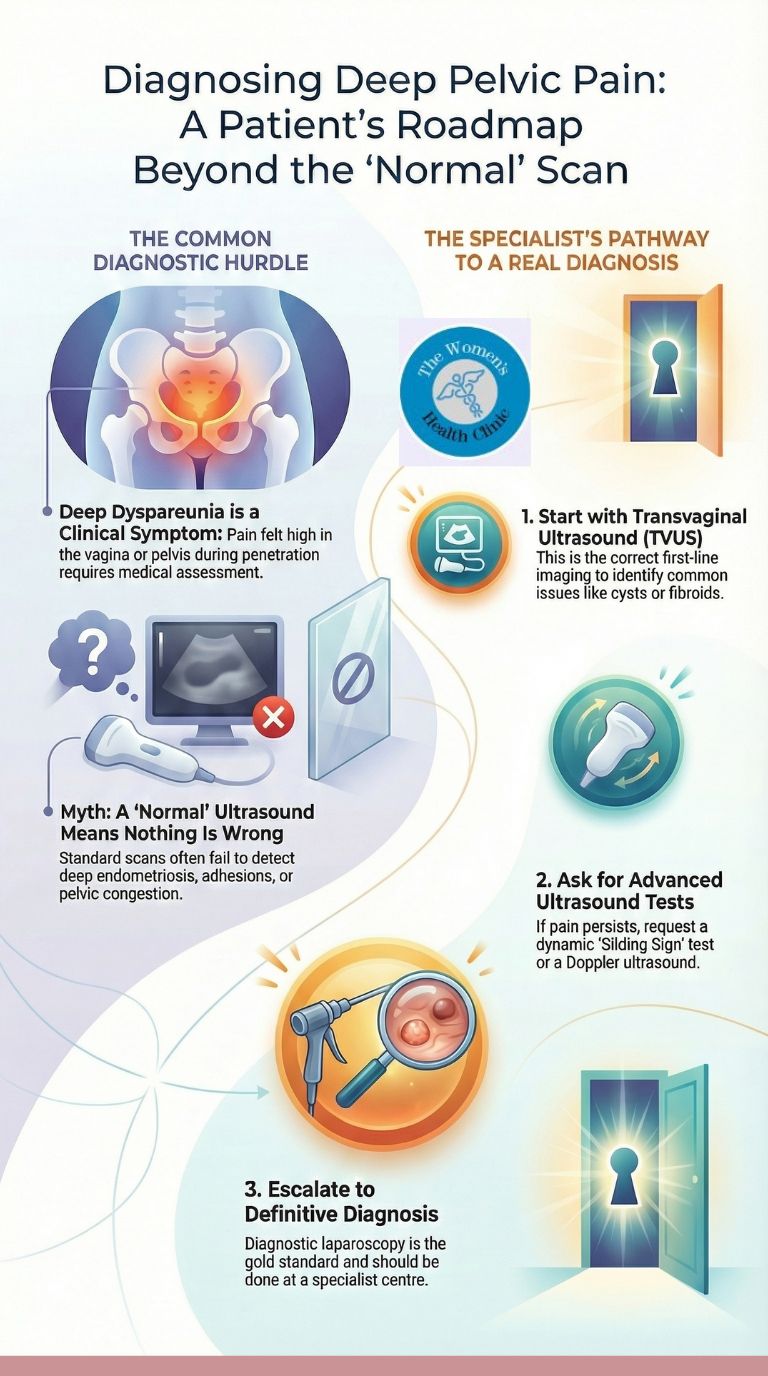
What imaging or referrals are appropriate for deep dyspareunia?
Deep dyspareunia—pain felt high in the vagina or pelvis during deep penetration—requires structured investigation to identify pelvic pathology. First-line imaging is transvaginal ultrasound, which can detect ovarian cysts, fibroids, adenomyosis, and endometriomas; if negative or symptoms persist, referral to gynaecology for pelvic MRI or diagnostic laparoscopy may be warranted. Early imaging helps rule out serious conditions and guides targeted treatment.
Show Detailed Answer
Deep dyspareunia differs from superficial pain because it originates from structures within the pelvis—the cervix, uterus, ovaries, bowel, or bladder—rather than the vaginal opening. The discomfort is often described as a deep ache, cramping, pressure, or sharp stabbing sensation triggered by thrusting or certain positions. It can be cyclical (worse during menstruation) or constant, and may be accompanied by heavy periods, pelvic pain outside of sex, or bowel or bladder symptoms.
Because the causes can include endometriosis, adenomyosis, pelvic inflammatory disease, ovarian cysts, uterine fibroids, or pelvic floor myofascial pain, a systematic diagnostic approach is essential. Delaying investigation can allow conditions like endometriosis to progress, affecting fertility and quality of life. Importantly, deep dyspareunia is never “just in your head”—it is a legitimate clinical symptom requiring medical assessment.
First-Line Imaging: Transvaginal Ultrasound
Transvaginal ultrasound (TVUS) is the gold-standard initial investigation for deep pelvic pain. It is non-invasive, widely available, and highly sensitive for detecting structural abnormalities.
- What it detects: Ovarian cysts (including endometriomas or “chocolate cysts”), uterine fibroids, adenomyosis (thickening of the uterine wall), polyps, and fluid collections suggesting infection.
- When to arrange: If deep dyspareunia is persistent (lasting more than three months), cyclical, or accompanied by irregular bleeding or pelvic pain outside of sex.
- Limitations: TVUS may not visualise superficial endometriosis, adhesions, or small peritoneal lesions. A “normal” ultrasound does not exclude endometriosis.
In the UK, TVUS can be arranged via your GP or directly through a gynaecology clinic. It is usually performed in the first half of the menstrual cycle for optimal visualisation of ovarian structures.
Second-Line Imaging: Pelvic MRI
If ultrasound findings are inconclusive, or if deep infiltrating endometriosis (DIE) is suspected—particularly affecting the bowel, bladder, or uterosacral ligaments—pelvic MRI is the next step.
- What it detects: Deep infiltrating endometriosis, adenomyosis, complex ovarian masses, and pelvic adhesions. MRI provides superior soft-tissue contrast and can map the extent of disease before surgery.
- When to arrange: Persistent symptoms despite normal ultrasound, suspicion of DIE (especially if bowel or bladder symptoms are present), or pre-operative planning for complex endometriosis.
- Access: MRI is typically arranged via specialist gynaecology referral and may be requested by a consultant with expertise in endometriosis.
Diagnostic Laparoscopy: The Gold Standard for Endometriosis
Laparoscopy is a keyhole surgical procedure that allows direct visualisation of the pelvic organs. It remains the definitive diagnostic tool for endometriosis, as tissue can be biopsied and treated simultaneously.
- When to consider: If imaging is negative but symptoms are severe and persistent, if fertility is a concern, or if medical management has failed.
- What it offers: Confirmation of endometriosis, excision or ablation of lesions, division of adhesions, and drainage of cysts.
- Referral pathway: Via gynaecology outpatient clinic. In the UK, NICE recommends considering laparoscopy for women with chronic pelvic pain and suspected endometriosis when other investigations are inconclusive.
When to Refer to Gynaecology
Referral to a gynaecologist is appropriate if:
- Deep dyspareunia persists for more than three months despite initial management (lubricants, pacing, analgesia).
- There are accompanying “red flag” symptoms: heavy or irregular bleeding, severe cyclical pain, bowel or bladder symptoms, or a palpable pelvic mass.
- Imaging reveals abnormalities requiring specialist interpretation or intervention.
- You are trying to conceive and pain is affecting fertility or intimacy.
In England and Wales, the NHS e-Referral Service (e-RS) allows GPs to book directly into gynaecology clinics. Private pathways may offer faster access to imaging and specialist review.
Other Specialist Referrals
Depending on associated symptoms, additional referrals may be helpful:
- Pelvic Health Physiotherapy: For myofascial pelvic floor pain or hypertonic muscles contributing to deep pain.
- Colorectal Surgery: If deep infiltrating endometriosis affecting the bowel is confirmed on MRI.
- Urology: If bladder pain or interstitial cystitis is suspected.
- Pain Clinic: For chronic pelvic pain with central sensitisation, where a multidisciplinary approach (medication, physiotherapy, psychology) is beneficial.
Common Concerns & Myths
“Won’t imaging find everything wrong?”
Not always. Superficial endometriosis and pelvic adhesions may not show on scans. A normal ultrasound or MRI does not rule out endometriosis—clinical suspicion and symptoms guide whether laparoscopy is needed.
“Will a scan be painful if I already have deep pain?”
Transvaginal ultrasound can be uncomfortable if you have pelvic tenderness, but the sonographer will work gently. You can request a break or stop at any time. MRI is completely non-invasive.
“Do I need a laparoscopy if my scan is normal?”
Possibly. If your pain is severe and affecting your life, and imaging is clear, laparoscopy may still be recommended to look for superficial endometriosis or adhesions that imaging cannot detect.
Clinical Context
Deep dyspareunia is a hallmark symptom of pelvic pathology, particularly endometriosis, which affects approximately 1 in 10 women of reproductive age in the UK. Diagnostic delay remains a significant problem—the average time to diagnosis for endometriosis in the UK is 7–8 years. Structured imaging protocols and early gynaecology referral can reduce this delay, improve symptom control, and preserve fertility. Educational only. Results vary. Not a cure.
Evidence-Based Approaches
Self-Care & Lifestyle
While imaging and referral are essential, symptom relief strategies can help in the interim:
- Pain Diary: Track when pain occurs (cycle phase, positions, timing) to help clinicians identify patterns and guide investigation.
- Pacing and Positioning: Avoid deep thrusting; use positions that allow you to control depth and pace (e.g., on top, side-lying).
- Heat Therapy: A warm bath or heat pad before intimacy may relax pelvic muscles and reduce deep aching.
- Anti-inflammatory Analgesia: NSAIDs (e.g., ibuprofen) taken 30–60 minutes before sex may reduce inflammatory pelvic pain, particularly if cyclical.
Medical & Specialist Options
Once imaging identifies—or rules out—structural causes, treatment is tailored to the underlying condition:
- Hormonal Suppression: Combined oral contraceptive pill, progestogens (e.g., desogestrel, dienogest), or GnRH analogues to suppress endometriosis and reduce cyclical pain.
- Surgical Excision: Laparoscopic excision of endometriosis, removal of ovarian cysts, or myomectomy (fibroid removal) if indicated.
- Pelvic Physiotherapy: For myofascial pain or secondary pelvic floor overactivity in response to chronic deep pain.
- Regenerative Treatments: Emerging therapies such as platelet-rich plasma (PRP) or laser vaginal rejuvenation may support tissue healing and pain reduction in selected cases.
For a comprehensive overview of treatment pathways, you can view our step-by-step treatment plan. If you would like to discuss your symptoms with a specialist, you can book a consultation.
C. Red Flags (When to see a GP urgently)
Seek same-day GP review or attend A&E if you experience sudden-onset severe pelvic pain, fever, heavy bleeding, fainting, or vomiting—these may indicate ovarian torsion, ruptured cyst, or pelvic infection.
External Resources:
- NICE – Endometriosis: diagnosis and management (NG73)
- RCOG – Endometriosis: information for you
- NHS – Endometriosis overview
- Endometriosis UK – Patient support and information
- British Society for Gynaecological Endoscopy – Accredited endometriosis centres
- PubMed – Deep dyspareunia and diagnostic imaging in endometriosis
Educational only. Results vary. Not a cure.
Clinical Reality: A "clear" ultrasound does not rule out deep pain causes. Standard scans often miss deep endometriosis and adhesions. You likely require a "Dynamic" ultrasound (checking for the Sliding Sign) or a specialized referral to a BSGE Centre, not just a general gynaecologist.
Additional Clinical Guidelines
MYTH: "My ultrasound was normal, so I don't have endometriosis."
REALITY: A standard "full bladder" scan (Transabdominal) cannot see Deep Infiltrating Endometriosis (DIE) or adhesions. You require a Transvaginal (Internal) Ultrasound performed by a specialist trained in the IDEA Protocol to detect these issues.
If you have deep pain during sex (Dyspareunia), your sonographer should perform a dynamic test called the "Sliding Sign."
[Image of female pelvic anatomy]How it works
- The Technique: The sonographer gently presses the probe against the cervix while pushing on your abdomen. They are watching to see if the rectum "slides" freely past the uterus.
- Positive (Good): The organs slide apart. The Pouch of Douglas is open.
- Negative (Bad): The organs move as a single block. This indicates the Pouch of Douglas is "obliterated" (glued shut) by adhesions or deep endometriosis.
If your deep pain is a "heavy ache" that worsens after standing, you need a Doppler Ultrasound to check for Pelvic Congestion Syndrome (Varicose Veins).
- Criteria: The scan must look for ovarian veins that are dilated >6mm with "retrograde flow" (blood flowing backwards).
- Note: You must usually be scanned while semi-upright or performing a Valsalva (bearing down) maneuver to see this.
Not all gynaecologists are surgeons. For deep pain, the destination of your referral matters.
When to escalate
- General Gynae: Suitable for ovarian cysts, fibroids, or initial investigations.
- BSGE Accredited Centre: If you have suspected Deep Endometriosis (involving bowel/bladder) or a "Negative Sliding Sign," NICE guidelines recommend referral to a specialist centre. These surgeons are specifically trained to remove complex disease.
- Pain Clinic: If surgery is not an option or has failed, referral to a multidisciplinary Pain Management Programme is the next clinical step.