


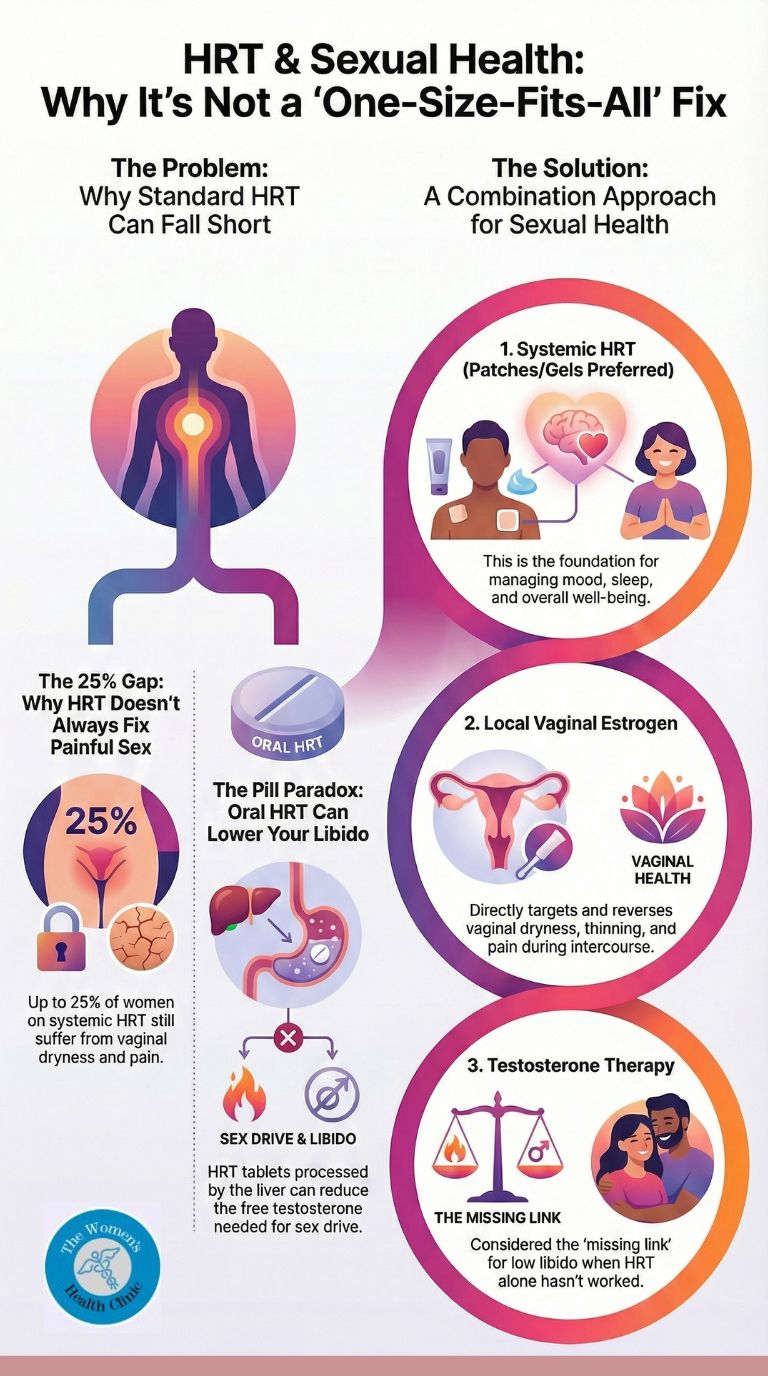
Does systemic HRT help sexual function for everyone?
Systemic hormone replacement therapy (HRT) can improve sexual function in many menopausal women, particularly by restoring oestrogen levels that support mood, energy, and overall well-being. However, it does not directly treat vaginal dryness or tissue thinning—the most common physical causes of painful or uncomfortable sex—and may not address all aspects of sexual difficulty for everyone. For comprehensive benefit, many women require both systemic HRT and local vaginal oestrogen.
Show Detailed Answer
Sexual function is complex and influenced by physical health, hormones, psychological well-being, relationship quality, and past experiences. During menopause, the decline in oestrogen affects multiple body systems, and systemic HRT (tablets, patches, or gels that deliver hormones throughout the body) can help restore some—but not all—of these functions.
Understanding what systemic HRT can and cannot do is essential for setting realistic expectations and building a treatment plan that truly addresses your needs. Many women assume that starting HRT will automatically resolve all intimacy challenges, but the reality is more nuanced.
What Systemic HRT Can Help With
Systemic HRT delivers oestrogen (and often progesterone) into the bloodstream, helping to relieve many common menopausal symptoms that indirectly affect sexual function:
- Mood & Mental Clarity: Oestrogen supports neurotransmitter function in the brain. Restoring levels can reduce anxiety, low mood, and brain fog—all of which can dampen libido and make intimacy feel like a chore rather than a pleasure.
- Energy & Sleep: By reducing night sweats and improving sleep quality, systemic HRT can restore the physical energy needed for intimacy and reduce the exhaustion that often kills desire.
- Body Confidence: Relief from hot flushes, weight redistribution, and skin changes can help women feel more comfortable and confident in their bodies.
- General Well-Being: When you feel physically and emotionally better overall, it is easier to reconnect with desire and prioritise intimacy.
What Systemic HRT Does NOT Directly Address
Critically, systemic HRT does not concentrate oestrogen where it is needed most for comfortable sex:
- Vaginal Dryness & Atrophy: The tissues of the vagina and vulva have high concentrations of oestrogen receptors. When oestrogen drops, these tissues become thin, dry, fragile, and less elastic—a condition called Genitourinary Syndrome of Menopause (GSM). Systemic HRT may offer minimal benefit to these tissues because the hormone is distributed throughout the body and does not deliver a concentrated dose locally.
- Pain with Penetration: If the root cause of painful sex is tissue thinning or loss of lubrication, systemic HRT alone is unlikely to resolve it. Many women continue to experience superficial dyspareunia (entry pain) even when taking systemic HRT.
- Reduced Sensation: Changes in nerve sensitivity and blood flow to the clitoris and vaginal tissues are not fully restored by systemic oestrogen.
Why Local Vaginal Oestrogen is Often Needed
Local (topical) vaginal oestrogen—available as creams, pessaries, or vaginal rings—delivers a small, targeted dose directly to vulval and vaginal tissues. This approach:
- Restores tissue thickness, elasticity, and natural lubrication
- Reverses atrophy and reduces pain with intercourse
- Improves urinary symptoms (urgency, recurrent infections) that often accompany GSM
- Is safe to use alongside systemic HRT and is recommended by NICE guidelines even for women already on systemic treatment
Research consistently shows that combining systemic HRT with local vaginal oestrogen provides the most comprehensive improvement in sexual function for menopausal women.
Other Factors That Influence Sexual Function
Hormones are only part of the picture. Sexual difficulties may also be linked to:
- Pelvic Floor Dysfunction: Overactive or weak pelvic muscles can cause pain or loss of sensation, requiring specialist physiotherapy.
- Relationship Dynamics: Communication, trust, and intimacy patterns all affect desire and arousal.
- Psychological Factors: Past trauma, body image concerns, or performance anxiety may need psychosexual counselling.
- Medications: Antidepressants, blood pressure tablets, and other drugs can reduce libido or impair arousal.
Common Concerns & Myths
“If HRT doesn’t fix everything, is it even worth taking?”
Absolutely. Systemic HRT can transform quality of life by addressing mood, sleep, hot flushes, and bone health. It is a vital foundation—but for sexual health, it often needs to be paired with local vaginal treatment.
“Will my libido come back as soon as I start HRT?”
Not always. Desire is influenced by many factors beyond oestrogen, including testosterone levels (which also decline with age), stress, and relationship quality. Some women benefit from testosterone therapy alongside HRT.
“Is it normal to still need lubricant even on HRT?”
Yes. Even with systemic HRT, many women find that arousal-related lubrication takes longer to build or is less abundant than before menopause. Using a high-quality lubricant is sensible, not a sign of failure.
Clinical Context
NICE guidelines (NG23) recommend that women with vaginal atrophy symptoms should be offered local vaginal oestrogen, even if they are already taking systemic HRT. The British Menopause Society echoes this, noting that systemic HRT alone rarely reverses established GSM. A holistic approach—addressing hormones, pelvic floor health, and psychological well-being—offers the best outcomes for sexual function during and after menopause. Educational only. Results vary. Not a cure.
Evidence-Based Approaches
Self-Care & Lifestyle
Supporting sexual health begins with simple, practical steps:
- Use Lubricant Generously: Choose water-based or silicone-based products that are fragrance-free and body-safe.
- Prioritise Intimacy Without Pressure: Focus on touch, closeness, and non-penetrative pleasure to rebuild connection without the stress of “performance.”
- Stay Physically Active: Regular movement improves blood flow, mood, body image, and pelvic floor tone.
- Communicate Openly: Talk with your partner about what feels good, what hurts, and what you need emotionally and physically.
Medical & Specialist Options
A comprehensive treatment plan for menopausal sexual health may include:
- Systemic HRT: Oestrogen (with progesterone if you have a uterus) to address mood, energy, and systemic menopausal symptoms.
- Local Vaginal Oestrogen: Targeted treatment for dryness, thinning, and pain. Safe for long-term use and does not carry the same risks as systemic HRT.
- Testosterone Therapy: May be considered for low libido, particularly if other treatments have not helped. Available via specialist prescription in the UK.
- Pelvic Floor Physiotherapy: Assessment and treatment of muscle tension, weakness, or guarding that contributes to pain or reduced sensation.
- Psychosexual Counselling: Specialist support for desire, arousal, and relationship challenges.
For tailored advice on treatment pathways, you can view our step-by-step treatment plan. If you are exploring private care options, you may also wish to see transparent pricing.
C. Red Flags (When to see a GP)
Seek urgent review if you experience post-menopausal bleeding, sudden severe pelvic pain, unexplained lumps, or discharge with an unusual odour or colour. These may indicate infection, polyps, or other conditions requiring investigation.
External Resources:
- NHS – Hormone Replacement Therapy (HRT) overview
- NICE – Menopause: diagnosis and management (NG23)
- British Menopause Society – Vaginal atrophy and local oestrogen
- RCOG – HRT and sexual health
- Menopause Matters – HRT and sexual function
- PubMed – Systemic and local oestrogen for sexual dysfunction in menopause
Educational only. Results vary. Not a cure.
Clinical Reality: HRT is not a single fix. Systemic HRT (patches/pills) controls hot flushes but often fails to fully restore vaginal comfort or libido. You may need a "Combination Approach": Transdermal Estrogen (for safety), Local Vaginal Estrogen (for comfort), and potentially Testosterone (for desire).
Why standard HRT might not be enough
Many women assume their HRT patch covers everything. However, systemic estrogen circulates the whole body, and sometimes not enough reaches the vaginal tissue to reverse severe atrophy.
- The Stat: Up to 25% of women on systemic HRT still experience vaginal dryness and pain.
- The Fix: NICE guidelines support using Local Vaginal Estrogen (pessaries/creams) alongside your patch or pill. You do not have to choose one or the other.
If you take Oral HRT (Tablets) and have low libido, the medication might be the cause.
The SHBG Effect
- The Science: Oral estrogen is processed by the liver, which triggers a spike in Sex Hormone Binding Globulin (SHBG).
- The Result: SHBG acts like a sponge, soaking up your free Testosterone. Less free testosterone = lower sex drive.
- The Solution: Switching to Transdermal HRT (Patches, Gels, or Sprays) bypasses the liver, keeping SHBG lower and leaving more testosterone available for libido.
If your estrogen is optimized but your desire is still zero, you may have HSDD (Hypoactive Sexual Desire Disorder).
- Guidance: The British Menopause Society (BMS) recommends a trial of Testosterone (gel/cream) for women with low libido if HRT alone hasn't worked. It is not just a male hormone; it is the driver of female desire.
- Timeline: It typically takes 3–6 months to see an improvement in sexual interest.
MYTH: "I can't take Testosterone because I'll grow a beard."
REALITY: When prescribed clinically for menopause, the dose is incredibly low (roughly 1/10th of a male dose), aiming to restore levels to where they were in your 30s. Side effects like hair growth are rare when monitored correctly via blood tests.