


Can trauma, stress or anxiety contribute to pain with sex?
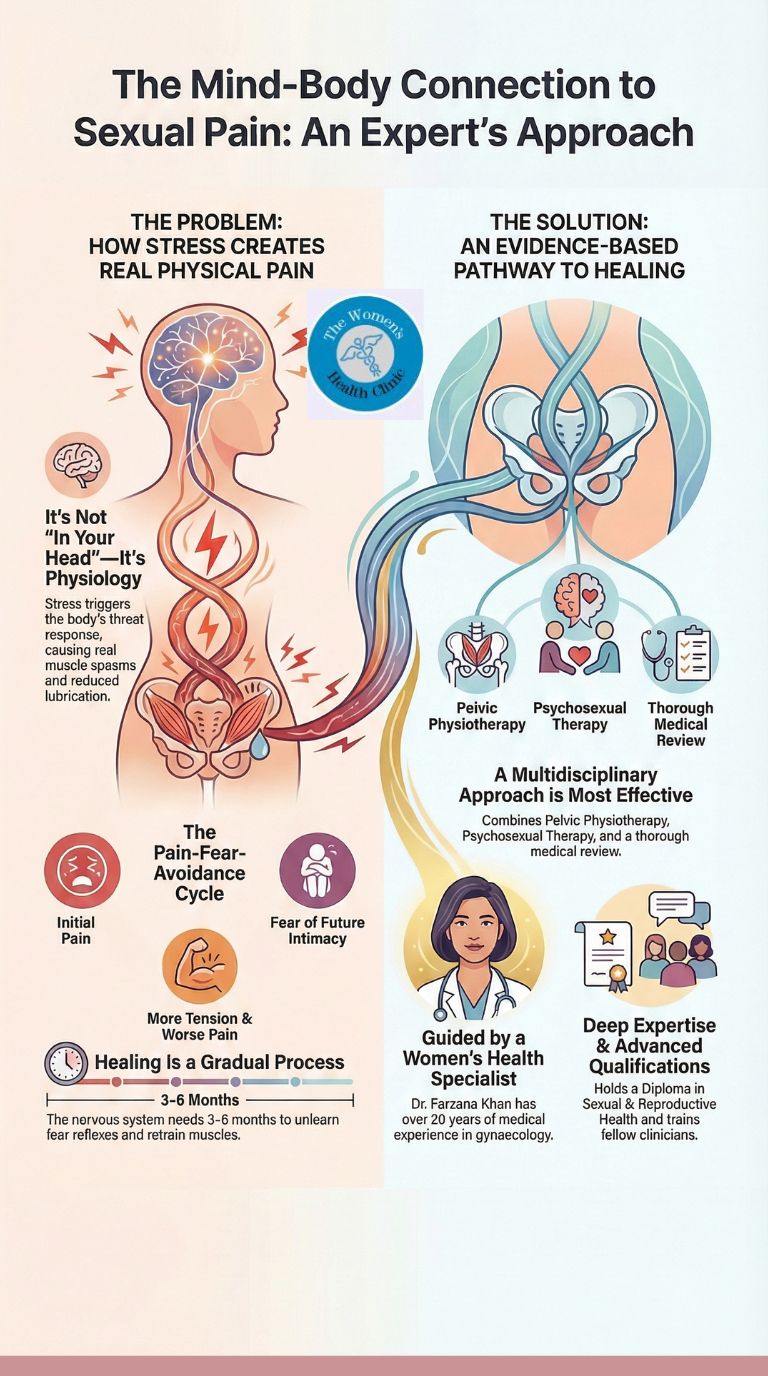
Yes, psychological trauma, chronic stress, and anxiety can all contribute directly to pain during sex. When the nervous system is in a heightened state of threat, it triggers involuntary muscle tension in the pelvic floor, reduces blood flow to genital tissues, and amplifies pain perception—creating a physical barrier to comfortable intimacy. This is not “in your head”—it is a real physiological response that can be treated with specialist support.
Show Detailed Answer
Sexual pain linked to psychological factors is often misunderstood as being purely emotional or imaginary. In reality, trauma, stress, and anxiety activate measurable changes in the body—muscle guarding, altered pain thresholds, and disrupted arousal responses—that make penetration genuinely painful or impossible.
This connection works through the autonomic nervous system. When you experience trauma or chronic stress, your body remains in a protective “fight or flight” state. The pelvic floor muscles—which normally relax during arousal—instead tighten defensively. Blood flow to the vagina decreases, reducing natural lubrication and tissue elasticity. Over time, the brain can also start to anticipate pain, creating a conditioned fear response that intensifies the physical sensation.
How Trauma Affects Sexual Function
Trauma—particularly sexual trauma, but also childbirth trauma, medical procedures, or childhood adversity—can leave a lasting imprint on the nervous system. The body may associate touch, intimacy, or vulnerability with danger, even when you consciously feel safe.
- Hypervigilance: The nervous system remains on high alert, scanning for threat. This prevents the relaxation needed for comfortable penetration.
- Dissociation: Some people “disconnect” from their body during sex as a protective mechanism, which interrupts arousal and can lead to dryness or pain.
- Vaginismus: Involuntary spasm of the pelvic floor muscles, often rooted in trauma or fear, making penetration extremely painful or impossible.
The Role of Chronic Stress and Anxiety
Even without a history of trauma, ongoing stress and generalised anxiety can interfere with sexual comfort. Elevated cortisol levels suppress reproductive hormones, including oestrogen, which can contribute to vaginal dryness and thinning of tissues.
- Performance Anxiety: Worrying about pain, about pleasing a partner, or about “failing” at sex can create a self-fulfilling prophecy where anxiety itself triggers muscle tension and pain.
- Chronic Tension: People who carry stress in their body often unconsciously clench their pelvic floor throughout the day, leading to chronic tightness, trigger points, and pain during intercourse.
- Reduced Arousal: Anxiety suppresses the parasympathetic nervous system (the “rest and digest” mode), which is essential for sexual arousal, lubrication, and pleasure.
The Pain-Fear-Avoidance Cycle
Once pain occurs, many people develop a secondary layer of anxiety about future sexual experiences. This creates a vicious cycle:
- Pain during sex → Fear of pain next time → Muscle guarding and tension → More pain → Avoidance of intimacy → Relationship strain and isolation.
Breaking this cycle requires addressing both the physical muscle tension and the psychological fear response simultaneously.
Common Concerns & Myths
“If it’s psychological, does that mean it’s not real pain?”
Absolutely not. Pain triggered by psychological factors involves real nerve signals, real muscle spasm, and real tissue changes. The pain is physical, even if the original trigger was emotional.
“Will talking about my trauma make the pain worse?”
With the right therapeutic support, the opposite is true. Trauma-informed therapy helps your nervous system re-learn safety, which can reduce pain over time. You are never forced to relive trauma in detail—therapists use gentle, body-focused techniques.
“Should I just push through the pain to desensitise myself?”
No. Forcing penetration when you are in pain reinforces the fear-pain cycle and can cause physical injury. Gradual, gentle, self-paced exposure under specialist guidance is the evidence-based approach.
Clinical Context
The link between psychological distress and sexual pain is well-established in gynaecological and pain medicine literature. Conditions like vaginismus, vulvodynia, and chronic pelvic pain often have a neurobiological component rooted in trauma or chronic stress. The Royal College of Obstetricians and Gynaecologists recognises psychosexual therapy as a core part of multidisciplinary care for dyspareunia. Importantly, this does not mean the pain is “made up”—it means the brain and body are working together in a maladaptive protective pattern that can be retrained. Educational only. Results vary. Not a cure.
Evidence-Based Approaches
Self-Care & Lifestyle
Start by creating a foundation of safety and regulation in your nervous system.
- Mindfulness and Breathwork: Slow, diaphragmatic breathing activates the parasympathetic nervous system, helping the pelvic floor relax.
- Self-Compassion: Replace self-blame with curiosity. Notice sensations without judgement, and remind yourself that pain is your body trying to protect you.
- Gradual Exposure: Use your own fingers or a dilator set to gently explore touch at your own pace, without the pressure of partnered sex.
- Body Scanning: Daily practice of progressive muscle relaxation can reduce chronic pelvic floor tension.
Medical & Specialist Options
A multidisciplinary approach is most effective, combining physical therapy, psychological support, and where appropriate, medical treatments.
- Pelvic Health Physiotherapy: Specialist physios use internal manual therapy, biofeedback, and down-training techniques to release pelvic floor tension and desensitise painful areas.
- Psychosexual Therapy: Trauma-informed therapists use approaches like Cognitive Behavioural Therapy (CBT), Eye Movement Desensitisation and Reprocessing (EMDR), or Sensate Focus to address the fear-pain cycle and rebuild safety around intimacy.
- Pain Management Clinics: For persistent pain, specialist pain services may offer nerve blocks, low-dose antidepressants (which modulate pain pathways), or topical anaesthetics.
- Medical Review: Even when pain is trauma-linked, it is essential to rule out physical causes like infections, endometriosis, or hormonal changes that may also need treatment.
For comprehensive support, you can meet our clinical team, who specialise in integrating physical and psychological care. Many patients also choose to book a consultation to discuss a personalised treatment pathway.
Red Flags (When to Seek Urgent Review)
Seek medical attention if you experience sudden onset of severe pain, heavy bleeding, fever, unexplained discharge, or if you have thoughts of self-harm related to the distress caused by sexual pain.
External Resources:
Educational only. Results vary. Not a cure.
Clinical Timeline: Healing follows a biological clock. The first 6 weeks are "Brain Training" (Neural Adaptation), while true muscle growth (Hypertrophy) takes 8–12 weeks. Do not judge your results until you hit the 3-month mark.
The Biological Timeline of Rehab
In the first month, you may not "feel" stronger. This is normal.
- What happens: Your brain is reconnecting with the pelvic floor nerves (Neural Adaptation). You are learning how to squeeze or relax correctly.
- The Trap: Many patients quit here because the muscle hasn't physically grown yet. Keep going.
True muscle change begins here.
- What happens: The muscle fibers physically thicken (Hypertrophy). This is when you start to notice a reduction in leaks or better support.
- Clinical Standard: Cochrane reviews state a minimum of 12 weeks is required to cure Stress Incontinence.
Condition Benchmarks
- Stress Incontinence (Weakness): Expect measurable improvement at 3 months (12 weeks) of daily exercises.
- Vaginismus/Pain (Tightness): "Down-Training" (learning to relax) is harder than strengthening. Improvements are often seen at 3–6 months because the nervous system must unlearn a fear reflex.
- Pudendal Neuralgia (Nerve): Nerves heal at 1mm per day. Deep nerve healing can take 6–12 months.
MYTH: "I did my exercises for a week and nothing happened."
REALITY: A week is not enough time for biology to change. Comparing 1 week of Kegels to 1 week of bicep curls—you wouldn't expect big arms in 7 days. Pelvic floor rehab requires the same consistency as gym training.