

Can local oestrogen improve comfort with sex?
Yes, local oestrogen can significantly improve comfort during sex, particularly when pain or discomfort is caused by vaginal atrophy or dryness linked to low oestrogen levels. It works by restoring tissue thickness, elasticity, and natural lubrication, reducing friction, burning, and tearing sensations during penetration. Most women notice improvement within 4–12 weeks of consistent use, and it is considered the gold-standard treatment for genitourinary syndrome of menopause.
Show Detailed Answer
Local oestrogen is a topical hormone treatment applied directly to the vaginal tissue in the form of creams, pessaries, gels, or slow-release rings. Unlike systemic hormone replacement therapy (HRT), it delivers very low doses of oestrogen straight to the area that needs it, with minimal absorption into the bloodstream. This makes it safe for long-term use and suitable for many women who cannot or choose not to take oral HRT.
When oestrogen levels drop—during perimenopause, menopause, breastfeeding, or due to certain medications—the vaginal lining becomes thinner, dryer, and less elastic. The tissue loses its protective glycogen layer, the pH rises (making infection more likely), and the natural lubrication response weakens. This cluster of symptoms is known as vulvovaginal atrophy (VVA) or, more broadly, genitourinary syndrome of menopause (GSM). For many, the result is sharp, burning pain with penetration, post-sex soreness, and a reluctance to engage in intimacy.
How Local Oestrogen Works
Local oestrogen acts by binding to oestrogen receptors in vaginal cells, triggering a cascade of positive tissue changes:
- Restores Tissue Thickness: It stimulates cell proliferation, making the vaginal lining plumper and more resilient.
- Improves Elasticity: Oestrogen promotes collagen and elastin production, helping tissues stretch comfortably rather than tear.
- Enhances Lubrication: It reactivates the glands that produce natural moisture, reducing friction during intercourse.
- Lowers pH: By encouraging healthy lactobacilli bacteria, it restores the naturally acidic environment that protects against infection.
What the Evidence Shows
Multiple high-quality studies and clinical guidelines, including those from NICE and the British Menopause Society, confirm that local oestrogen is highly effective for treating symptoms of vaginal atrophy. Women consistently report reduced pain during sex, improved vaginal moisture, and better overall sexual satisfaction. Importantly, the dose used is so low (typically 10 micrograms or less) that systemic absorption is negligible, meaning it does not carry the same risks as oral HRT and does not usually require progestogen “protection” of the womb lining.
Clinical improvement often begins within 2–4 weeks, with full benefit seen after 8–12 weeks of regular use. Many clinicians recommend an initial “loading” phase (using the treatment daily or every other day) followed by long-term maintenance use (twice weekly). Because atrophy does not “cure” itself after menopause, many women continue treatment indefinitely.
Common Concerns & Myths
“Will it increase my risk of breast cancer or blood clots?”
No. Local oestrogen is absorbed in tiny amounts and does not significantly raise blood oestrogen levels. It does not carry the same systemic risks as oral HRT and is safe for most women, including those with a personal history of breast cancer (though always discuss with your oncologist).
“Can’t I just use more lubricant instead?”
Lubricant helps reduce friction during sex, but it does not restore the health of the tissue itself. If the underlying problem is tissue thinning and dryness, lubricant alone will not resolve the burning, tearing, or post-sex soreness. Local oestrogen treats the root cause.
“Will it make me feel hormonal or cause weight gain?”
No. Because local oestrogen is absorbed minimally into the bloodstream, it does not cause the mood changes, bloating, or weight fluctuations sometimes associated with systemic HRT.
Clinical Context
Vaginal atrophy affects up to 50–70% of postmenopausal women but is often underdiagnosed because many feel too embarrassed to discuss symptoms. Pain with sex can lead to avoidance, relationship strain, loss of intimacy, and low self-esteem. Local oestrogen is recommended as the first-line treatment by NICE, the British Menopause Society, and the Royal College of Obstetricians and Gynaecologists. It is one of the few treatments with robust, long-term safety data and proven efficacy. Educational only. Results vary. Not a cure.
Evidence-Based Approaches
Self-Care & Lifestyle
Even with local oestrogen, optimising comfort during sex involves a holistic approach.
- Use Water-Based Lubricant: Choose fragrance-free, pH-balanced lubricants to reduce friction. Apply generously and reapply as needed.
- Maintain Regular Intimacy: Gentle, regular vaginal activity (with a partner or alone) helps keep tissues supple and improves blood flow.
- Pelvic Floor Care: Consider pelvic floor physiotherapy if you also experience tightness, guarding, or involuntary muscle spasm.
- Avoid Irritants: Skip scented soaps, wipes, douches, and tight synthetic underwear that can inflame delicate tissue.
Medical & Specialist Options
Local oestrogen is available on NHS prescription and privately. Your GP or gynaecologist will discuss the best formulation for you.
- Vaginal Creams: Applied with an applicator. Flexible dosing but can be messier.
- Vaginal Pessaries: Small tablets inserted into the vagina. Discreet and easy to use.
- Vaginal Rings: A soft silicone ring that releases low-dose oestrogen continuously for three months. Very convenient once inserted.
- Combination Approaches: Some women benefit from combining local oestrogen with systemic HRT, vaginal moisturisers, or energy-based treatments like vaginal laser therapy.
If you are considering a structured treatment pathway that includes specialist assessment and integrated pelvic care, you can explore treatment benefits or book a consultation with our clinical team.
C. Red Flags (When to see a GP)
Seek medical advice if you experience unexpected vaginal bleeding, persistent pain despite treatment, unusual discharge, or symptoms that worsen rather than improve. Any new lumps, sores, or ulcers should be reviewed promptly to rule out other conditions.
External Resources:
- NHS – Vaginal dryness overview and treatment
- NICE – Menopause: diagnosis and management (NG23)
- BNF – Oestradiol prescribing information
- British Menopause Society – Vaginal oestrogen preparations consensus statement
- RCOG – Menopause patient information leaflet
- PubMed – Efficacy of vaginal oestrogen for genitourinary syndrome of menopause
Educational only. Results vary. Not a cure.
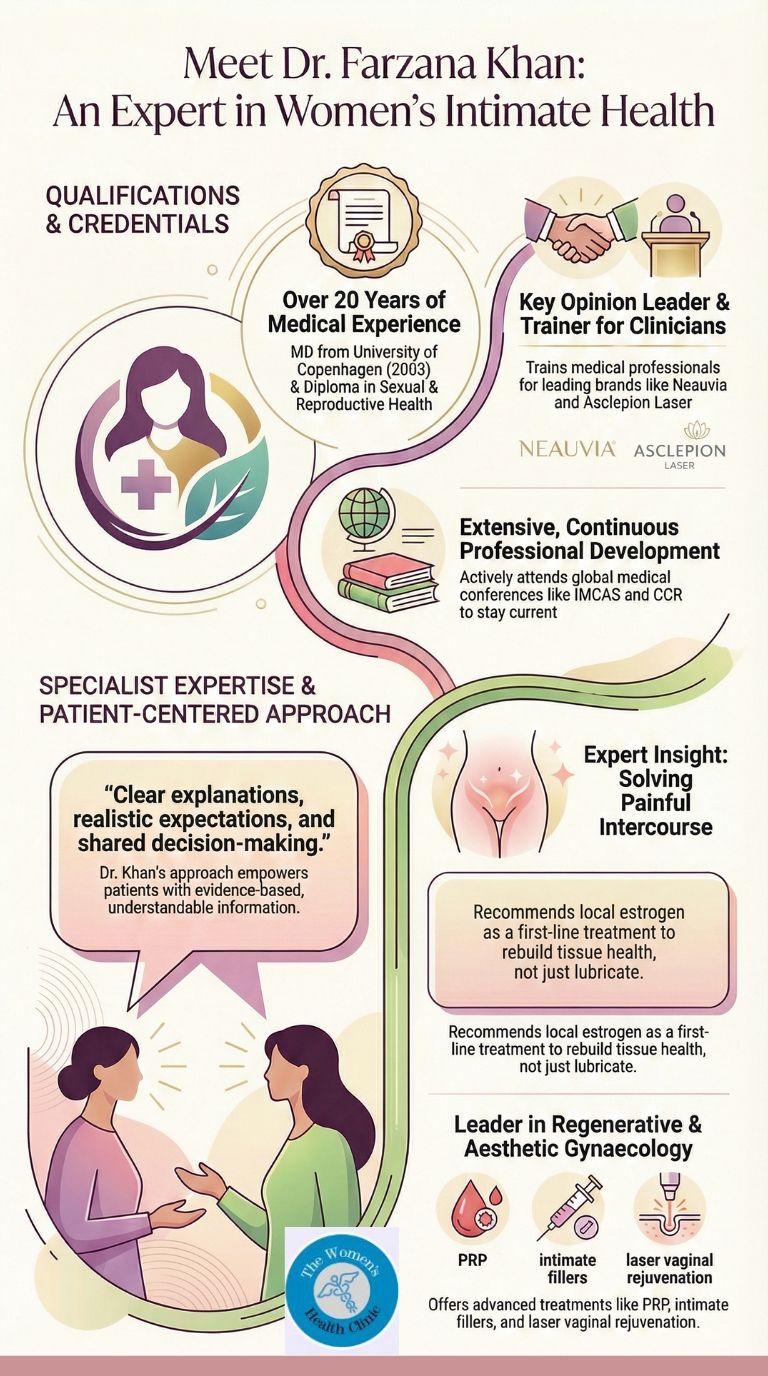
Clinical Insight: Vaginal Estrogen doesn't just "wet" the tissue; it rebuilds it. It restores the acidic pH barrier against UTIs and thickens the skin to prevent friction tears. For bladder symptoms (urgency), applying it to the "anterior wall" (front) is clinically more effective.
Additional Clinical Benefits
Estrogen receptors are dense in the urethra and bladder neck. Replacing local estrogen often fixes "Urgency" (needing to pee suddenly) and recurrent UTIs.
Pro Tip: The "Anterior Wall" Technique
If you have bladder symptoms, don't just insert the applicator blindly.
- Targeting: Aim the cream or pessary towards the front wall (the "ceiling" of the vagina) as you insert it. This sits directly behind the urethra and bladder.
- External Use: If using cream (e.g., Ovestin), apply a small amount externally around the urethra opening to soothe stinging.
Many women fear using "hormones" due to cancer history. However, local vaginal estrogen is different from systemic HRT.
- Absorption: It is minimally absorbed into the bloodstream.
- Guidelines: The British Menopause Society (BMS) and NICE state that vaginal estrogen can be considered for breast cancer survivors (including those on Tamoxifen) after discussion with their oncologist, if non-hormonal options fail.
Don't stop if it doesn't work in week 1. You need to "saturate" the receptors.
- Standard Protocol: Use nightly for 2 weeks (Loading), then twice weekly (Maintenance).
- Why: The tissue is so thin initially that it needs a burst of estrogen to thicken up before it can maintain its own moisture.
MYTH: "I can't use lubricants if I use estrogen cream."
REALITY: You can (and should) use both. Estrogen repairs the tissue long-term (maintenance), while lubricant reduces friction *during* sex. Just apply your estrogen cream *after* sex or on different nights to avoid diluting it.