


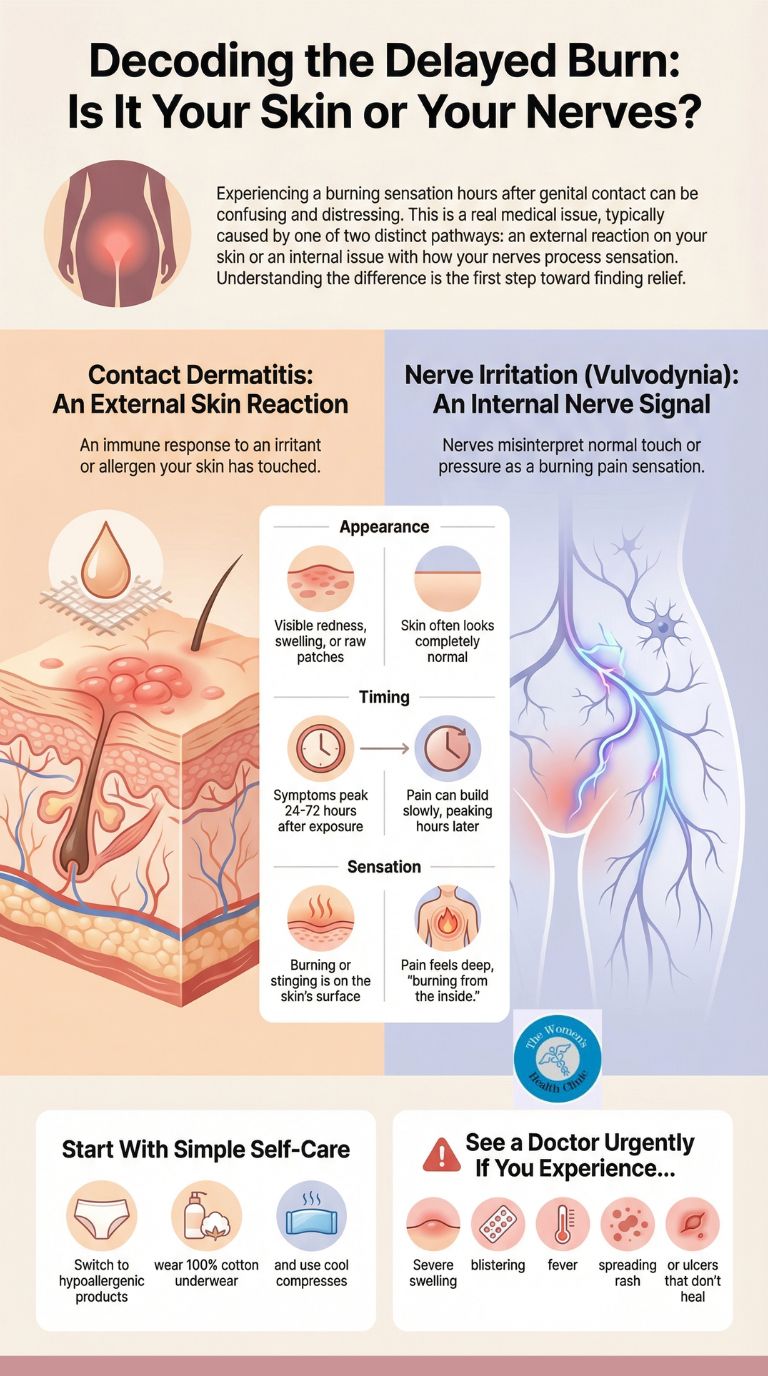
Burning hours after contact—could it be contact dermatitis or nerve irritation?
Delayed burning sensations occurring hours after genital contact can indeed indicate either contact dermatitis or nerve hypersensitivity. Contact dermatitis typically causes a delayed inflammatory reaction to irritants or allergens, whilst nerve irritation (such as vulvodynia) involves altered pain processing where normal touch triggers burning sensations. Both conditions require different treatment approaches, so accurate diagnosis through pattern recognition and sometimes patch testing is essential.
Show Detailed Answer
Experiencing burning pain several hours after genital contact—whether from sex, touching, tight clothing, or products—can feel bewildering and isolating. The delayed nature makes it difficult to identify triggers, and many people worry they are imagining symptoms or that something is seriously wrong.
Understanding the two main pathways that cause this delayed burning helps demystify what is happening in your body. Contact dermatitis involves an immune response in the skin itself, whilst nerve irritation reflects changes in how your nervous system processes sensation. Sometimes both mechanisms overlap, making diagnosis more complex but not impossible.
Contact Dermatitis: The Inflammatory Pathway
Contact dermatitis occurs when the vulval skin reacts to a substance it has touched. There are two types:
- Irritant Contact Dermatitis: Direct damage to the skin barrier from harsh substances like soaps, fragranced products, chlorine, or urine. The vulval skin is particularly thin and permeable, making it vulnerable. Symptoms typically appear within hours and include burning, stinging, redness, and sometimes raw patches.
- Allergic Contact Dermatitis: An immune-mediated delayed hypersensitivity reaction (Type IV). Your immune system “remembers” an allergen (such as latex, preservatives in lubricants, or fragrance compounds) and mounts an inflammatory response 24–72 hours after exposure. This explains why burning may not start until the evening or next day.
Common culprits include scented intimate washes, biological laundry detergent residue on underwear, condom lubricants, spermicides, and even certain fabric dyes or elastics. The vulval tissue has a unique microbiome and pH that can be disrupted easily, triggering inflammation.
Nerve Irritation: Altered Pain Processing
Nerve-related burning (often termed vulvodynia or provoked vestibulodynia) involves heightened sensitivity of the pudendal nerve or local nerve endings. In this condition, the nerves misinterpret normal touch or pressure as pain. Key features include:
- Allodynia: Pain from stimuli that should not hurt, such as light touch, tampon insertion, or sitting.
- Delayed Onset: Pain may not peak until hours after the triggering contact, as nerve inflammation and neurotransmitter release build over time.
- Central Sensitisation: In chronic cases, the spinal cord and brain amplify pain signals, making the entire area hypersensitive.
This is not “in your head”—it reflects real changes in nerve signalling pathways. Triggers can include previous infections (such as recurrent thrush), trauma (childbirth, surgery), or pelvic floor muscle tension that compresses nerves.
How to Distinguish Between the Two
Clinical assessment focuses on pattern recognition:
- Contact Dermatitis: Look for visible redness, flaking, or swelling. Symptoms improve when the irritant is removed. A clear link to a new product, activity, or fabric change. Patch testing can identify specific allergens.
- Nerve Irritation: Skin may look completely normal. Pain is often described as “burning from the inside”. No clear visual trigger. Pain may worsen with stress or fatigue (nervous system factors). Relief from nerve-targeted treatments like topical anaesthetics or neuromodulating medications.
Sometimes both conditions coexist: repeated inflammation from contact dermatitis can sensitise nerves over time, creating a vicious cycle.
Common Concerns & Myths
“If I can’t see anything wrong, am I making it up?”
Absolutely not. Nerve pain is real pain, even when skin looks normal. Neurological conditions like vulvodynia are well-documented in medical literature and respond to evidence-based treatment.
“Will antihistamines help if it’s allergic dermatitis?”
Not usually. Allergic contact dermatitis is a delayed (Type IV) reaction mediated by T-cells, not histamine. Topical corticosteroids and trigger avoidance are the mainstays of treatment, not oral antihistamines.
“Could it be a sexually transmitted infection?”
Delayed burning hours later is uncommon with STIs, which typically cause immediate discharge, sores, or odour. However, any new genital symptom warrants STI screening as part of a thorough assessment.
Clinical Context
Vulval dermatitis is one of the most common reasons for referral to vulval dermatology clinics, whilst vulvodynia affects an estimated 8–16% of women at some point in their lives. Both conditions significantly impact quality of life, sexual function, and mental health. The vulval skin has unique characteristics: it is thinner than facial skin, has a higher density of nerve endings, and lacks the protective sebaceous glands found elsewhere. This makes it exceptionally vulnerable to both chemical irritation and nerve sensitisation. Educational only. Results vary. Not a cure.
Evidence-Based Approaches
Self-Care & Lifestyle
First-line management focuses on eliminating potential irritants and protecting the skin barrier.
- Product Audit: Switch to unperfumed, hypoallergenic products. Use only water or emollient wash (like aqueous cream or Dermol 500) for cleansing. Avoid soap, wipes, and douches entirely.
- Clothing Choices: Wear 100% cotton underwear washed in non-biological detergent. Avoid tight jeans, synthetic fabrics, and thongs that create friction.
- Barrier Protection: Apply plain emollient (such as Diprobase or Epaderm) before activities that may cause friction, including sex or exercise.
- Cool Compresses: Use a clean, damp flannel soaked in cool water to soothe burning. Avoid ice directly on skin.
Medical & Specialist Options
Clinical treatment depends on accurate diagnosis and may involve dermatology, gynaecology, or pain specialists.
- For Contact Dermatitis: Short courses of topical corticosteroids (such as hydrocortisone 1% or betamethasone) to calm inflammation. Patch testing to identify specific allergens. Strict avoidance of identified triggers.
- For Nerve Irritation: Topical anaesthetics (lidocaine 5% ointment) applied before triggering activities. Oral neuromodulating medications such as amitriptyline or gabapentin to calm overactive nerves. Pelvic floor physiotherapy to release muscle tension that may compress nerves.
- Emerging Therapies: Regenerative treatments such as platelet-rich plasma or laser therapy are being explored for tissue health and nerve desensitisation in specialist centres.
To explore comprehensive assessment and advanced treatment pathways, you can meet the clinical team specialising in vulval pain. If you are ready to take the next step, you may book a consultation for personalised care.
Red Flags (When to see a GP urgently)
Seek immediate review if you experience severe swelling, blistering, fever, spreading rash beyond the genital area, difficulty urinating, or any lumps or ulcers that do not heal within two weeks.
External Resources:
Educational only. Results vary. Not a cure.
Diagnostic Clue: The timing of the burn matters. Immediate burning suggests friction or nerve hypersensitivity (Vestibulodynia). Delayed burning (hours or days later) often points to Contact Dermatitis (allergy) or Hyperosmolar Damage from your lubricant.
Decoding the "Burn": Timing is Everything
If you felt fine during sex but developed itching or burning the next day, this is rarely friction. It is likely an immune reaction.
Contact Dermatitis (Type IV Hypersensitivity)
- Mechanism: An allergic reaction (e.g., to latex, fragrance in laundry detergent, or preservatives in lube) takes time to develop. The immune system needs 24–48 hours to mount a response.
- The Clue: Redness, swelling, or itching that appears the next day.
- Common Culprits: Methylisothiazolinone (in wipes) or Propylene Glycol (in lubes).
Many standard lubricants are Hyperosmolar (highly concentrated with salt/sugar). They pull water out of your vaginal cells.
- The Effect: This causes the top layer of cells to slough off (exfoliate) hours after use. You may feel a raw, "sunburn-like" sensation or see peeling skin the next day.
- The Fix: Switch to an Iso-Osmolar lubricant (balanced to body fluids).
If the burning feels deep, electric, or like a "hot poker" and lasts for hours after sex, this is often Pudendal Neuralgia or Vestibulodynia.
- Mechanism: Mechanical pressure during sex irritates the sensitive nerves. They don't always fire immediately; they "wind up" (Central Sensitization), causing a pain flare that peaks hours later.
- Management: Use ice packs immediately after sex to calm the nerve inflammation before it spikes.